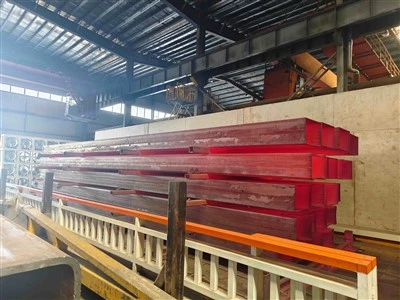
Tianjin Brisk Metalwork Co., Ltd. is one of the leading manufacturers and suppliers of s275 seamless hollow section for heavy duty structures in China. We have world-leading production equipment and strong manufacturing capabilities. Please feel free to buy bulk durable s275 seamless hollow section for heavy duty structures from our factory.


Why Does a Weld Seam Matter More Under Cyclic Load Than It Does Under Static Load?
A welded hollow section and a seamless one of the same grade and dimensions can have identical static yield and tensile strength - S275 is S275 either way. Under a single static load case, the weld seam is largely irrelevant.
Under repeated (cyclic) loading, the weld seam becomes the weak point regardless of the parent steel's strength. The heat-affected zone and weld toe act as a geometric and metallurgical stress concentration, and structural fatigue design codes reflect this directly: a longitudinal or circumferential weld seam typically places a member in a lower fatigue detail category than the same section without a weld - meaning the allowable stress range for a given number of load cycles is reduced at the seam, even though the parent material away from the weld performs at full capacity.
Seamless hollow section removes this weak point entirely. There is no seam, no heat-affected zone, and no weld-toe geometry anywhere around the circumference - the fatigue performance of the member matches the base material's own fatigue strength, not a reduced weld-detail category. For structures where the governing design check is cycles-to-failure rather than a single load case, this is the specific, quantifiable reason seamless gets specified.
Where Does This Actually Matter in Practice?
Not every structural application needs seamless - most static building frames are correctly and economically built with welded EN 10219/EN 10210 section. Seamless earns its cost premium specifically where load repeats or reverses:
- Crane structures and outrigger legs, where boom extension/retraction and load cycles repeat continuously over the equipment's service life
- Heavy machinery and vibrating equipment bases, where operating vibration adds a high-cycle fatigue component on top of static dead load
- Jacking and lifting system columns, where the same section is loaded and unloaded on every lift cycle
- Mobile and off-highway equipment chassis members, exposed to shock and impact loading from uneven terrain in addition to static payload
What Do We Supply?
| Parameter | Range We Run |
|---|---|
| Outside diameter (round) | 21.3 mm to 400 mm |
| Square/rectangular seamless* | Formed from seamless round tube, size on request |
| Wall thickness | 3 mm to 40 mm |
| Standard lengths | 6 m / 12 m (custom lengths on request) |
| Grade | S275JR / S275J0 / S275J2 |
| Manufacturing process | Hot-pierced and rolled (no longitudinal or spiral weld) |
| Finish | Black (mill), hot-dip galvanized on request |
*Square and rectangular seamless section is produced by reshaping seamless round tube - we'll confirm achievable size/thickness combinations against your drawing before quoting, since not every round-to-square ratio is practical at every wall thickness.
Heavy wall capability is a core part of what "heavy-duty" actually requires. Concentrated point loads at crane pin connections, jacking points, and equipment mounting brackets often demand wall thickness that welded coil-fed production can't reach economically. Our seamless line runs wall thickness up to 40 mm at usable diameters, giving heavy-duty designs the section modulus they need without stacking plate reinforcement onto a thinner base tube.
How Do We Control the Properties That Fatigue-Critical Buyers Actually Check?
Fatigue performance is sensitive to defects that a static strength test won't catch. Our process control includes:
- Full-length ultrasonic testing for internal defects - laminations or inclusions from the piercing process are exactly the kind of internal stress-riser that shortens fatigue life, and they don't show up in a standard tensile test
- Wall thickness eccentricity scanning around the full circumference, since uneven wall concentrates stress on the thin side under repeated load
- Surface condition inspection for the hot-piercing process, since surface roughness or scale-pitting on the ID/OD can act as a fatigue crack initiation site the same way a weld toe does
- Mechanical testing including impact values (Charpy) at the J0/J2 subgrade level, since heavy-duty structures frequently see impact and shock loading in addition to pure fatigue cycling
A Real Example: Fatigue Failure at a Weld Seam, Solved by Switching to Seamless
A heavy-equipment fabricator had built outrigger support legs using welded S275 CHS, 219 mm OD x 10 mm wall, sized correctly for the static extended-load case. After roughly 18 months of field service - repeated extend/retract cycling on a daily-use crane - the customer reported cracking initiating at the longitudinal weld seam on several legs, well before the component's design life, despite the static load never exceeding the design value.
Root cause analysis pointed to fatigue crack initiation at the weld toe under the cyclic stress range, consistent with the seam's lower fatigue detail category rather than any static overload. Switching to seamless S275 CHS at the same 219 mm OD x 10 mm wall eliminated the weld-toe initiation site entirely; the fabricator's follow-up units passed the customer's field service interval with no reported cracking after the equivalent 18-month mark, at a material cost increase of roughly 9% per leg - a cost the customer accepted once the failure mode was traced to the seam rather than the section size.
FAQ
Q: Is seamless always the right choice for crane or lifting equipment structural members?
A: Not automatically - if your load case is genuinely static or low-cycle, welded section at the correct size is often the more economical, equally safe choice. Seamless earns its premium specifically where cyclic loading, vibration, or shock is part of the duty cycle. We're glad to review your load case with you before recommending one over the other.
Q: Can you supply seamless square or rectangular section in the same wall thickness range as round?
A: Achievable wall thickness on formed square/rectangular seamless depends on the starting round tube size and corner-forming ratio - send us your target dimensions and we'll confirm what's practical rather than quoting a size we can't actually deliver to spec.
Q: Do you test for internal defects on every length, or by sample?
A: Ultrasonic internal defect testing runs on the full length of seamless product on our line, not spot-sampled, specifically because fatigue-critical buyers need length-wise assurance, not a statistical sample.
Q: How does lead time on seamless compare to welded section at the same size?
A: Seamless production runs on a different mill schedule than coil-fed welded section, so lead time is typically longer - we'll give you an accurate date at quotation so it can be built into your project schedule rather than assumed equal to welded lead time.


Hot Tags: s275 seamless hollow section for heavy duty structures, China s275 seamless hollow section for heavy duty structures manufacturers, suppliers, factory