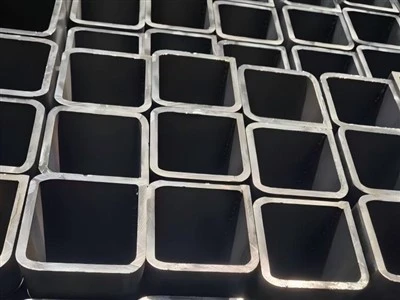
Tianjin Brisk Metalwork Co., Ltd. is one of the leading manufacturers and suppliers of s275jr hollow section in China. We have world-leading production equipment and strong manufacturing capabilities. Please feel free to buy bulk durable s275jr hollow section from our factory.


What Does "JR" Actually Mean in the Designation?
Under EN 10025-2, the S275 designation breaks down precisely:
- S = structural steel
- 275 = minimum yield strength, 275 N/mm2 (for section thickness up to 16 mm; the value steps down slightly at greater thickness)
- J = the Charpy V-notch longitudinal impact energy category (27 Joules minimum)
- R = the test temperature at which that 27J impact value is guaranteed: +20 degrees C, i.e. room temperature
In practical terms, JR certifies that the steel has adequate toughness at ordinary ambient conditions - it makes no guarantee about impact performance below room temperature. That's the entire distinction between JR and the J0 (tested at 0 degC) and J2 (tested at -20 degC) subgrades: same yield strength, same chemistry baseline, different guaranteed toughness at low temperature. JR is not a "lower quality" version of J2 - it's the correct, fully adequate specification for any structure that will never see meaningfully sub-zero service or installation conditions.
When Is JR the Right Call, and When Should You Upgrade?
JR is the appropriate and most cost-effective choice for the large majority of general structural and fabrication work:
- Indoor structural framing, mezzanines, and platforms with controlled ambient conditions
- General construction in temperate and warm climates where winter design temperature stays comfortably above freezing
- Static-load, non-seismic members where brittle fracture risk from low-temperature embrittlement isn't a governing design case
- General engineering fabrication - equipment frames, enclosures, non-critical structural weldments
An upgrade to J0 or J2 is worth the incremental cost specifically when:
- The structure will be erected, transported, or put into service in a location with winter design temperatures approaching or below 0 degC
- The member is a primary structural element where brittle fracture (rather than ductile yielding) would be a sudden, non-warning failure mode
- The project specification or local building code explicitly calls for a minimum impact subgrade based on climate zone or structure category
We ask buyers for their project's location and lowest expected service temperature before confirming JR is sufficient - it's a five-minute check that avoids both under-speccing a cold-climate structure and over-paying for toughness a warm-climate warehouse frame will never need.
What Do We Supply?
| Parameter | Range We Run |
|---|---|
| Shapes | Square (SHS), Rectangular (RHS), Circular (CHS) |
| Size range | 20 x 20 mm to 400 x 400 mm (square/rect); 21.3 mm to 610 mm OD (round) |
| Wall thickness | 2 mm to 40 mm |
| Standard lengths | 6 m / 12 m (custom on request) |
| Process route | Cold-formed (EN 10219) or hot-finished (EN 10210) |
| Finish | Black (mill), hot-dip galvanized, or primer-coated |
| Yield strength | 275 N/mm2 min (up to 16 mm wall; steps down per EN 10025-2 at greater thickness) |
| Impact requirement | 27J min longitudinal Charpy at +20 degC |
Every mill certificate we issue states the actual tested impact value and test temperature, not just a pass/fail against the JR minimum - so if your project later needs to demonstrate margin above the 27J/+20degC requirement, the documentation is already on file rather than requiring a retest.
How Do We Confirm JR Is Correctly Met, Batch to Batch?
Chemistry alone doesn't guarantee impact performance - the same nominal composition can behave differently depending on rolling temperature history and grain structure. Our control process for JR includes:
- Charpy V-notch testing per heat/lot at +20 degC, confirming the 27J minimum on the actual production batch, not just a chemistry-based assumption
- Chemical composition verification (C, Mn, Si, P, S limits per EN 10025-2) tied to the same heat number as the impact test
- Yield and tensile testing per lot, cross-checked against wall thickness since yield strength requirements step down at greater section thickness
- Full heat traceability from mill certificate through to the specific length shipped, so any batch can be traced back to its test results if a question arises after delivery
A Real Example: Avoiding an Unnecessary Upgrade
A fabricator building a single-story warehouse frame had specified S275J2H hollow section throughout, following the same specification template used on a previous cold-climate project. Before quoting, we asked for the actual project location and design winter temperature - it turned out the new site's minimum recorded winter temperature was -3 degC, well within JR's applicable service range, not the -20 degC condition J2 is tested for.
Switching the specification to S275JR for the full frame package (approximately 38 tonnes) kept the identical yield strength and section sizes, with no change to the structural design, while avoiding the J2 testing premium across the order. The fabricator's own structural engineer confirmed JR met the governing design code requirement for the site's climate category before we proceeded, and the order shipped with standard JR mill certificates rather than the extended low-temperature test package.
FAQ
Q: Does JR mean the steel is weaker than J0 or J2?
A: No - yield and tensile strength are identical across JR, J0, and J2 at the same nominal thickness. The only difference is the temperature at which the 27J impact toughness is guaranteed.
Q: Can you supply mixed JR and J2 hollow section on the same order if different parts of a structure need different subgrades?
A: Yes - it's common for a project to specify J2 for primary members exposed to low ambient temperature and JR for indoor or secondary members. We can quote and ship both subgrades together, clearly documented on separate mill certificates.
Q: If our project spec just says "S275" with no letter suffix, what do you supply by default?
A: We'll confirm with you before production, but S275JR is the standard default across the industry when no impact subgrade is specified, since it's the base requirement all S275 material must meet regardless of subgrade.
Q: Do you offer both cold-formed and hot-finished S275JR in the same size?
A: In most common sizes, yes - we'll confirm availability for your specific dimension and advise on lead time difference between the two process routes at quotation.


Hot Tags: s275jr hollow section, China s275jr hollow section manufacturers, suppliers, factory