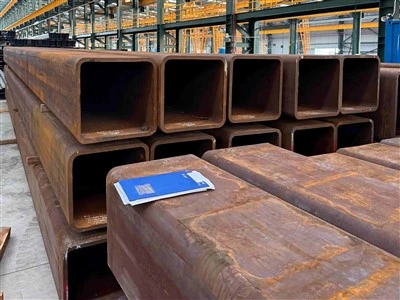
Tianjin Brisk Metalwork Co., Ltd. is one of the leading manufacturers and suppliers of hot finished square and rectangular hollow sections in China. We have world-leading production equipment and strong manufacturing capabilities. Please feel free to buy bulk durable hot finished square and rectangular hollow sections from our factory.
Tianjin Brisk Steel is one of the manufacturers of Hot Finished Square And Rectangular Hollow Sections in China. Our products are mainly exported to the Middle East, Southeast Asia, Europe, New Zealand, and other regions.If you would like to learn more about our products, feel free to contact us and send your purchase list.
PRODUCT
Tianjin Brisk Steel focus on produce and supply hollow section and steel pipe


Specifications
| Item | Specification |
|---|---|
| Standard | EN 10210-1 (technical delivery conditions), EN 10210-2 (tolerances, dimensions, sectional properties) |
| Steel grade | S235JRH, S275J0H/J2H, S355J0H/J2H/K2H, S460NH/NLH |
| Section shape | Square (SHS), Rectangular (RHS), Circular (CHS) |
| Size range (SHS) | 20×20mm – 1200×1200mm |
| Size range (RHS) | 20×10mm – 1000×1500mm |
| Wall thickness | 1.5mm – 50mm |
| Length | 6m / 12m standard, custom lengths available |
| Corner radius | Approximately 1.0–1.5× wall thickness (per EN 10210-2 tables) |
| Tolerance class | Standard tolerances per EN 10210-2, tighter tolerances available on request |
| Surface finish | Black (mill finish), or hot-dip galvanized on request |
Why Choose Hot Finished Hollow Sections
- More uniform mechanical properties: Because the section is finished at temperature, the corners - which undergo the most severe cold deformation in a cold-formed section - recrystallize and end up with properties much closer to the flat faces, giving more predictable structural behavior under load.
- Better toughness at low temperature: Grades with the "H" toughness suffix (e.g., S355J2H) are commonly specified for structures exposed to low ambient temperatures, seismic loading, or dynamic/fatigue loading, where consistent toughness - including at the corners - is important.
- No residual cold-forming stress: The hot finishing process relieves internal stresses from the forming operation, which can be a specific requirement for structures sensitive to stress concentration or subsequent fabrication (heavy welding, further forming).
- Established design guidance: Structural design codes such as Eurocode 3 (EN 1993-1-1 and EN 1993-1-8) include specific guidance and buckling curves developed with hot finished hollow sections in mind, simplifying design verification for structural engineers.
- Consistent circular-to-square forming quality: Producing SHS/RHS from a hot finished circular hollow section (rather than directly from strip) tends to give more consistent wall thickness distribution around the section, particularly at the corners.
Hot Finished (EN 10210) vs Cold-Formed (EN 10219) Hollow Sections
| Factor | Hot Finished (EN 10210) | Cold-Formed (EN 10219) |
|---|---|---|
| Forming temperature | Elevated (hot) | Ambient (cold) |
| Corner yield strength | Closer to flat-face value | Higher (strain-hardened) |
| Corner toughness | Generally better | Can be reduced due to cold work |
| Residual stress | Relieved during hot finishing | Present unless separately stress-relieved |
| Dimensional tolerance | Standard EN 10210-2 tolerances | Generally tighter, per EN 10219-2 |
| Typical unit cost | Higher | Lower |
| Common use cases | Seismic structures, dynamic/fatigue loading, low-temperature service, offshore structures | General construction, standard structural framing, most commercial buildings |
| Design code guidance | Extensive (Eurocode 3, well-established buckling data) | Extensive, with cold-forming strength enhancement rules available |
Neither standard is universally "better" - EN 10210 is typically specified where toughness, fatigue performance, or residual-stress sensitivity are structurally important, while EN 10219 is the more economical default for standard static structural applications where its tighter tolerances and cold-formed strength are not a disadvantage.
Buying Guide: How to Select Hot Finished Square and Rectangular Hollow Sections
- Confirm your structural design code requires hot finished sections. Check whether your project's structural calculations, seismic design category, or fatigue design requirements specifically call for EN 10210 material rather than EN 10219 - this is usually stated in the project specification or by the structural engineer of record.
- Select the correct toughness grade for your service temperature. The "H" suffix grades (JRH, J0H, J2H, K2H, NH, NLH) each correspond to different Charpy impact test temperatures and energy requirements - confirm the minimum design temperature for your structure and match the grade accordingly.
- Check available size and thickness combinations before finalizing design. Not every wall thickness is available across every section size from every mill - confirm actual mill production capability against your structural drawings before the design is finalized, to avoid late substitutions.
FAQ
Q: What is the difference between hot finished and cold-formed hollow sections?
A: Hot finished sections (EN 10210) are formed or finished at elevated temperature, which relieves residual stress and gives more uniform mechanical properties around the section, including the corners. Cold-formed sections (EN 10219) are formed at ambient temperature, resulting in higher corner strength from strain hardening but generally lower corner toughness and some residual stress.
Q: When should I specify EN 10210 instead of EN 10219?
A: EN 10210 is typically specified for structures with seismic design requirements, dynamic or fatigue loading, low ambient service temperatures, or where residual stress sensitivity matters for later fabrication. For standard static structural framing without these requirements, EN 10219 is generally more cost-effective.
Q: What do the toughness suffix letters (JR, J0, J2, K2) mean in the steel grade?
A: These suffixes indicate the minimum Charpy V-notch impact energy and the test temperature at which that energy must be achieved - for example, J2 typically requires 27J minimum impact energy at -20°C. Higher toughness grades (K2, NL) are specified for lower service temperatures or higher-consequence structures.
Q: Can hot finished hollow sections be hot-dip galvanized?
A: Yes - hot finished SHS/RHS can be hot-dip galvanized after production, either at the mill or by a separate galvanizer, following standard practices such as ASTM A123 or ISO 1461, provided venting/drainage holes are included in the fabrication design where required.


Hot Tags: hot finished square and rectangular hollow sections, China hot finished square and rectangular hollow sections manufacturers, suppliers, factory, COLD FORMED SQUARE HOLLOW SECTION, custom hollow section, hollow section for architecture, hollow section installation, HOLLOW STRUCTURAL SECTION ASTM A500, reliable hollow section