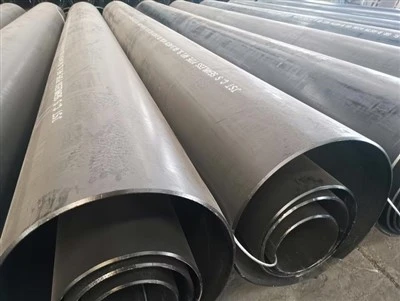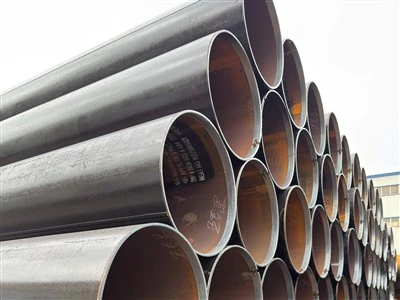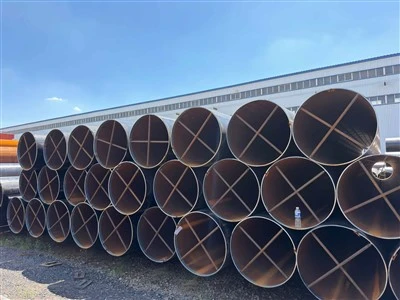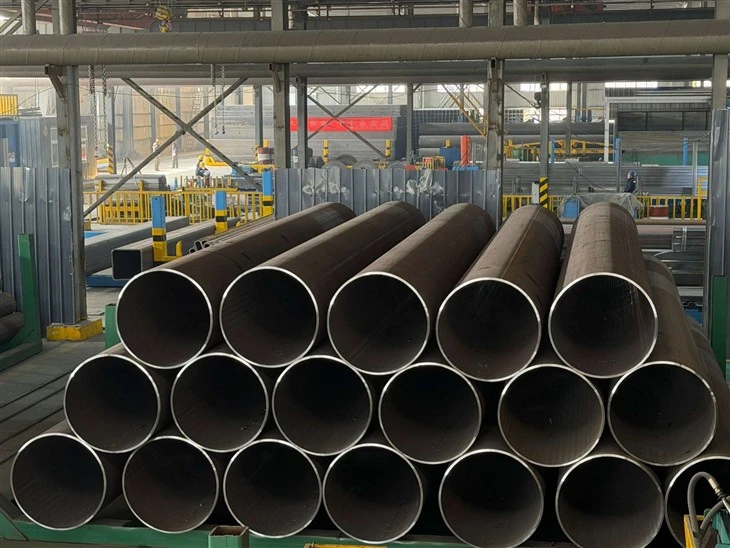
Tianjin Brisk Metalwork Co., Ltd. is one of the leading manufacturers and suppliers of astm a53 lsaw steel fluid pipe in China. We have world-leading production equipment and strong manufacturing capabilities. Please feel free to buy bulk durable astm a53 lsaw steel fluid pipe from our factory.
Tianjin Brisk Steel is one of the Fluid Transportation LSAW Pipe in China. Our products are mainly exported to the Middle East, Southeast Asia, Europe, New Zealand, and other regions.If you would like to learn more about our products, feel free to contact us and send your purchase list.


Quick Spec Reference
| Item | Typical Specification |
|---|---|
| Governing production standard | AWWA C200 (water pipe) or API 5L PSL1 (general fluid/low-pressure line pipe) |
| Chemistry/mechanical target | ASTM A53 Grade B equivalent (min. yield 35,000 psi / 241 MPa, min. tensile 60,000 psi / 415 MPa) |
| Process | Longitudinal submerged arc welding (LSAW), plate-formed, JCOE or UOE forming |
| Diameter range | NPS 16" – 100"+ (below ~16" LSAW is not economical; ERW/seamless cover that range) |
| Wall thickness | Governed by internal pressure AND external/buried load, not pressure alone |
| Testing | Full-length UT/RT of the longitudinal seam, hydrostatic test per governing standard |
| Ends | Plain bevel for butt weld, or bell-and-spigot for AWWA-style field joints |
| Lining/coating | Cement-mortar or epoxy lining (fluid contact); FBE, 3PE, or coal-tar enamel exterior (buried service) |
Why "A53" Appears on a Large-Diameter Fluid Pipe Inquiry
A53 was written for seamless and straight-seam welded pipe up to NPS 26", not for plate-rolled LSAW pipe at 36", 48", or 72" diameter. When a project needs A53-grade chemistry at a diameter A53 was never scaled to cover, the practical path is to specify the chemical and mechanical properties from A53 Grade B as a target and have the mill certify to them under a standard built for large-diameter plate pipe - AWWA C200 for potable/raw water, API 5L PSL1 where the fluid service and jurisdiction favor a line-pipe standard instead. The resulting pipe is not "A53 pipe" on the mill certificate, but it delivers the same steel grade behavior the buyer's spec sheet was written around.
Wall Thickness: Two Load Cases, Not One
This is where fluid-pipe wall thickness selection genuinely differs from an oil or gas pipeline of the same diameter. Transmission gas or oil pipelines are almost always governed by internal design pressure. Large-diameter fluid mains - particularly gravity or low-pressure water transmission lines - are frequently governed instead by external load: soil overburden, live traffic load if shallow-buried, groundwater buoyancy, and vacuum/negative-pressure conditions during a shutdown or line-fill event. A wall thickness sized only against internal pressure using an oil-and-gas mindset can be structurally undersized against buckling from external load once the pipe is in the ground. AWWA C200's design method (via AWWA M11 manual) explicitly checks both cases; a spec sheet copied from an API 5L pipeline project without that external-load check is a common, avoidable gap.
Ends and Joints: Not the Same as a Pipeline Girth Weld
Oil and gas transmission LSAW pipe is almost always plain-end, beveled for a full-penetration butt weld in the field. Fluid transmission pipe - especially AWWA-governed water mains - is frequently supplied with a bell-and-spigot rubber-gasket joint instead, allowing rapid mechanical assembly without field welding on every joint. This changes end-preparation tooling, joint tolerance requirements, and installation crew skillset, and it's a detail that gets lost when a buyer reuses a pipeline-style spec sheet for a water project. Buyers should decide joint type early, since bell-and-spigot ends are a different manufacturing step than a beveled weld end and affect both lead time and price.
A Case Worth Knowing
A municipal contractor sourcing 42" pipe for a raw-water intake line specified "ASTM A53 Grade B LSAW pipe" directly from a prior gas-pipeline project's boilerplate spec, including a beveled plain-end callout and no mention of external buried-load design. The mill flagged that A53 doesn't cover LSAW at that diameter and proposed AWWA C200 certification to the same Grade B chemistry - straightforward to resolve. The larger issue only surfaced during design review: the wall thickness, sized purely against the line's modest 80 psi working pressure, hadn't been checked against the buried depth's external soil and traffic load, and needed to increase by roughly 15% once the AWWA M11 external-load check was applied. Reusing a pipeline-service spec for a buried water main without re-running the load case is a more expensive mistake to catch late than the standard-naming issue itself.
FAQ
Q: If A53 doesn't certify LSAW pipe, can the mill certificate still reference A53?
A: The certificate should state the actual governing standard (AWWA C200 or API 5L PSL1) with a note that chemistry and mechanical properties meet A53 Grade B requirements. A certificate claiming direct A53 compliance for LSAW pipe outside A53's scope is not technically accurate and shouldn't be accepted at face value.
Q: Is API 5L or AWWA C200 the better choice for a fluid pipeline?
A: AWWA C200 is purpose-built for water pipe design, including the external-load calculation method described above, and is the more common choice for municipal water and wastewater work. API 5L PSL1 is a reasonable alternative where a project's engineering standard already centers on API line-pipe practice, or where the fluid isn't potable water specifically.
Q: Does this pipe need internal lining?
A: For potable or process water in long-term buried service, cement-mortar or epoxy lining is standard practice to prevent internal corrosion and, for potable systems, to protect water quality - but it's a separate line item from the base pipe spec and needs to be explicitly ordered, not assumed.
Q: What NDT is performed on the seam?
A: Full-length ultrasonic and/or radiographic testing of the longitudinal weld seam, consistent with AWWA C200 or API 5L requirements, plus a hydrostatic test of the finished pipe before shipment.


Hot Tags: astm a53 lsaw steel fluid pipe, China astm a53 lsaw steel fluid pipe manufacturers, suppliers, factory, heavyweight lsaw pipe, medium carbon steel lsaw pipe, seamless pipe alternative, steel pipe for bridge support, steel pipe for chemical transfer, steel pipe for onshore facility