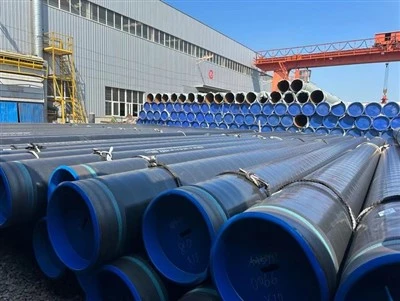
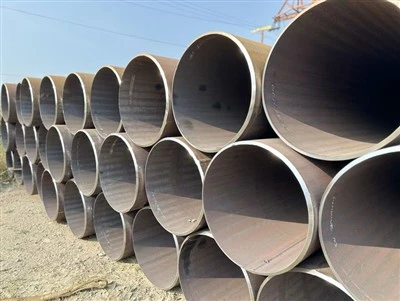
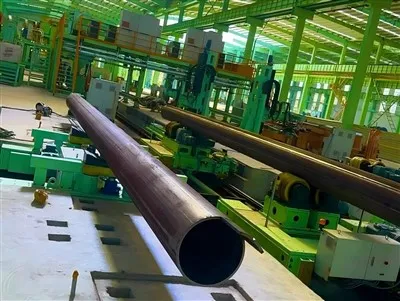
Tianjin Brisk Steel is one of the manufacturers of API 5L X52 LSAW Steel Pipe in China. Our products are mainly exported to the Middle East, Southeast Asia, Europe, New Zealand, and other regions.If you would like to learn more about our products, feel free to contact us and send your purchase list.


Why X52 Is Selected
X52 sits in a practical middle ground for pipeline designers:
- Adequate strength for medium-pressure service without the higher alloy content, tighter chemistry control, and welding precautions required for X60 and above.
- Good weldability, making field girth welding on pipeline construction sites more straightforward than with higher-strength grades.
- Cost efficiency. For pipelines where design pressure does not require X60/X65/X70, specifying X52 avoids paying for strength margin the project doesn't need.
- Wide availability of fittings and flanges rated to match X52 line pipe in common diameter ranges.
API 5L Specification Basics for X52
PSL1 vs PSL2: X52 pipe can be ordered to Product Specification Level 1 (PSL1) or the more stringent PSL2, which adds requirements such as Charpy V-notch impact testing, tighter carbon equivalent limits, and mandatory chemical composition reporting. PSL2 is typically specified for higher-consequence or sour service-adjacent pipelines.
Minimum Yield Strength: 52,000 psi (358 MPa)
Minimum Tensile Strength: 66,000 psi (455 MPa) for PSL1; PSL2 requirements are defined with both minimum and maximum limits to control weldability
Delivery Condition: typically normalized, thermomechanically rolled, or as-rolled depending on wall thickness and mill process - this affects toughness and should be confirmed for PSL2 orders
Typical Specifications
- Outer Diameter: approx. 406 mm – 1,420 mm (16" – 56")
- Wall Thickness: typically 6 mm – 30 mm, depending on design pressure and diameter
- Length: single random length (SRL) or double random length (DRL), or fixed length on request
- End Finish: beveled ends for girth welding
- Testing: 100% ultrasonic and/or radiographic testing of the weld seam, hydrostatic testing of every pipe, plus mechanical and chemical testing per heat/lot
Applications
- Onshore oil and gas gathering and transmission pipelines
- Water transmission and municipal pipeline systems
- Medium-pressure industrial pipeline networks
- Pipeline sections where X52's balance of strength and weldability fits the design pressure
FAQ
Q: What does the "X52" in API 5L X52 mean?
A: The "X" indicates the pipe is a high-strength line pipe grade under API 5L, and "52" refers to a minimum yield strength of 52,000 psi (approximately 358 MPa). Higher numbers (X60, X65, X70) indicate higher minimum yield strength.
Q: What is the difference between PSL1 and PSL2 for X52 pipe?
A: PSL1 is the basic specification level with standard mechanical and dimensional requirements. PSL2 adds mandatory requirements including Charpy V-notch impact testing, maximum carbon equivalent limits, full chemical composition reporting, and generally tighter quality control - PSL2 is commonly required for pipelines carrying hazardous or sour service fluids, or where project specifications call for higher assurance.
Q: Can X52 LSAW pipe be used for high-pressure pipelines?
A: X52 can be used for higher-pressure service if the wall thickness is increased accordingly, but for very high design pressures at reasonable wall thickness, pipeline designers often move to a higher grade such as X60, X65, or X70 instead of thickening X52 pipe excessively.
A: Both can be supplied in X52, but ERW pipe is coil-fed and generally limited to smaller diameters and thinner walls, while LSAW pipe is plate-fed and can be produced in much larger diameters and heavier wall thicknesses, making LSAW the standard choice for large-diameter transmission pipelines.


Hot Tags: api 5l x52 lsaw steel pipe, China api 5l x52 lsaw steel pipe manufacturers, suppliers, factory, cost effective steel pipe, martensitic stainless steel pipe, pipeline construction lsaw pipe, steel pipe for fluid conveyance, steel pipe for water, welded joint steel pipe