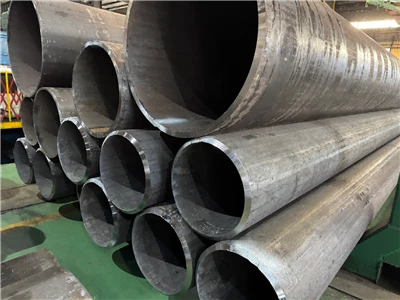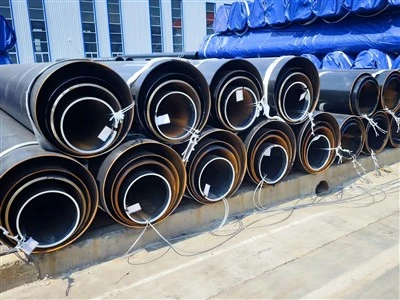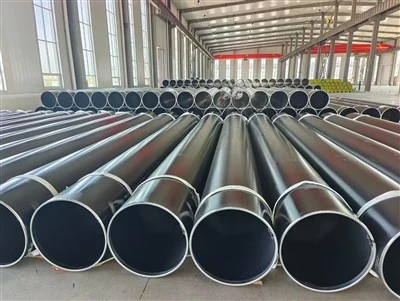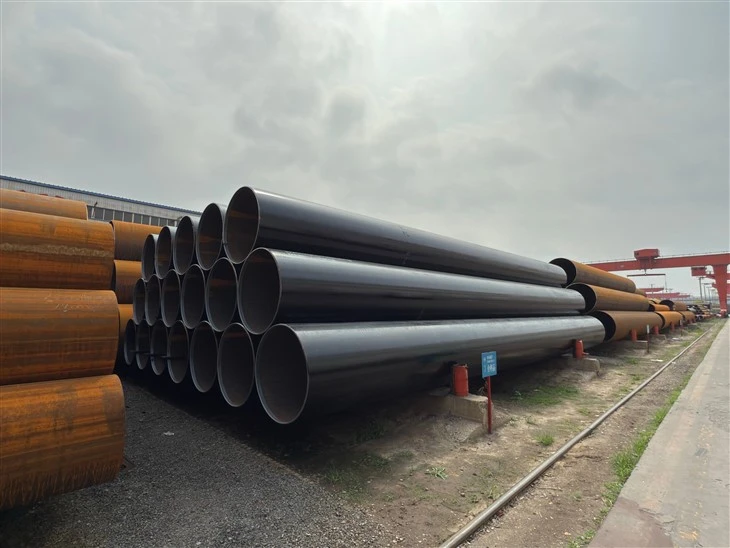
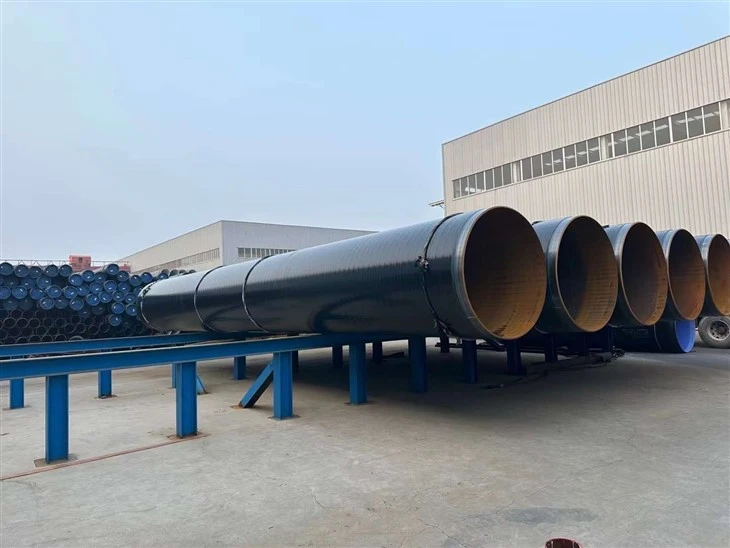
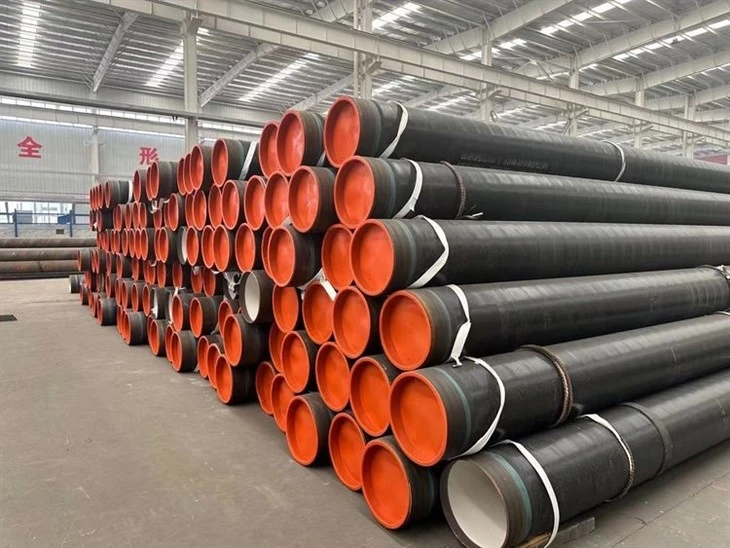
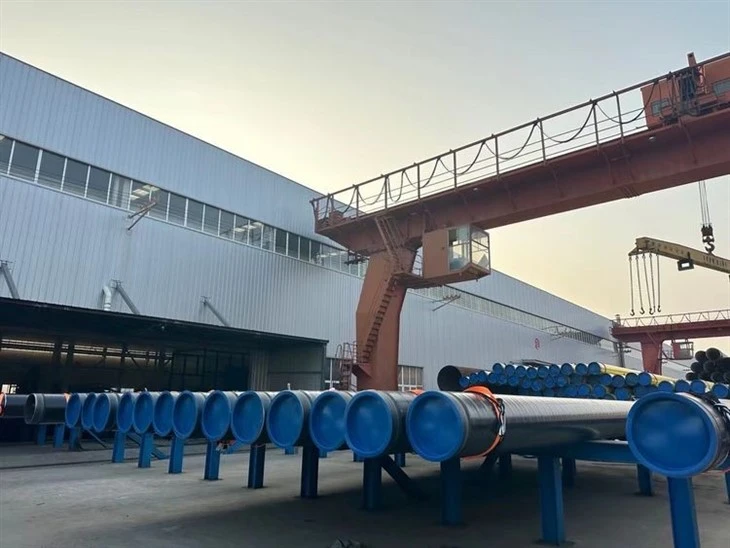
Tianjin Brisk Steel is one of the API5L PSL2 LSAW STEEL PIPE in China. Our products are mainly exported to the Middle East, Southeast Asia, Europe, New Zealand, and other regions.If you would like to learn more about our products, feel free to contact us and send your purchase list.


Quick Specification Reference
| Item | Typical Range |
|---|---|
| Standard | API Spec 5L, current edition |
| Product Specification Level | PSL2 |
| Process | LSAW (double submerged arc welded, JCOE or UOE forming) |
| Grades | X42 through X80 (Grade B available but PSL2 X-grades are the common LSAW order) |
| Outside diameter | 406 mm (16") to 2540 mm (100"), project-dependent |
| Wall thickness | 6 mm to 40 mm |
| Length | Single Random (SRL) or Double Random (DRL), typically 10.7-12.2 m |
| End finish | Beveled for butt welding, per API 5L Annex |
| Coating | Bare, FBE, 3PE/3PLE, or per project spec |
| Common optional annexes | Annex H (sour service), Annex J (offshore) |
What PSL2 Actually Adds Beyond PSL1
PSL1 sets minimum mechanical properties and leaves most testing to the purchaser's discretion. PSL2 changes that in several specific, checkable ways:
- Tighter and bounded chemistry. PSL2 imposes lower carbon equivalent (CE) limits than PSL1 for the same grade, which is what gives PSL2 pipe its predictable, low-preheat field weldability.
- A yield strength ceiling, not just a floor. PSL1 only sets a minimum yield strength. PSL2 sets both a minimum and a maximum. That upper bound matters for strain-based pipeline design, where an over-strength pipe body can shift how a girth weld behaves under bending.
- Mandatory Charpy V-notch (CVN) impact testing. PSL1 does not require impact testing at all. Under PSL2, every pipe is tested for toughness, which is the property that determines whether a defect grows as a slow, containable tear or a fast-running brittle fracture.
- Mandatory, full-length NDT. PSL1 leaves non-destructive testing largely to agreement. PSL2 requires the full length of every pipe to be inspected, with no substitution of sampling for coverage.
- Mandatory hydrostatic testing of every pipe, with no alternative method accepted in place of it.
None of this is optional once PSL2 is specified - it is the definition of PSL2, not an upgrade package on top of it.
Why LSAW Buyers Need to Read the Seam Requirements Specifically
On seamless pipe, PSL2 toughness testing is a base-metal question. On LSAW pipe, it is not - the weld seam and the heat-affected zone (HAZ) are separate locations that carry their own toughness and soundness requirements:
- CVN testing on welded PSL2 pipe is taken from the weld metal and the HAZ, in addition to the base metal, because the seam is where a real pipeline defect is statistically most likely to originate.
- 100% NDT coverage on LSAW pipe means both the parent plate and the completed double submerged arc weld are inspected along their full length, typically by automated ultrasonic testing supplemented by radiography at plate ends and seam start/stop points.
- For higher grades and larger diameters, drop-weight tear testing (DWTT) is commonly added on top of CVN to confirm the pipe body resists a running shear fracture, not just a single-point impact.
- Guided bend testing on weld samples confirms the seam has adequate ductility, separate from and in addition to its toughness rating.
A mill quoting PSL2 LSAW pipe without a clear seam-and-HAZ testing plan is quoting PSL1-grade documentation under a PSL2 label - a gap that only shows up when the actual test reports are requested.
Sour Service and Offshore: PSL2 Is the Floor, Not the Whole Answer
PSL2 is a prerequisite for two common project-level requirements, but it does not automatically include either one:
- Sour service (NACE MR0175 / ISO 15156). Pipe intended for H2S-containing service needs the sour-service suffix added to the grade designation (for example, X60QS or X65NS), which brings additional chemistry, hardness, and heat-treatment controls beyond the base PSL2 requirement. Ordering plain PSL2 X60 does not deliver sour-service-rated pipe.
- Offshore service (Annex J). Subsea and offshore installation adds its own set of collapse resistance, fatigue, and installation-load qualifications on top of the PSL2 baseline.
Both annexes are called out separately on the purchase order and verified with their own certification - PSL2 gets a project most of the way to either requirement, but it is not a substitute for naming the annex explicitly.
A Case Worth Knowing
A contractor ordered API 5L X65 PSL2 LSAW pipe for a project in a cold-climate region, correctly citing PSL2 for the mandatory impact testing. What the purchase order didn't specify was the CVN test temperature and sample orientation. The mill, working from the base API 5L requirement, tested and certified at the standard reference temperature and orientation - technically compliant with PSL2, but short of the lower test temperature and transverse orientation the project's design code actually required for that climate. The mismatch surfaced during document review, not during production, but it still meant re-testing archived samples and a delay to shipment. PSL2 sets the minimum testing regime; project-specific temperature, orientation, and acceptance values still have to be written into the order.
Reading a Genuine PSL2 Mill Test Report
A PSL2 MTR that actually supports the pipe should show, at minimum:
- Heat and pipe traceability linking chemistry, mechanical test results, and NDT records to the specific length of pipe
- Calculated carbon equivalent alongside the raw chemistry, not just a pass/fail statement
- CVN joule values with test temperature and specimen orientation stated, for base metal, weld, and HAZ on welded product
- A stated NDT method and coverage (ultrasonic, radiographic, or both) confirming full-length inspection, not spot sampling
- Hydrostatic test pressure and hold time recorded per pipe
If any of these is missing or summarized as a bare "PASS," it is worth asking the mill for the underlying data before the pipe ships, not after it arrives on site.
FAQ
Q: Does PSL2 automatically mean the pipe is suitable for sour or offshore service?
A: No. PSL2 is the baseline quality tier those services build on, but sour service (NACE MR0175/ISO 15156, with an NS/QS/MS grade suffix) and offshore qualification (Annex J) are separate requirements that need to be named on the order.
Q: Is CVN testing done on the weld seam for LSAW pipe, or only the base plate?
A: Both. PSL2 welded pipe requires impact testing of the weld metal and heat-affected zone in addition to the base metal, since the seam is the location most likely to govern toughness performance on welded product.
Q: Can PSL1 pipe be re-certified to PSL2 after it's already been produced?
A: Generally no. PSL2 requirements are built into the production, testing, and documentation process from the start; pipe already certified only to PSL1 should not be represented as PSL2 without the original manufacturing records and testing genuinely supporting it.
Q: What test temperature and orientation should I specify for CVN testing?
A: API 5L sets a reference default, but the temperature and orientation that actually matter for your pipeline depend on the governing design code, minimum design temperature, and project specification - confirm this with your design engineer and put the exact value on the purchase order rather than relying on the standard's default.


Hot Tags: api5l psl2 lsaw steel pipe, China api5l psl2 lsaw steel pipe manufacturers, suppliers, factory, austenitic stainless steel pipe, customized lsaw pipe, longitudinally welded pipe, seamless joint steel pipe, seamless pipe alternative, steel pipe for gas transmission