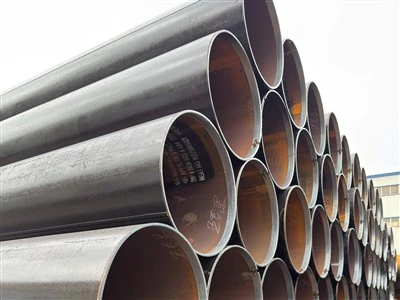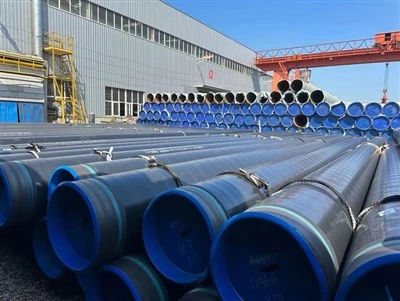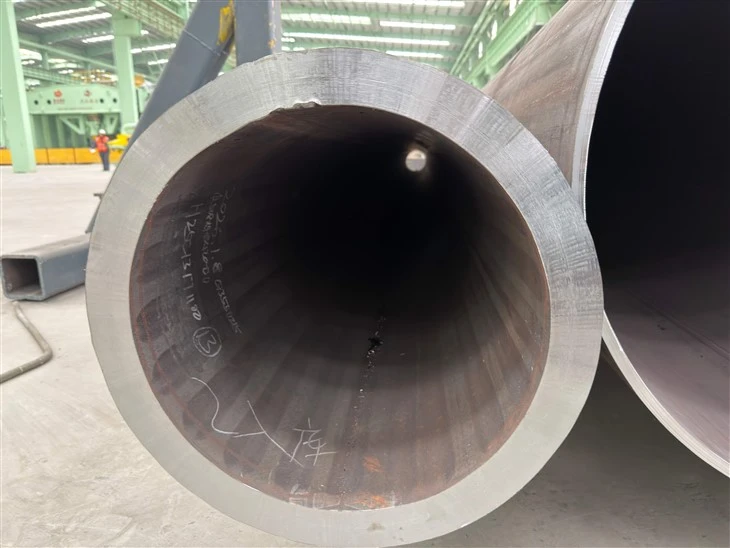


Tianjin Brisk Metalwork Co., Ltd. is one of the leading manufacturers and suppliers of large diameter thick wall lsaw pipe in China. We have world-leading production equipment and strong manufacturing capabilities. Please feel free to buy bulk durable large diameter thick wall lsaw pipe from our factory.
PRODUCT
Tianjin Brisk Steel focus on produce and supply hollow section and steel pipe


Product Range at a Glance
| Item | Our Thick Wall LSAW Range | |
|---|---|---|
| Outside diameter | 406 mm - 1,420 mm | |
| Wall thickness | 20 mm - 50 mm | |
| Length | 6 m - 12 m, fixed or random | |
| Steel grades | Q355 / S355 series, API 5L B to X70, ASTM A252 Gr.2 and Gr.3, other grades on request | |
| Forming and welding | JCOE forming, tack weld, double-sided multi-wire submerged arc welding | |
| Finishing | Cold expansion, full-length hydrostatic test, plain or beveled ends | |
| Surface | Bare, varnished, 3LPE, FBE, epoxy coal tar or internal lining | |
| Documents | EN 10204 3.1 as standard, 3.2 with third-party witness |
Why Does Thick Wall Take a Different Process?
Moving from 12 mm to 40 mm wall is not the same job at a higher setting. Four things change:
- The plate has more thickness in which a lamination or segregation band can hide.
- The seam needs several passes per side instead of one, so heat input and interpass temperature have to be managed pass by pass.
- Forming takes far more press force, and the springback is larger, so roundness is harder to hold.
- The weld bevel is deeper, so any lack of fusion at mid-wall is expensive to find and repair later.
We have built our process around those four points. The sections below show how.
Why Does Joint Count Drive the Cost of Heavy Wall Pipe?
Weld metal in a V-groove grows roughly with the square of the wall thickness. Going from a 20 mm wall to a 40 mm wall takes about four times the filler at the same groove angle. Every thick wall girth joint then means more passes, more preheat, more interpass checks and more NDT.
So the useful question is not only "what does one tonne of pipe cost", but "how many girth joints will this member need?" A pipe supplied in long lengths with no internal circumferential welds answers that question in your favor.
How Do We Keep the Plate Sound Before It Is Formed?
Every plate is traced to its heat number. Before forming, the plate is ultrasonically scanned across the body and along the edge band, because the edges become the weld bevel and any lamination there ends up in the seam. Plates with indications outside our acceptance limit are cut out or rejected, not formed. Chemistry is checked against the mill certificate so that carbon equivalent stays within the range we need for multi-pass welding.

How Is the Thick Wall Seam Welded?
After JCOE forming, the seam is tack welded, then welded inside and outside with multi-wire submerged arc welding. On our thick wall pipe:
- The bevel is milled, not flame cut, so root faces are consistent from pipe to pipe.
- Pass count rises with wall: a 20 mm wall is welded with a single pass pair, while walls of 40 mm and above take several passes per side.
- Interpass temperature is controlled, so the heat-affected zone does not lose toughness as the weld builds up.
- The inside and outside beads overlap, with penetration confirmed on test coupons and by macro-section checks at the start of each production lot.
How Do We Prove the Weld Is Clean?
The seam is inspected after welding and again after expansion. This catches defects that only show once the pipe has been stressed.
| Stage | Check |
|---|---|
| After welding | 100% automatic ultrasonic testing of the full seam length |
| After expansion | Repeat ultrasonic testing, plus radiography at pipe ends and at any doubtful location |
| Mechanical | Seam tensile, guided bend and Charpy impact (weld metal and heat-affected zone) per production lot |
| Pressure | Hydrostatic test on every pipe, held for the time required by the applicable standard |
| Dimensions | OD, wall, ovality, straightness and end squareness measured and recorded |
What Does Cold Expansion Do for a Thick Wall Pipe?
After welding, each pipe is mechanically expanded by a small, controlled amount along its full length. For thick wall pipe this does two jobs: it brings the body to a uniform, accurate diameter, and it relieves part of the forming and welding stress. The result is pipe ends that match, which matters most when you are making girth welds on a heavy wall where a few millimeters of misalignment is hard to absorb.
Where Is Thick Wall LSAW Pipe Used?
| Application | What the Thick Wall Does |
|---|---|
| Hydropower penstock | Carries high head pressure and withstands vacuum on draining |
| High-pressure oil and gas lines | Meets higher design factors in populated or river-crossing sections |
| Heavy piling and bridge foundations | Survives hammer driving and resists bending in soft ground |
| Pressure shafts and tunnel linings | Resists external ground and groundwater load |
| Heavy structural columns and pylons | Provides high axial capacity in a single-piece member |
| Port and jetty structures | Handles berthing impact and corrosion allowance |
FAQ
Q: Can thick wall LSAW replace seamless pipe in large sizes?
A: Above the practical diameter limit of seamless mills, LSAW is the normal route. For thick wall at 508 mm and larger, we supply LSAW with the same pressure testing and traceability you would expect from a seamless order.
Q: Can you prepare ends for joining pipes of different wall thickness?
A: Yes. We can machine an internal taper or counterbore so that a 40 mm wall pipe meets a 32 mm wall pipe at a smooth transition.
Q: Do you offer third-party witnessed testing?
A: Yes. Inspection by SGS, BV, TUV or your appointed inspector can be arranged, with EN 10204 3.2 certificates.
Related:SWAL STEEL PIPE


Hot Tags: large diameter thick wall lsaw pipe, China large diameter thick wall lsaw pipe manufacturers, suppliers, factory, durable steel pipe, lsaw pipe, LSAW STEEL PIPES, rigid steel pipe, steel pipe for marine structure, steel pipe with threaded joint