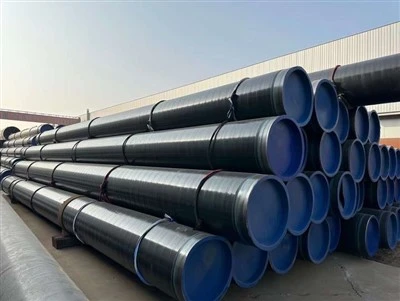
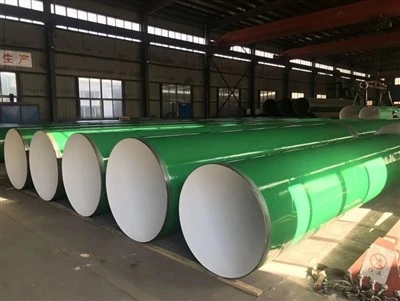
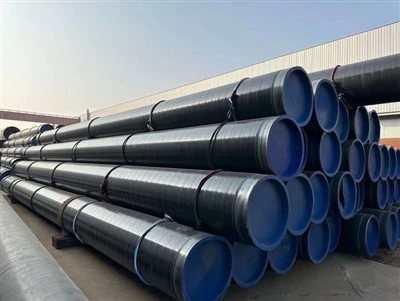
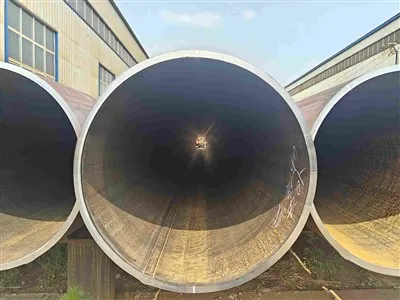
Tianjin Brisk Metalwork Co., Ltd. is one of the leading manufacturers and suppliers of cold-expanded lsaw steel pipe in China. We have world-leading production equipment and strong manufacturing capabilities. Please feel free to buy bulk durable cold-expanded lsaw steel pipe from our factory.
Tianjin Brisk Steel is one of the manufacturers of Cold-Expanded LSAW Steel Pipe in China. Our products are mainly exported to the Middle East, Southeast Asia, Europe, New Zealand, and other regions.If you would like to learn more about our products, feel free to contact us and send your purchase list.


What Cold Expansion Actually Changes in the Pipe
- Roundness (circularity): out-of-round pipe is pushed back toward a true circular cross-section, which matters directly for field fit-up and for accurate wall-stress calculations under internal pressure.
- Diameter tolerance: expansion sizes the pipe to a tighter, more repeatable final OD than forming alone can achieve.
- Residual stress: some of the stress locked in during forming and welding is relieved as the pipe is expanded.
- Yield strength behavior: this is worth being precise about rather than glossing over. Cold expansion typically raises the pipe's tensile yield strength slightly (strain hardening), but it can also introduce the Bauschinger effect - a reduction in compressive yield strength in the direction opposite to the applied strain. API 5L accounts for this in its testing and grade qualification requirements, which is one reason mill certificates for expanded pipe should show actual post-expansion mechanical test results rather than only pre-expansion plate certs.
None of this makes cold-expanded pipe "better" in some absolute sense - it makes it dimensionally and mechanically more predictable, which is what large pipeline projects actually need for consistent field installation and design-code compliance.
Typical Specification Range
| Parameter | Typical Value |
|---|---|
| Manufacturing process | UOE or JCOE with mechanical expansion |
| Expansion ratio | Approx. 0.8%–1.5% of diameter (mill- and spec-dependent) |
| Governing pipe standards | API 5L |
| OD range | 406 mm–1420 mm (16"–64") |
| Wall thickness | Up to approximately 40–60 mm depending on mill capacity |
| Steel grades | API 5L Grade B through X80 (X100/X120 available from some mills) |
| Post-expansion testing | Hydrostatic pressure test, ultrasonic testing (UT) of weld and body, dimensional/roundness check |
Exact expansion ratio and post-expansion test requirements vary by project specification and by which edition of API 5L governs the order - this is not a fixed universal number, and a supplier quoting one without reference to the governing standard edition should be asked to clarify.
Buying Guide: Questions Worth Asking Before You Order
- Does the mill test certificate reflect post-expansion properties, or only the incoming plate? This is the single most important document check. Mechanical properties (yield strength, tensile strength, elongation) can shift after cold expansion. A certificate that only carries plate-mill data doesn't tell you what the finished pipe actually tested at.
- What expansion ratio does this mill run, and is it documented per heat/lot or just as a general process description? Expansion ratio affects both dimensional tolerance and residual mechanical properties. Reputable mills can tell you the ratio range they run and back it up with process records, not just a marketing statement that "cold expansion is applied."
- Is roundness (ovality) actually measured and reported, or only nominal OD? Nominal OD being in tolerance doesn't guarantee circularity is within spec - ask specifically for ovality/roundness measurement records, particularly for thick-wall, large-diameter orders where out-of-roundness is more likely to be an issue.
- For sour service or higher pressure-class projects, has expansion ratio been considered against toughness requirements? Higher expansion ratios can affect toughness and hardness in ways that matter for sour service (NACE MR0175/ISO 15156) or high-pressure-class (PSL2) orders. This should be part of the technical discussion with the mill, not assumed to be automatically compliant.
- What NDT is performed after expansion, not just after welding? Ultrasonic testing of the weld seam and pipe body should be confirmed as occurring after the expansion step, since expansion can, in principle, reveal or affect defects that pre-expansion testing wouldn't catch in their final state.
- Does the hydrostatic test pressure and hold time match your project spec, not just a generic mill default? Hydrotest parameters (pressure, duration) are often specified per project/code (e.g., ASME B31.4, B31.8) rather than left to a mill default - confirm this is built into the order, not assumed.
- If ends need to be re-rounded or sized further for field fit-up, is that included? Some projects specify additional end-sizing or beveling tolerances tighter than the mill's standard cold expansion delivers along the body. Clarify this separately if your girth-welding tolerances are unusually tight.
FAQ
Q: Is cold expansion the same as cold forming?
A: No. Cold forming refers to shaping the plate into a cylinder (the U, O, J, or C steps) without heating the steel. Cold expansion is a distinct, later step - after welding - where the already-formed and welded pipe is radially expanded to correct roundness and dimensional tolerance. Both happen at ambient temperature, which is why the terms sometimes get conflated, but they are different operations with different purposes.
Q: Does cold expansion weaken the weld seam?
A: Not inherently - the expansion step is a standard, code-recognized part of UOE/JCOE manufacturing, and post-expansion NDT (UT, hydrostatic testing) exists specifically to confirm weld integrity survives the process. Problems arise from poor process control (excessive expansion ratio, inconsistent application) rather than from cold expansion itself.
Q: Why not just make the pipe round enough during forming and skip expansion?
A: In practice, forming heavy plate into a cylinder and welding it introduces enough residual variation that a final sizing step is more reliable and repeatable than trying to hold tight roundness tolerance through forming alone, especially at large diameters and heavier wall thicknesses.
Q: Does a higher expansion ratio mean higher quality?
A:Not necessarily - it means more correction was needed or more sizing was applied, not automatically "better" pipe. What matters is whether the ratio used is appropriate for the wall thickness, grade, and service conditions, and whether the resulting mechanical properties still meet the governing standard.


Hot Tags: cold-expanded lsaw steel pipe, China cold-expanded lsaw steel pipe manufacturers, suppliers, factory, en standard lsaw pipe, jointed lsaw pipe, low alloy steel pipe, steel pipe for chemical, steel pipe with stable performance, thick walled lsaw pipe