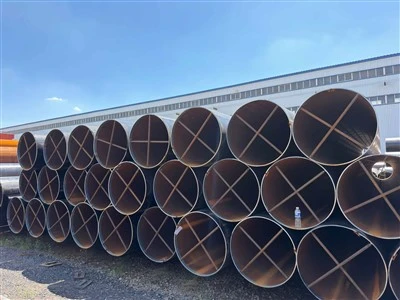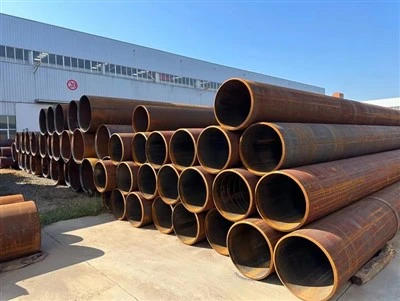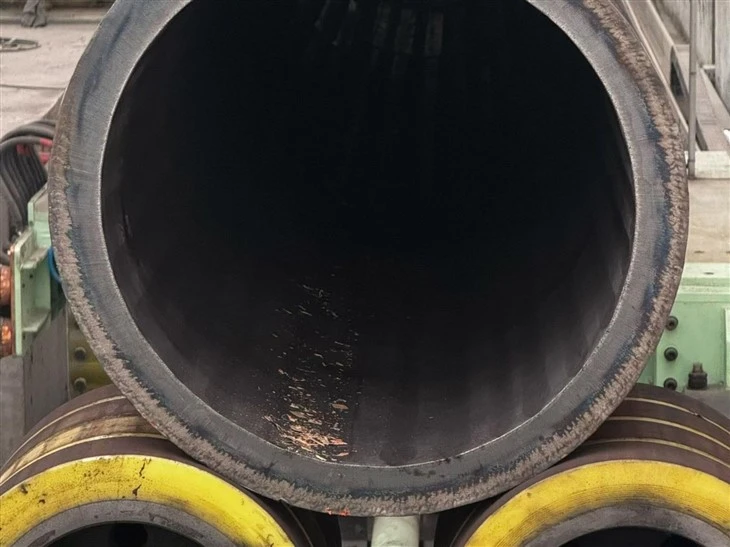
Tianjin Brisk Metalwork Co., Ltd. is one of the leading manufacturers and suppliers of large diameter lsaw pipeline in China. We have world-leading production equipment and strong manufacturing capabilities. Please feel free to buy bulk durable large diameter lsaw pipeline from our factory.
Tianjin Brisk Steel is one of the manufacturers of Large Diameter LSAW Pipeline Pipe in China. Our products are mainly exported to the Middle East, Southeast Asia, Europe, New Zealand, and other regions.If you would like to learn more about our products, feel free to contact us and send your purchase list.


Where LSAW Actually Sits Among Large-Diameter Options
"Large diameter pipeline pipe" isn't made one way - at diameters above roughly 20 inches, buyers are usually choosing between LSAW, SSAW (spiral submerged arc welded), and, at the upper end of what's practical, seamless pipe. Each has a real trade-off, not just a price difference:
- Seamless pipe has no weld seam at all, which removes the seam as a potential weak point, but manufacturing seamless pipe becomes difficult and expensive above roughly 24 inches OD - it's essentially not a large-diameter option at pipeline transmission sizes.
- SSAW pipe can be produced at very large diameters (up to around 100 inches) from relatively narrow steel coil wound into a spiral, which makes it economical, but the spiral weld is longer than a straight seam for the same pipe length and involves more total weld length to inspect.
- LSAW pipe forms plate into a cylinder with a single straight longitudinal seam, then welds it. That single, straight, predictable seam is easier to inspect thoroughly and automatically than a spiral weld, and LSAW mills can produce genuinely heavy wall thicknesses at large diameters - which is why most high-pressure, long-distance oil and gas transmission specifications call for LSAW specifically rather than "large diameter welded pipe" generically.
None of this makes LSAW automatically "better" - SSAW is a legitimate, widely used choice for many large-diameter pipelines, particularly at lower pressure classes or where cost is the driving factor. LSAW earns its place specifically where weld quality, dimensional tolerance, and thick-wall/high-pressure capability matter enough to justify the difference.
PSL1 vs. PSL2: What the Numbers Actually Say
Most large-diameter LSAW pipe for transmission service is ordered to API 5L, and the PSL1/PSL2 decision is one of the more consequential ones in the purchase order - not because PSL2 is universally "better," but because it's a genuinely different, more tightly controlled product with real numeric limits, not just a vague quality upgrade:
| Requirement | PSL1 | PSL2 |
|---|---|---|
| Maximum sulfur content | Up to 0.030% | Up to 0.015% (typical) |
| Maximum phosphorus content | Up to 0.030% | Up to 0.025% (typical) |
| Carbon equivalent (CEQ) limit | Not mandated | Mandated maximum, grade-dependent |
| Yield/tensile strength | Minimum only specified | Minimum AND maximum specified |
| Charpy V-notch (CVN) impact testing | Not required | Required |
| Non-destructive testing of every pipe | Not mandated | Mandated |
| Sour service / offshore annexes | Not applicable | Annex H (sour service), Annex J (offshore) apply when specified |
The maximum yield/tensile strength requirement under PSL2 is easy to overlook but matters in practice: a pipe that tests well above the minimum yield strength isn't automatically a bonus - over-strength pipe can behave less predictably in some design scenarios, which is exactly why PSL2 caps it rather than just setting a floor.
Why Sulfur and Phosphorus Limits Aren't Just a Chemistry Detail
Lower sulfur and phosphorus content isn't a purity nicety - both elements directly affect susceptibility to hydrogen-induced cracking and sulfide stress cracking, which is precisely why sour service applications (any pipeline carrying H₂S-bearing product) require PSL2 with sour-service qualification under Annex H, not PSL2 alone. If your project has any sour service exposure, that needs to be flagged explicitly in the order - "PSL2" by itself doesn't guarantee sour-service suitability unless the sour-service annex and grade suffix (e.g., X65 QS/MS/NS) are specifically called out.
FAQ
Q: Is LSAW pipe always thicker-walled than SSAW pipe at the same diameter?
A: Not necessarily - both can be produced across a range of wall thicknesses. The practical difference is that LSAW mills, using heavy plate and high-tonnage forming presses, are generally better suited to combining very large diameter with very heavy wall thickness than spiral-forming a narrower coil can achieve, which is why the heaviest-wall, highest-pressure-class large-diameter pipe tends to be LSAW rather than SSAW.
Q: Does PSL2 automatically mean the pipe is suitable for sour or offshore service?
A: No - PSL2 is a baseline of tighter chemical and mechanical control, but sour service and offshore service each require their own specific annex (H and J respectively under API 5L) to be invoked and tested for. PSL2 is generally a prerequisite for these, not a substitute.
Q: What's the practical difference between UOE and JCOE forming for the buyer, not just the mill?
A: Both are legitimate large-diameter forming methods and both are followed by mechanical expansion; the choice mostly affects mill capability and cost rather than final pipe performance when both are done to the same governing standard. For a buyer, the standards compliance and post-expansion test records matter more than which forming route the mill uses to get there.
Q: Is a lower carbon equivalent (CEQ) always better?
A: Lower CEQ generally makes field welding easier (less preheat, lower cracking risk), but CEQ also correlates with strength - pushing it very low can make it harder to achieve higher grade requirements economically. The standard sets a maximum, not a target to minimize indefinitely; the practical goal is staying within the specified limit while meeting strength and toughness requirements.


Hot Tags: large diameter lsaw pipeline, China large diameter lsaw pipeline manufacturers, suppliers, factory, butt welded lsaw pipe, high strength steel pipe, pipeline construction lsaw pipe, recyclable lsaw pipe, seamless joint steel pipe, steel pipe with low alloy content