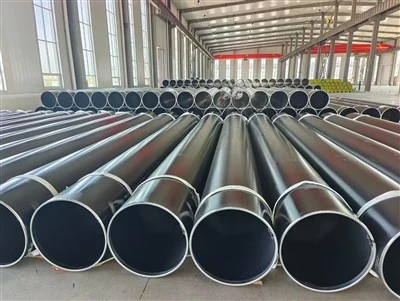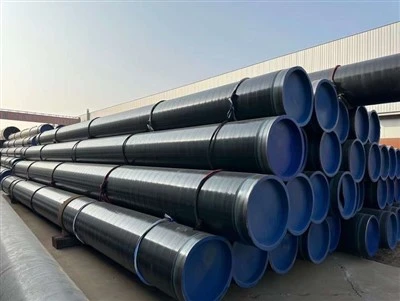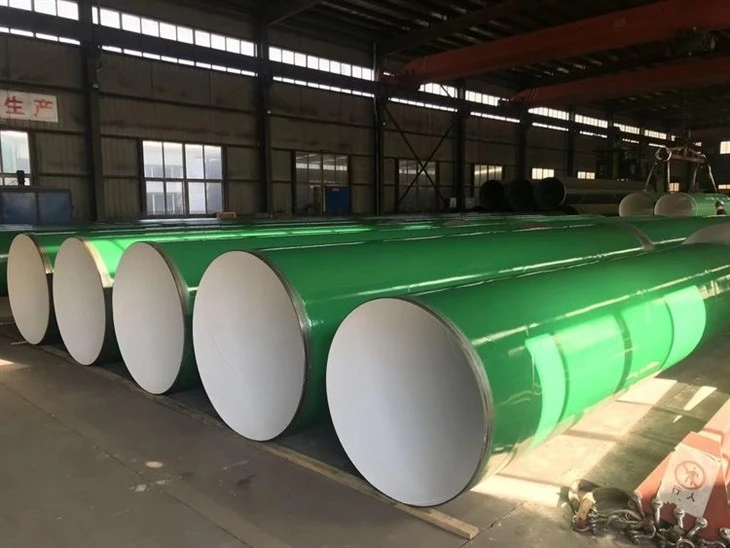

Tianjin Brisk Steel is one of the manufacturers of Internal Epoxy Coated Steel Pipe in China. Our products are mainly exported to the Middle East, Southeast Asia, Europe, New Zealand, and other regions.If you would like to learn more about our products, feel free to contact us and send your purchase list.


The Science of Internal Epoxy Linings
For structural engineers and international procurement teams, understanding the strict application standards and chemical mechanics behind internal coatings ensures proper system performance:
Liquid Epoxy Linings (e.g., AWWA C210): Typically applied as a two-part chemically cured epoxy system sprayed directly onto a high-velocity blast-cleaned internal surface. Liquid epoxy sets into a hard, glass-like finish that is highly resistant to industrial chemicals, raw water, and wastewater matrices.
Fusion Bonded Epoxy (FBE) Internal Lining (e.g., AWWA C213): Utilizes a thermosetting epoxy powder deposited electrostatically onto a pre-heated steel pipe bore (typically around 200℃). The powder melts, flows, and chemically cross-links to form a continuous, heavy-duty polymer layer perfectly bonded to the steel substrate.
Flow Efficiency Optimization: The application of internal epoxy dramatically lowers the pipe's internal surface roughness. By achieving an incredibly low hydraulic friction coefficient, pumps consume less energy to move fluids across long distances.

Key Advantages & Performance Metrics
1. Superior Corrosion & Tuberculation Defense
Internal epoxy linings isolate the raw carbon steel from aggressive chemicals, dissolved oxygen, and acidic fluids. This entirely eliminates tuberculation-the buildup of rust crusts and bacterial nodules that choke standard unlined water pipes over time.
2. Certified Potable Water Safety
Our specialized internal epoxies comply fully with strict global drinking water standards, including NSF/ANSI/CAN 61 and BS 6920. The lining is 100% inert, ensuring zero leaching of volatile organic compounds (VOCs) or chemical alterings, maintaining pure water quality from source to tap.
3. Lower Pumping Costs & Energy Savings
The ultra-smooth surface finish results in a high Hazen-Williams friction factor . This minimal resistance reduces internal fluid turbulence and localized pressure drops, allowing operators to downsize pumping equipment or lower lifetime electrical energy consumption.
4. Excellent Adhesion & Thermal Stability
Our automated mechanical blasting ensures a deep anchor profile (50-100μm) before coating application. This ensures that the epoxy forms an inseparable bond that will not peel, blister, or delaminate under rapid fluid pressure changes or thermal cycling.
Technical Specifications & Size Portfolio
We export certified internal epoxy coated steel pipes engineered to fit smoothly into global utility networks:
| Parameter | Specifications & Capabilities |
| Standard Compliance | AWWA C210 (Liquid), AWWA C213 (FBE), API RP 5L2 (Flow Lining) |
| Safety Certifications | NSF/ANSI 61, WRAS, BS 6920 (For Potable Drinking Water) |
| Pipe Base Materials | Seamless (SMLS), ERW, LSAW, SSAW Steel Pipes |
| Outer Diameter (OD) | 2" to 60" (60.3mm – 1524mm) |
| Coating Thickness | Flow Lining: 60 - 100 μm | Corrosion Lining: 300 - 500 μm |
| End Configuration | Beveled Ends with custom cutback or Threaded & Coupled |


Frequently Asked Questions (FAQ)
Q: What is the difference between a thin-film "flow lining" and a heavy-duty "corrosion protection lining"?
A: The primary difference is the intended purpose and thickness. A Flow Lining (typically 60-100 μm thick, following API RP 5L2) is engineered for dry natural gas pipelines to minimize internal friction and optimize gas velocity rather than fight heavy corrosion. A Corrosion Protection Lining (typically 300-500 μm thick, following AWWA C210/C213) is a much denser barrier designed specifically for municipal water, wastewater, or chemicals where continuous fluid contact requires a robust protective shield.
Q: How does internal epoxy coating affect the field joint welding process?
A: The Drop Weight Tear Test (DWTT) is performed according to API 5L requirements to evaluate the ductile fracture propagation behavior of high-strength gas line pipes. We test full-thickness notched specimens in our lab by impacting them at specified project design temperatures. To pass PSL2 compliance, the fracture surface must exhibit a minimum percentage of ductile shear area, ensuring the pipeline will naturally arrest a running fracture during a high-pressure gas decompression event.
Q: What non-destructive testing (NDT) is performed to guarantee the continuity of the internal lining?
A: Every pipe undergoes a strict two-stage internal inspection. First, we utilize electronic dry-film thickness (DFT) gauges to verify consistent micron depth across the entire length of the internal bore. Second, we perform a high-voltage Holiday Test (Spark Testing); an electrical probe passes through the pipe, and if any micro-pinhole or thin spot exists, a spark registers, indicating immediate repair is required before final packaging.
Q: Can internal epoxy coated pipes handle abrasive fluids like mining slurry or sand-heavy wastewater?
A: Standard internal epoxies are optimized for clean water, gases, and general hydrocarbons. For heavy mining slurry, abrasive dredging sands, or gravel-heavy wastewater, we recommend upgrading to a specialized Ceramic Epoxy or Polyurethane (PU) lining. These modified epoxies contain high-density ceramic or polymer aggregates designed explicitly to handle heavy impact erosion and sliding abrasion.
Partner with a Certified Global Steel Supplier
Maximize your pipeline's lifespan and lower fluid transport friction with high-precision internal coatings. Contact our international sales division today to request technical material sheets, specify custom internal micron tolerances, or secure a competitive FOB or CIF quotation delivered directly to your port of destination.


Hot Tags: internal epoxy coated steel pipe, China internal epoxy coated steel pipe manufacturers, suppliers, factory, environmentally friendly steel pipe, longitudinally welded steel pipe, SSAW PIPE, steel pipe for chemical, steel pipe with jointed structure, steel pipe with medium carbon content