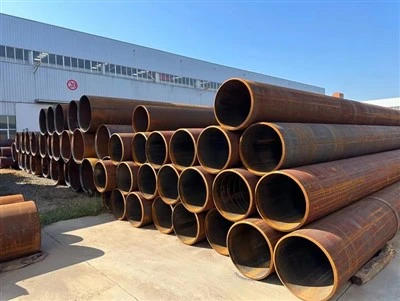
Tianjin Brisk Metalwork Co., Ltd. is one of the leading manufacturers and suppliers of fusion bonded epoxy lsaw pipe in China. We have world-leading production equipment and strong manufacturing capabilities. Please feel free to buy bulk durable fusion bonded epoxy lsaw pipe from our factory.
Tianjin Brisk Steel is one of the manufacturers of Fusion Bonded Epoxy LSAW Pipe in China. Our products are mainly exported to the Middle East, Southeast Asia, Europe, New Zealand, and other regions.If you would like to learn more about our products, feel free to contact us and send your purchase list.


What This Product Is
An FBE coated LSAW pipe is a large-diameter, longitudinally welded steel pipe - formed from rolled plate and joined by submerged arc welding - that has an external (and sometimes internal) layer of fusion bonded epoxy applied at the mill before shipment. The steel and the coating are two separate manufacturing steps qualified under two separate sets of standards, and buyers evaluating a quote should treat them that way rather than as one bundled spec.
Where this product typically shows up in a project:
- Cross-country oil and gas transmission lines
- Water supply trunk mains
- Gathering lines and flowlines at production sites
- As the primer layer beneath a 3LPE or 3LPP outer jacket on more demanding sections
How the Coating Actually Gets Applied
This is the part most product pages skip over, but it matters for evaluating supplier quality:
- Pipe is abrasive blast cleaned (typically to Sa 2.5) to remove mill scale, rust, and oil, and to create a rough anchor profile.
- The pipe is induction-heated to a target range, usually somewhere between 200°C and 250°C depending on the powder system.
- Epoxy powder is sprayed electrostatically onto the hot pipe surface, where it melts on contact.
- The molten film flows into the blast profile and begins cross-linking (curing) almost immediately as the pipe cools.
- The coated pipe is water-quenched, and the coating is then checked for thickness, holidays (pinholes), and adhesion before release.
Because the curing reaction happens on contact with the hot steel, FBE cannot realistically be applied in the field the way liquid coatings can - this is a shop-applied coating, and pipe ends are always left bare for a set distance to allow girth welding on site.
Performance Notes (Including Where It's Not the Best Choice)
FBE's main strength is adhesion: because the film is chemically bonded rather than just mechanically stuck to the surface, it holds up well under cathodic protection over long service periods, and it doesn't tend to disbond the way some tape or coal-tar systems can.
Where it's weaker: a single FBE layer has limited resistance to gouging and impact compared to 3LPE. On rocky backfill, horizontal directional drilling pull sections, or road/river crossings where pipe gets dragged or struck during installation, plain single-layer FBE is often not the right spec on its own - either a dual-layer abrasion-resistant FBE system or a full 3-layer PE/PP system is more appropriate. A supplier that recommends single-layer FBE for every installation scenario without asking about backfill and installation method is skipping a step that matters.
Standards: Pipe vs. Coating (Don't Confuse These)
| Governs | Typical Standards |
|---|---|
| Base pipe manufacturing | API 5L, ISO 3183, GB/T 9711 |
| FBE coating qualification | ISO 21809-2, CSA Z245.20, AWWA C213 (water pipe) |
| Coating film thickness (typical) | 300–600 microns, single layer |
| Steel grades commonly paired with FBE | API 5L Grade B through X80 |
| OD range (typical LSAW) | 406.4 mm–1,626 mm (16"–64") |
| Surface prep grade | Sa 2.5 near-white blast |
A mill test certificate that only references the pipe standard, without a separate coating inspection report (thickness readings, holiday test results, adhesion test), is incomplete for FBE-coated product.
Buying Guide: What to Check Before Ordering
Selecting the right FBE LSAW pipe involves more than confirming diameter and wall thickness. Buyers should review the following points with their supplier:
- Confirm the coating standard, not just "FBE." Different standards (ISO 21809-2, CSA Z245.20, AWWA C213) specify different surface preparation, thickness, and holiday (pinhole) testing requirements. Ask the supplier which standard the coating is qualified and tested to.
- Verify surface preparation grade. Sa 2.5 blast cleaning is standard for FBE application; inadequate blasting is one of the most common causes of premature coating failure. Request mill test reports showing surface profile and cleanliness results.
- Check coating thickness and holiday testing records. Request holiday detection (spark testing) reports for each pipe joint, along with thickness measurement records at multiple points around the circumference.
- Match steel grade to service conditions. For pipeline applications, steel grade (e.g., X60, X70) should be selected based on design pressure, not simply the highest grade available - over-specifying grade increases cost without a proportional benefit for lower-pressure service.
- Ask about girth weld coating compatibility. Since FBE cannot be pre-applied over the field weld area, confirm whether pipe ends are left bare for field joint coating and what bare-end length the supplier provides.
- Request third-party inspection options. For large orders, third-party inspection (SGS, BV, TÜV, or similar) of both the base pipe welding (per API 5L/ISO 3183) and the coating application (per the relevant coating standard) is standard practice for project buyers.
- Confirm transport and storage handling. FBE coating can be damaged by improper stacking, chain slings, or UV exposure during prolonged outdoor storage. Ask what protective measures (padded cradles, coating repair kits) are included.
- Clarify repair procedures. Minor coating damage during handling is common; ask whether the supplier provides FBE patch/repair materials and whether repair procedures are documented per the governing coating standard.
FAQ
Q: Is FBE the same thing as epoxy paint?
A: No. Epoxy paint is a liquid, solvent- or water-based coating applied by brush or spray and air- or heat-cured. FBE is a solid powder that is electrostatically sprayed onto steel heated well above the powder's melt point, so the film forms by fusion rather than by solvent evaporation. The two have different adhesion mechanisms and are not substitutes for each other in a pipeline spec.
Q: Why leave the pipe ends uncoated?
A: Girth welding in the field requires bare metal. If FBE covered the full pipe length, the weld area would need the coating stripped anyway before welding, and the heat from welding would damage adjacent coating regardless. Leaving a bare-end allowance (length varies by project spec) is simpler and more consistent than field-stripping.
Q: How does a buyer know the coating will actually last, not just look fine on delivery?
A: No coating supplier can guarantee field performance independent of installation quality - that's a genuinely honest limitation, not evasiveness. What you can verify before delivery is surface prep grade, cure state (via solvent rub or DSC testing if specified), thickness, and holiday-free continuity. Long-term performance then depends heavily on handling during transport/stringing and on the cathodic protection system being commissioned correctly after burial.
Q: What is the typical service life of FBE-coated LSAW pipe?
A:Service life depends heavily on installation quality, soil conditions, and whether cathodic protection is properly maintained, so suppliers generally do not quote a fixed number of years. Properly applied and installed FBE coating, combined with cathodic protection, is designed to support pipeline design lives commonly specified in the 20–50 year range in industry practice, but this should be evaluated on a project-specific basis.


Hot Tags: fusion bonded epoxy lsaw pipe, China fusion bonded epoxy lsaw pipe manufacturers, suppliers, factory, easy to install steel pipe, ferritic stainless steel lsaw pipe, medium carbon steel lsaw pipe, pipeline steel pipe, safe lsaw pipe, thick walled lsaw pipe