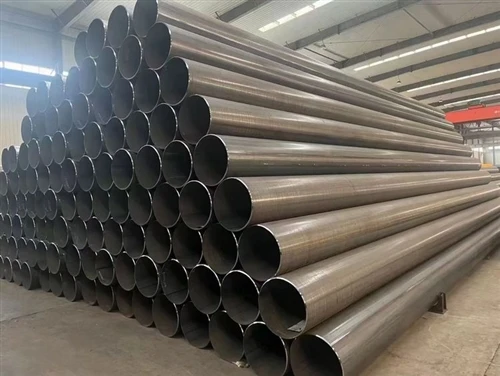
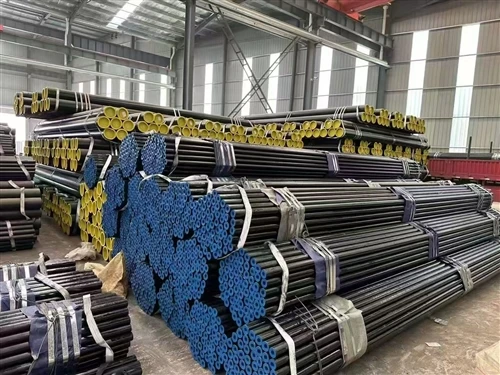
For decades, the standard column in a light or medium steel workshop was built from channel steel: one channel, a pair of channels laced together, or a box welded up from plate. Today a growing number of designers and fabricators specify a single spiral welded steel pipe instead. Modern professional steel-structure workshops offer controllable production cycles, moderate processing cost, and practical, repeatable fabrication, and the column is one of the places where that shows most clearly.
This article explains how spiral pipe is made, what its spiral seam changes compared with a straight seam, where channel columns run into limits, and how to buy spiral pipe for column use so that it arrives ready to fabricate.
How Is Spiral Welded Steel Pipe Made, and Why Can One Coil Width Cover Many Diameters?
Spiral welded steel pipe (often written SSAW or HSAW) is made from steel strip or coil that is bent continuously into a helix. The two edges of the strip meet along a spiral line, and the joint is closed by automatic double-sided submerged arc welding: one pass on the inside and one on the outside.
The geometry is what makes the process flexible. The pipe diameter is set by the strip width and the forming angle:
D = B / (pi x cos beta), where B is the strip width and beta is the angle between the strip edge and the pipe axis.
Change the angle and the same strip produces a different diameter. With a 1,500 mm strip, a forming angle of about 53 degrees gives a pipe of about 800 mm, and about 66.5 degrees gives about 1,200 mm (Figure 1).

This has three practical consequences for a buyer:
- Quick size changeover. A mill can run different diameters from the same strip width by adjusting the forming angle, so it handles small batches and many sizes without retooling for each one.
- Few length limits. Forming is a continuous bending process, so the tube is cut to length as it comes off the line rather than being limited by a plate length or a press stroke. Custom lengths are the norm, and lengths up to 30 m can be arranged for column and long-span applications.
- Uniform structure. The spiral weld is distributed evenly around the circumference, and continuous bending gives good dimensional accuracy and a stable overall structure. Diameter, ovality and wall thickness are still measured and recorded, but the process is well suited to a consistent product.


What Does the Spiral Seam Change Compared With a Straight Seam?
Three differences matter when you compare spiral pipe with straight-seam pipe of the same diameter and wall.
1. The weld is longer. The weld length per metre of pipe equals pi x D / B. For the two pipes in Figure 1 that is about 1.68 m and 2.51 m of seam per metre of pipe, against 1 m for a straight seam. There is more weld to inspect, but it is produced by an automatic process, and it is inspected in a repeatable way.
2. Defects lie at an angle. A flaw in the spiral seam is inclined to the pipe axis. Under hoop stress, the effective length of that flaw across the stress direction is roughly its length multiplied by cos beta, so at a forming angle of about 60 degrees it is about half the effective length of the same flaw in a straight seam. In pressure service, this is why the spiral seam disperses stress and tolerates imperfections better. This advantage is defined against hoop stress. In a column carrying mainly axial load, capacity is governed by the section geometry, and weld quality is still verified by testing.
3. Plate properties are not the same in every direction. Line-pipe steel is rolled, and its Charpy impact energy along the rolling direction is commonly around three times the value across it (the ratio varies with the steel). In a typical straight-seam pipe made from plate, the hoop direction runs across the rolling direction. In spiral pipe the strip runs along the helix, so the rolling direction is inclined toward the hoop direction and hoop-direction toughness falls between the two values.
These characteristics explain why spiral pipe has a long record in water supply, power and chemical plants. The same manufacturing route is the reason it now serves steel structures.
Why Did Channel Steel Columns Show Their Limits?
A channel is an open section. It is stiff about its strong axis and weak about the other. Compare a single 20a channel with a spiral pipe of 219 mm outside diameter and 6 mm wall at a 6 m effective length in both directions:
| Property | Single [20a channel | Spiral pipe 219 x 6 mm |
|---|---|---|
| Mass per metre | 22.6 kg | 31.5 kg |
| Cross-section area | 28.8 cm2 | 40.2 cm2 |
| Radius of gyration, strong axis | 7.86 cm | 7.53 cm |
| Radius of gyration, weak axis | 2.11 cm | 7.53 cm |
| Slenderness, weak axis (6 m) | about 284 | about 80 |
Channel values are taken from standard section tables. Pipe values are calculated from the geometry. The comparison is deliberately simple: real columns are braced, or built up from several members.

A single channel at 284 is far beyond the slenderness limit of about 150 commonly applied to main compression members, so channel columns had to be built up: two channels laced or battened together, or four plates welded into a box. That solves the weak axis, but it adds:
- Fabrication hours. Lacing bars or batten plates must be cut, fitted and welded along the whole length.
- Crevices and corners. Back-to-back channels and lacing joints trap moisture and are difficult to blast and paint properly, which is where coating failure usually starts.
- Low torsional stiffness. Open sections twist easily; a closed circular tube resists torsion far better.
A circular tube has the same radius of gyration in every direction, no weak axis, no lacing, a smooth closed surface, and ends that can be sealed. That is the technical reason the industry moved from channel columns to pipe columns.
What Advantages Does Spiral Pipe Offer as a Workshop Column?
- A wide size range. Because a spiral mill changes diameter by adjusting the forming angle, mainstream diameters and walls used for workshop columns can be produced, from about 219 mm upward, without waiting for special tooling.
- Length on demand. Custom lengths are available, and up to 30 m can be arranged. That allows one-piece, full-height columns and combined column units fabricated as a single piece, with no field splice, splice plates or bolt group to align on site.
- Better overall performance than channel steel. Equal stiffness in all directions, high torsional stiffness, and a clean closed surface make the pipe column more efficient in compression and biaxial bending.
- A cost profile that fits most projects. Pipe costs more per tonne than a plain channel in some markets, but the saving in lacing, fitting and welding on built-up channel columns usually offsets the difference. We recommend comparing installed cost per column, not price per tonne.
- An upgrade path. For higher capacity, the tube can be filled with concrete, which raises compression capacity without changing the outer size.
What Trade-Offs Should You Plan For?
We would rather tell you these before you order than after:
- Connections need early detailing. Beams cannot simply be bolted to a web as on a channel. Round tubes take gusset plates, end plates, through-plates or ring stiffeners, and cut ends may need coping.
- The outside seam bead stands proud. Where wall cladding, finishes or tight-fitting connections meet the tube, the bead should be ground flush.
- Local buckling limits apply. A large diameter with a very thin wall can buckle locally before the column reaches its overall capacity, so check the diameter-to-thickness ratio against your governing code.
- Long columns are hard to galvanize. Hot-dip galvanizing kettles are typically limited to roughly 12-14 m unless double-dipped, so columns above that length are normally protected with a paint system instead.
- Transport limits are real. A standard road trailer carries about 13.5 m, and a container about 12 m. A 30 m column needs a flat-rack, breakbulk or special-transport plan, or a designed shop splice.
What Should a Spiral Pipe Column Purchase Specification Contain?
Most disputes on column supply come from a specification that was left open. Fill in the ten lines below before you ask for prices, and every supplier will quote the same product.
| Line | What to write | Why it matters |
|---|---|---|
| Grade | S355J2H to EN 10219; add the impact sub-grade and your lowest service temperature | Impact values are fixed when the steel is made and cannot be added afterwards |
| Diameter and wall | Nominal OD x wall, and the tolerance class you design to | Your section properties depend on the real wall, not the nominal one |
| Length | Finished length per column, the length tolerance, and whether random or exact lengths are acceptable | Exact lengths remove cutting waste and site trimming |
| End condition | Square cut or bevelled, with an end squareness tolerance | The base plate bears on the tube end |
| Seam finish | External bead ground flush or as welded; internal bead as welded | Cladding and tight-fitting connections need a flush surface |
| Strip-end welds | None inside the end zones where plates are welded | Keeps a weld intersection out of the connection |
| Testing | Seam NDT method and extent, plus mechanical tests per lot | Defines what "inspected" means before production |
| Surface | Blast grade, primer system and thickness, or galvanizing; sealed ends for painted tubes | Coating failure usually starts at unsealed or badly prepared surfaces |
| Marking | Grade, size, heat number and column mark on each tube | Lets the erector match each tube to the drawing |
| Documents | EN 10204 3.1 certificate, NDT report, dimensional record | Needed for your own inspector and for the project file |
How Can We Help With Your Column Supply?
We manufacture spiral welded steel pipe in diameters and lengths suited to steel-workshop columns, and we prepare a written offer for every enquiry showing grade, size, length plan, seam finish and testing scope.
To receive a quotation within 24 hours, please send us:
- Column diameter, wall thickness and grade (or your loads and column height, and we will propose sizes)
- Finished length and quantity
- Coating or galvanizing requirement
- Destination port or site
Send your drawing as it is, and we will suggest where a size, grade or length change could reduce steel weight or fabrication time.