

Once a large-diameter spiral steel pipe reaches a certain length, some bending is almost unavoidable, and every pipe mill and pipeline contractor has met it. The pipe may be slightly uneven along its length, or it may turn away from the axis at one end in what mill workers call a "goose-neck" bend. Neither defect automatically means the steel is poor. Both, however, decide whether the pipe joins cleanly in the trench, lines up for a girth weld, or drives straight as a pile. This guide explains where the bending comes from, how mills correct it, and what a buyer should specify and check so that the pipe arrives straight enough to use.
What Does "Bending" Mean in Large-Diameter Spiral Steel Pipe?
Two different defects share the word "bending", and they behave differently.
Overall camber (sweep) is unevenness along the length: the whole body bows away from a straight line. Goose-neck bend is a local bend at the pipe end: the body may be straight, but the last stretch turns away from the axis.
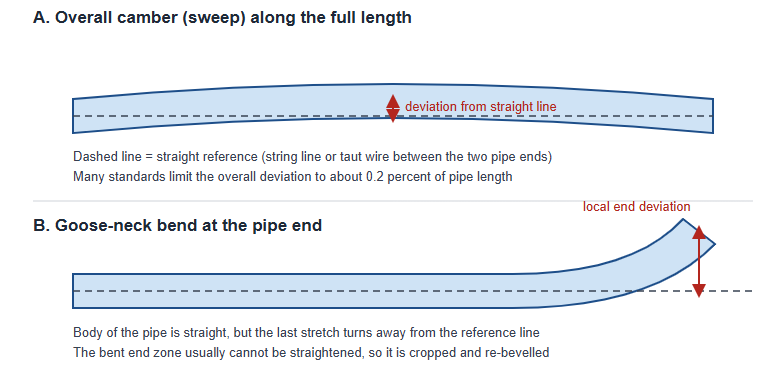
Camber is measured by stretching a string line or taut wire between the two ends of the pipe and reading the gap at mid-length. A goose-neck bend is checked with a straight edge laid along the end zone. Many standards, including API 5L, limit the overall deviation to about 0.2% of pipe length, which is 24 mm on a 12 m pipe and 36 mm on an 18 m pipe. Local end limits differ from standard to standard, so read the one on your contract instead of assuming.
Where Does the Bending Come From? Five Causes Along the Production Chain
Bending is rarely caused by a single fault. It is the sum of what happens to the pipe in forming, sizing, cooling, straightening and handling. These are the five causes we see most often, in the order the pipe meets them.
Why Do Forming Rolls That Are Not Collinear Cause Bending?
Spiral pipe is made by feeding steel strip into a forming stand at an angle and welding the helical seam. If the forming rolls are not held on one straight line, the strip is bent unevenly across its width. One side is stretched slightly more than the other, and the finished pipe carries that asymmetry as a permanent bow. The remedy is to calibrate the roll positions and restore the coaxiality of the whole roll set.
This cause matters more than its size suggests. A roll fault repeats on every pipe and pushes the bow in the same direction, and same-direction camber adds up along a pipeline, while random camber tends to cancel out.
How Does Sizing Equipment Add Bending?
The sizing machine gives the pipe its final diameter and roundness. If its parts are machined off-size, assembled out of alignment or adjusted unevenly, the pipe is squeezed unevenly around its circumference and can leave the machine with a bow. A sizing fault is hard to see on one pipe. It shows up as a pattern across many pipes, which is why a mill that records straightness by pipe number finds it quickly.
Can Local Water Cooling Bend a Pipe During Hot Inspection?
Yes. After welding, the pipe can still be warm when it is checked by hand. If water is applied to one spot to cool it, that spot contracts faster than the rest, and the cooled side pulls the pipe toward it. The cause is the temperature difference, not the water itself: uneven cooling of thick, large-diameter steel locks in local thermal stress. Letting the pipe cool evenly, or cooling it uniformly, avoids the problem.
What Happens When the Straightener Is Misadjusted or Worn?
Straightening is meant to remove bending, but a badly adjusted straightener can add it. Worn straightening rolls no longer touch the pipe along the intended line, so the pressure is uneven. The pipe end is also the hardest part to straighten, because the last stretch leaves the rolls without full support. That is why residual bends tend to appear at the ends, as goose-neck bends.
How Do Lifting and Transport Bend Pipe?
Large pipes with a high diameter-to-wall-thickness ratio are relatively flexible along their length. Lifting on a single hook, wide sling spacing, too few dunnage supports or long unsupported spans on a trailer let the pipe sag under its own weight, and repeated loading can leave a permanent set. Because this happens after inspection, a pipe that left the mill straight can still arrive bent.
| Cause | Typical Result | Stage |
|---|---|---|
| Forming rolls not collinear | Consistent overall camber | Forming |
| Sizing machine faults | Bow, uneven roundness | Sizing |
| Uneven local cooling | Random bow | Hot inspection |
| Straightener wear or misadjustment | Camber and goose-neck ends | Straightening |
| Lifting and transport | Sag or permanent set | Handling |
How Do Mills Correct a Bent Spiral Pipe?
The correction depends on the type of bend, and the first step is always to measure.
If the overall bend exceeds the limit, the pipe can be re-straightened. After a second straightening, the pipe is measured again. Because straightening loads the pipe, a careful mill also re-checks diameter, roundness and the weld seam afterwards. A pipe that will not come into tolerance after a second pass should be cut rather than pushed through repeatedly.
A goose-neck bend that cannot be straightened must be cut off. The bent end zone has no support during straightening, so the practical solution is to crop it, re-bevel the new end and measure again. This costs some length and yield, which is one reason the order length and length tolerance should allow for cropping.
Repeat defects call for a root-cause fix. If the same bend appears on pipe after pipe, straightening each one is not enough. The mill should calibrate the forming rolls so that every roll sits on the same axis, check the machining and assembly of the sizing section, replace worn straightener rolls and review its cooling practice.

Why Does Straightness Matter for Your Application?
Spiral pipe serves water supply and drainage, natural gas, steam and liquefied petroleum gas, petrochemical, chemical and power plants, agricultural irrigation, urban construction, and structural work such as piles, bridges, wharves, roads and building structures. Straightness affects each of these in a different way.
| Application | Where Bending Hurts |
|---|---|
| Water supply and drainage | Joint alignment and gasket seating in the trench |
| Natural gas, steam, LPG | Girth-weld fit-up and misalignment at welded joints |
| Petrochemical, chemical, power | Alignment with equipment and supports, spool fit-up |
| Irrigation and urban construction | Long straight runs, visible sag, uneven laying |
| Piles, bridges, wharves, buildings | Pile verticality during driving, splice alignment, eccentric loading |
How Do You Buy Large-Diameter Spiral Pipe That Stays Straight?
1. Put straightness in the purchase order. Name the governing standard and the limits, such as the overall deviation as a percentage of length and any end deviation the standard defines. If the standard is silent, write the number you need. Do not rely on "commercial straightness".
2. Ask how straightness is measured and recorded. Find out whether the mill uses a string line or taut wire for the full length and a straight edge at the ends, whether every pipe or only a sample is checked, and whether the records carry pipe numbers.
3. Agree the end condition. Ask whether goose-neck ends are cropped, how much can be cropped, and what length tolerance, end squareness and bevel apply afterwards. Order length with the cropping allowance in mind.
4. Ask about straightening practice. Confirm whether the pipe is straightened, how the rolls are maintained and replaced, and what re-inspection follows a re-straightening: diameter, roundness and weld seam.
5. Ask for forming and sizing calibration records. Roll alignment checks and sizing-section maintenance show whether the mill removes causes or only sorts out bent pipe at the end. A mill that calibrates on schedule sees fewer repeat defects.
6. Check how your standard defines "straight". Standards do not all measure bending the same way, so two mills can both "meet the standard" while checking different things. API 5L and ISO 3183 use two limits: an overall deviation of about 0.2% of pipe length, and a separate local check at each end with a straight edge over 1.5 m, with a limit of 3.2 mm. Other standards give a per-metre figure, or only one overall percentage, and some say nothing about the ends. Please verify the clause in the current edition of the standard you order to. In your purchase order, write down which deviation is measured (overall, per metre or end local), which method is used (string line or taut wire), and which limit applies. A goose-neck bend is exactly the kind of defect that passes an overall check and fails an end check.
7. Match the straightness requirement to how the pipe will be installed. The same pipe can be fine for one job and unusable for another.
- Butt-welded pipelines: end bends and out-of-round ends create high-low misalignment at the girth weld. Internal line-up clamps can correct small errors, but a goose-neck end may be beyond what a clamp can pull back, so the ends matter more than the middle of the pipe.
- Trenchless and pipe-jacking casings: the pipe is pushed through the ground, and bends add up joint by joint, so overall straightness and square ends are critical.
- Driven piles: a bent pile drifts off line while it is driven, and splices between lengths make the error worse.
- Water mains with gasketed or flanged joints: bending shows up as extra joint deflection and uneven gasket seating in the trench.
Tell your supplier which installation method applies, so the straightness and end requirements are set for the job and not only for the standard.


