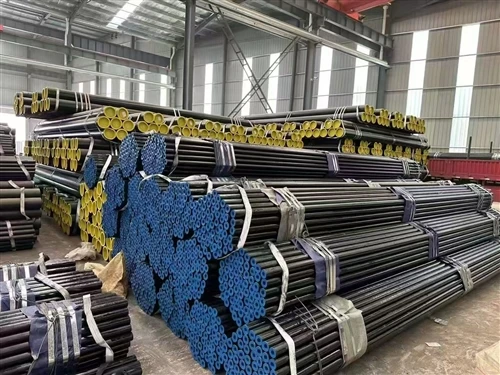
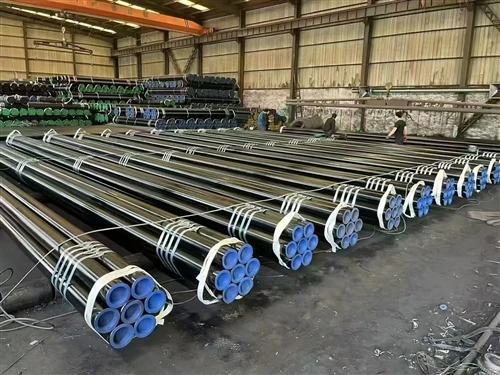
API 5L specification covers line pipe for the conveyance of natural gas, oil, water and other fluids. For ERW (Electric Resistance Welded) pipe, chemical composition and mechanical properties vary between Gr.B, X42, X46 and X52, and the limits are further split into PSL 1 and PSL 2. PSL 2 has stricter chemical controls, mandatory Charpy impact testing, tighter mechanical tolerances and full material traceability, while PSL 1 has relaxed requirements and no routine Charpy V-notch impact test.
Chemical Composition Limits
| Grade | C max | Mn max | P max | S max | Microalloys (V+Nb+Ti) |
|---|---|---|---|---|---|
| PSL1 | |||||
| Grade B | 0.26 | 1.20 | 0.030 | 0.030 | Total ≤0.15% |
| X42 | 0.26 | 1.30 | 0.030 | 0.030 | Total ≤0.15% |
| X46 | 0.26 | 1.40 | 0.030 | 0.030 | Total ≤0.15% |
| X52 | 0.26 | 1.40 | 0.030 | 0.030 | Total ≤0.15% |
| PSL2 | |||||
| Grade B | 0.24 | 1.20 | 0.025 | 0.015 | Controlled addition |
| X42 | 0.24 | 1.30 | 0.025 | 0.015 | Controlled addition |
| X46 | 0.24 | 1.40 | 0.025 | 0.015 | Controlled addition |
| X52 | 0.24 | 1.40 | 0.025 | 0.015 | Controlled addition |
Note: All chemical values are maximum weight percent (wt%), unless otherwise noted. The values below follow API 5L 46th edition.
Key chemical explanation
- Carbon (C): Carbon increases steel strength and hardness. Higher carbon improves tensile strength but hurts ductility and weldability. API 5L PSL2 caps carbon at 0.24% for these grades to keep good field welding performance for ERW pipe. Too much carbon raises the risk of hard zones and cold cracking during welding.
- Manganese (Mn): Manganese is the primary strengthening element in these line pipe grades. It refines grain structure, boosts yield and tensile strength, and offsets the negative impact of sulfur. As grade rises from Gr.B to X52, maximum manganese allowance increases, which is how the mill achieves higher yield strength without excessive carbon.
- Phosphorus (P): Phosphorus is an impurity. It improves strength but makes steel brittle, especially at low temperature. PSL2 limits phosphorus to 0.025% max, stricter than PSL1's 0.030%, to reduce brittle fracture risk for critical pipelines.
- Sulfur (S): Sulfur forms sulfide inclusions inside steel. High sulfur causes hot shortness during rolling and welding, and reduces toughness. PSL2 restricts sulfur to 0.015% maximum, which is essential for good Charpy impact performance.
- Carbon Equivalent Value (CEV): CEV estimates weld cracking tendency. Lower CEV = easier welding. X52 PSL2 allows slightly higher CEV (0.45 max) because higher manganese content is needed to hit X52 strength level. All grades here maintain CEV within acceptable ranges for field welding with standard WPS.
Alloy elements: Cr, Ni, Mo, Cu are optional trace additions. The mill may add small amounts to fine-tune mechanical properties, but they are not mandatory for Gr.B, X42, X46, X52 ERW.
Mechanical Properties (Minimum Values)
| Grade | Min Yield Strength | Min Tensile Strength | Yield / Tensile Ratio (PSL2) |
|---|---|---|---|
| Gr.B | 241 MPa (35 ksi) | 414 MPa (60 ksi) | ≤0.90 |
| X42 | 290 MPa (42 ksi) | 414 MPa (60 ksi) | ≤0.90 |
| X46 | 317 MPa (46 ksi) | 434 MPa (63 ksi) | ≤0.90 |
| X52 | 359 MPa (52 ksi) | 455 MPa (66 ksi) | ≤0.90 |
Mechanical property breakdown
- Yield Strength: The "X" number directly refers to minimum yield strength in ksi. X42 means minimum 42 ksi yield. Yield strength determines the maximum allowable operating pressure of your pipeline under ASME B31 codes. Higher yield grades allow thinner wall for identical design pressure.
- Tensile Strength: Tensile strength shows the steel's ultimate breaking resistance. Notice Gr.B and X42 share the same minimum tensile strength, even though X42 has higher yield strength. This means X42 deforms at higher load before failure, while its breaking limit remains similar to Gr.B. X46 and X52 both come with higher minimum tensile strength.
- Yield-to-Tensile Ratio (Y/T): Only enforced for PSL2. Y/T ≤ 0.90 ensures the pipe has enough ductility before rupture. If Y/T is too high, the steel will stretch very little before fracture, which is dangerous for gas and hydrocarbon pipelines.
- Elongation: Elongation measures ductility. Higher elongation means steel can stretch and deform without cracking. All four grades follow API 5L elongation formula based on specimen cross-section; higher-strength grades normally deliver slightly lower elongation than Gr.B, so ductility control becomes more important for X52.
- Charpy V-notch Impact Toughness (PSL2 only): PSL1 does not require routine Charpy test. For PSL2 ERW pipe, Charpy impact tests are required for both pipe body and weld seam. The required impact energy depends on pipe OD, wall thickness and design temperature.
- Gr.B PSL2: good low-cost option for moderate low-temperature service when Charpy is specified
- X42 / X46 / X52 PSL2: higher strength base material, and weld seam impact must also pass. ERW weld zone is a critical inspection point because heat during electric resistance welding changes local grain structure.
ERW-specific material notes for these grades
ERW pipe is formed by rolling steel strip into cylinder and welding the longitudinal seam via electric resistance. The raw material is hot rolled steel coil.
- The whole chemical composition control starts from the steel coil. The mill must guarantee consistent chemistry across the coil length, otherwise mechanical properties will fluctuate along finished pipe.
- ERW weld seam: The weld area undergoes rapid heating and cooling. Even if base metal meets chemistry limits, the weld zone may have different hardness and toughness. That is why API 5L requires hydrostatic test or non-destructive electric test for ERW seams.
- Hardness: For sweet service, hardness is normally controlled. For sour service with H₂S, hardness limits (typically ≤22 HRC) must be checked, and higher strength grades like X52 need extra careful review against NACE MR0175 to avoid sulfide stress cracking.
Quick comparison summary
- Gr.B: Lowest yield strength, simple chemistry, excellent weldability. Best for low-pressure water, gathering lines.
- X42: The most popular general-purpose X grade. Balanced chemistry, reliable mechanical performance for medium-pressure oil & gas lines.
- X46: Mid-step between X42 and X52. Selected when X42 is marginally insufficient and X52 is overkill. Less common stock than X42 / X52.
- X52: Highest strength in this group. Higher manganese, slightly higher CEV. Used for medium-high pressure trunk lines, reduces wall thickness and total steel weight. Requires stricter mill process control.