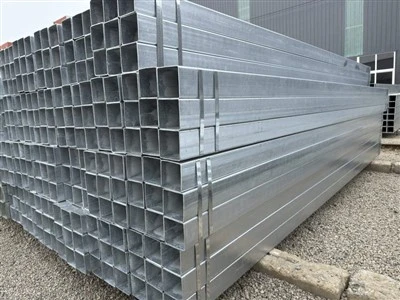
Tianjin Brisk Metalwork Co., Ltd. is one of the leading manufacturers and suppliers of s275 square hollow section for structural applications in China. We have world-leading production equipment and strong manufacturing capabilities. Please feel free to buy bulk durable s275 square hollow section for structural applications from our factory.


What Do We Supply?
| Parameter | Range We Run |
|---|---|
| Outside dimension | 20 x 20 mm to 500 x 500 mm |
| Wall thickness | 1.2 mm to 16 mm |
| Standard lengths | 6 m / 12 m (custom lengths on request) |
| Grade | S275JR / S275J0 / S275J2 |
| Process route | Cold-formed (EN 10219) or hot-finished (EN 10210) - buyer's choice |
| Finish | Black (mill), hot-dip galvanized, or primer-coated |
| Corner radius | Approx. 2 x wall thickness (cold-formed) |
Every batch ships with mill test certificates covering heat number, dimensional tolerance, and mechanical test results traceable to the coil or billet of origin. For projects requiring third-party inspection, we coordinate with SGS, BV, or TUV at the buyer's request.
Why Does a Square Profile Outperform a Rectangular One in Column and Brace Applications?
Every open section (I-beam, channel, angle) and every rectangular hollow section has a strong axis and a weak axis. A structural engineer has to specify orientation, and a fabricator on site has to install it correctly - get the rotation wrong by 90 degrees and the member's real buckling capacity can be a fraction of what the drawing assumed.
Square Hollow Section removes that failure mode entirely. Because the moment of inertia is identical about both the X and Y axes (Ix = Iy), an SHS column or brace has the same resistance to buckling and bending no matter which way it's rotated when it's welded or bolted into place. For:
- Columns carrying biaxial wind or seismic load
- Diagonal bracing members loaded from either side
- Space-frame and truss nodes where multiple members meet at odd angles
...this symmetry is not a marketing point, it's a real reduction in both design complexity and site installation risk. We regularly supply SHS specifically because a buyer's structural engineer flagged orientation-sensitivity as a QA concern on a prior rectangular-section job.
SHS also carries a meaningfully higher torsional stiffness per unit weight than an open I-section of comparable strength, because a closed section resists twist by shear flow around a continuous loop rather than by warping. For brackets, cantilevered canopy frames, or any member picking up eccentric or out-of-plane load, that torsional behavior is the practical reason SHS gets specified over W-shapes even when pure bending capacity would be similar.
Where Does S275 Specifically Fit, Versus S355?
S275 is the right grade when your design is governed by stiffness or serviceability, not by ultimate strength. Column buckling capacity, deflection limits, and connection geometry are frequently controlled by section size and wall thickness rather than by yield strength - which means paying for S355's extra ~80 N/mm2 of yield often buys nothing the design actually uses.
We see S275 SHS specified most often for:
- Mid-rise building columns and bracing where axial load is moderate and section size is already set by architectural/connection constraints
- Warehouse and industrial frame bracing where stiffness, not strength, governs member selection
- Secondary structural steelwork - mezzanine supports, platform legs, equipment frames
Where a project genuinely needs the extra yield margin - long unbraced column lengths, high seismic demand, or minimum-weight optimization - S355 is the better spend. We're happy to quote both so your engineer can compare on an equal-size basis.
How Do We Control Squareness and Straightness at This Grade?
Because SHS's structural advantage depends on true geometric symmetry, a section that's rolled out-of-square undermines the exact property the buyer is paying for. Our line runs:
- Continuous roll-forming with in-line laser gauging checking both face widths simultaneously, not just one face against a fixed reference
- Squareness verification at set intervals (deviation of diagonal-to-diagonal measurement, not just side-length tolerance)
- Straightness check over the full 6 m/12 m length, since camber compounds installation misalignment on multi-story column runs
- Weld seam ultrasonic testing on every coil-welded length before cutting to size
A Real Example: When Rectangular Wasn't the Right Substitution
A fabricator building a mezzanine platform frame had originally specified 150 x 100 x 6 mm RHS columns to match an earlier project's bill of materials. During shop drawing review, the structural engineer flagged that the platform's bracing pattern applied lateral load from both the X and Y direction roughly equally - a condition the original RHS choice hadn't been checked against on its weak axis. Re-running the calculation showed the RHS weak-axis buckling capacity was about 34% lower than the strong-axis value the fabricator had assumed applied uniformly.
Switching to 150 x 150 x 5 mm S275 SHS matched the strong-axis capacity of the original RHS spec while removing the orientation dependency - at a steel weight increase of only about 6% for the full column run (42 columns), avoiding both a re-design cycle and a site re-check of every column's installed rotation. The order shipped on the fabricator's original schedule.
FAQ
Q: Does wall thickness scale directly with load, or does section size matter more?
A: For a given axial or bending demand, increasing the outside dimension is almost always more material-efficient than increasing wall thickness alone, since moment of inertia grows with the cube of the dimension. We can help you compare two or three size/thickness combinations against the same target capacity before you commit to a size.
Q: Can we order S275 SHS and RHS together on one shipment?
A: Yes - mixed sizes and both cold-formed (EN 10219) and hot-finished (EN 10210) product can ship in the same container as long as total tonnage meets our minimum order requirement per size.
Q: What surface finish do you recommend for exposed exterior steelwork?
A: Hot-dip galvanizing to EN ISO 1461 for long-term exterior exposure; primer-coated black steel is more common for interior or subsequently fireproofed/painted structural steel where the coating is a site-applied finish system.
Q: Do you supply mill certificates for every individual length, or per heat/lot?
A: Certification is issued per heat/lot with full traceability; individual piece marking (heat number stenciled on each length) is available on request for projects requiring piece-level traceability.


Hot Tags: s275 square hollow section for structural applications, China s275 square hollow section for structural applications manufacturers, suppliers, factory