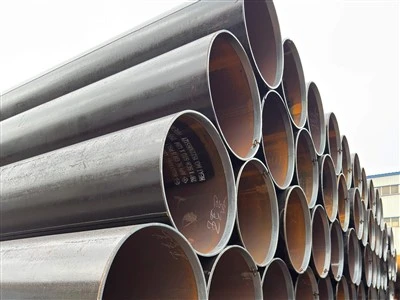
Tianjin Brisk Metalwork Co., Ltd. is one of the leading manufacturers and suppliers of painted structural steel tubing in China. We have world-leading production equipment and strong manufacturing capabilities. Please feel free to buy bulk durable painted structural steel tubing from our factory.
Tianjin Brisk Steel is one of the manufacturers of Painted Structural Steel Tubing in China. Our products are mainly exported to the Middle East, Southeast Asia, Europe, New Zealand, and other regions.If you would like to learn more about our products, feel free to contact us and send your purchase list.


Where Painted Tube Fits Versus Bare and Galvanized Tube
Structural steel tube typically ships in one of three finish conditions, and choosing the wrong one is one of the more common - and costly - specification mistakes on a project:
- Bare mill finish. No coating; relies entirely on subsequent field priming/painting or indoor, low-corrosion-risk use. Lowest cost, but offers no interim protection during transport, storage, or construction.
- Painted (primed and/or topcoated). A shop-applied coating system providing interim rust protection and, depending on the topcoat, a finished appearance. Suitable for indoor structural framing, furniture and equipment frames, and moderate-exposure outdoor use where the coating system is rated for it - but not a substitute for galvanizing in long-term, high-corrosion outdoor service.
- Hot-dip galvanized. A metallurgically bonded zinc coating providing decades of protection even in harsh outdoor exposure, at higher cost and with size/weight limits set by the galvanizing kettle.
Buyers sometimes specify "painted" tube expecting galvanizing-level durability, or specify costly galvanizing for an indoor application where a primed finish would perform perfectly well - confirming your actual exposure condition against the coating's intended service environment is the single most important step before ordering.
Standards and Base Tube Specifications
| Standard | Scope | Typical Use |
|---|---|---|
| ASTM A500 (Grade B/C) | Cold-formed welded structural tubing | General structural framing, fabrication |
| ASTM A1011/A1018 (coil basis) | Hot-rolled/cold-rolled sheet steel used in tube forming | Base material specification reference |
| SSPC-SP standards (SP2, SP3, SP6, SP10) | Surface preparation grades prior to coating | Governs surface cleanliness before primer application |
The painted finish itself isn't governed by a single universal standard - coating performance is typically specified by referencing the surface preparation grade (SSPC-SP series), the primer/paint system manufacturer's product data sheet, and a target dry film thickness (DFT), rather than a single tube-coating standard the way galvanizing references ASTM A123.
Coating System Options
| Coating Type | Typical Use | Notes |
|---|---|---|
| Rust-preventive oil/light shop primer | Indoor storage, short-term protection before field coating | Minimal protection; not a finish coat |
| Alkyd or epoxy primer | Indoor structural framing, equipment frames | Common baseline shop primer |
| Epoxy primer + polyurethane topcoat | Furniture, visible architectural tube, moderate outdoor exposure | Better UV and abrasion resistance than primer alone |
| Powder coating (polyester/epoxy-polyester) | Furniture, railings, retail fixtures | Durable, consistent finish; typically applied after fabrication |
Dry film thickness (DFT) is the key technical figure that determines coating performance - a primer specified at 25 microns will not perform the same as one at 75 microns even from the same product line, so DFT should always be confirmed as a numeric spec rather than left to "standard shop practice."
FAQ
Q: Is painted structural tubing as durable as hot-dip galvanized tubing outdoors?
A: No - painted coatings generally provide shorter-term protection than hot-dip galvanizing for sustained outdoor exposure. A well-specified epoxy/polyurethane system can perform well for years in moderate conditions, but for decades-long outdoor service, especially in coastal or industrial environments, hot-dip galvanizing remains the more durable option. The right choice depends on your project's actual service life requirement and exposure severity.
Q: What's the difference between primed tube and fully painted (topcoated) tube?
A: Primer alone is typically an interim rust-inhibiting coat meant to be overcoated later, either in the shop or in the field - it's not usually intended as a final exposed finish. A topcoated system (primer plus a polyurethane, alkyd, or powder-coat finish layer) is designed to be the final, exposed surface with added UV and abrasion resistance.
Q: Can painted structural tube be welded without removing the coating?
A: Welding directly through most primers and paints is not recommended - it can produce hazardous fumes and often compromises weld quality and coating adhesion near the joint. Best practice is to grind back the coating in the weld zone before welding, then touch up the coating afterward.
Q: How should painted tube be stored before installation to avoid coating damage?
A: Painted tube should be stored off the ground, bundled to prevent bundle-to-bundle abrasion, and protected from prolonged standing water or condensation trapped between stacked pieces - even a cured coating can be damaged by extended moisture contact at contact points before installation, so end-capping and dunnage spacing are worth confirming with your supplier for extended storage periods.


Hot Tags: painted structural steel tubing, China painted structural steel tubing manufacturers, suppliers, factory, EN10210 HOT FINISHED STRUCTURAL HOLLOW SECTIONS, furniture hollow section, hollow section palletizing, hollow section pipe, hollow section steel, RECTANGULAR HOLLOW SECTION