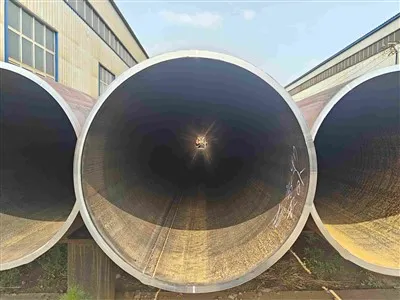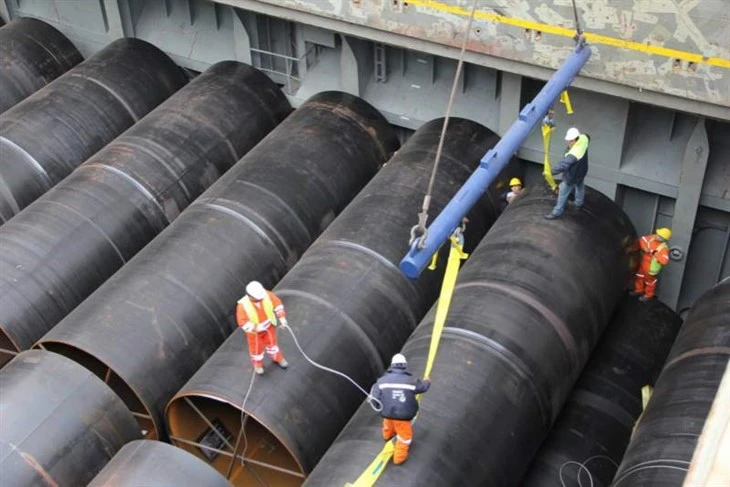
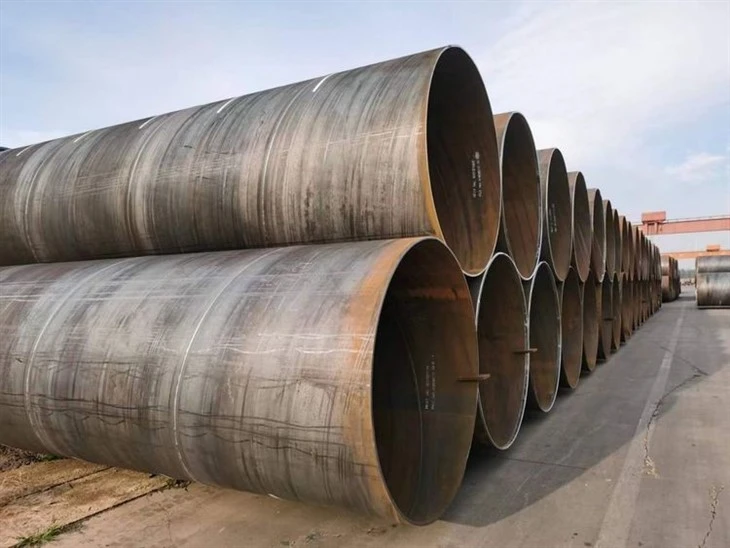
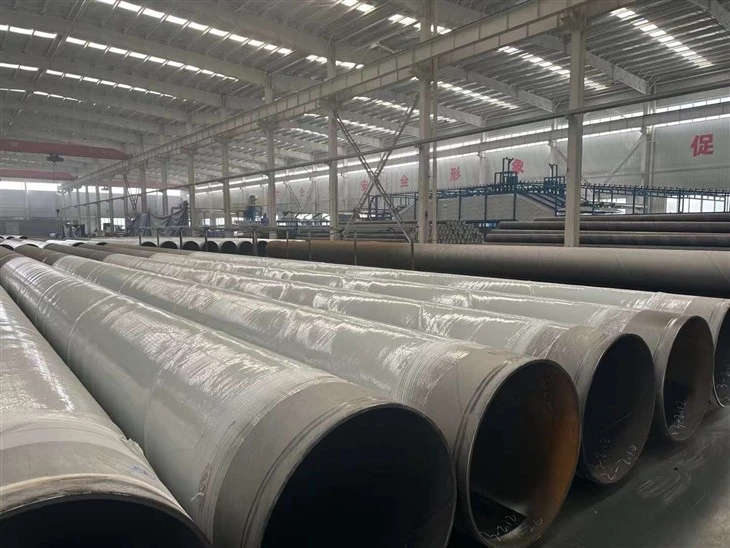
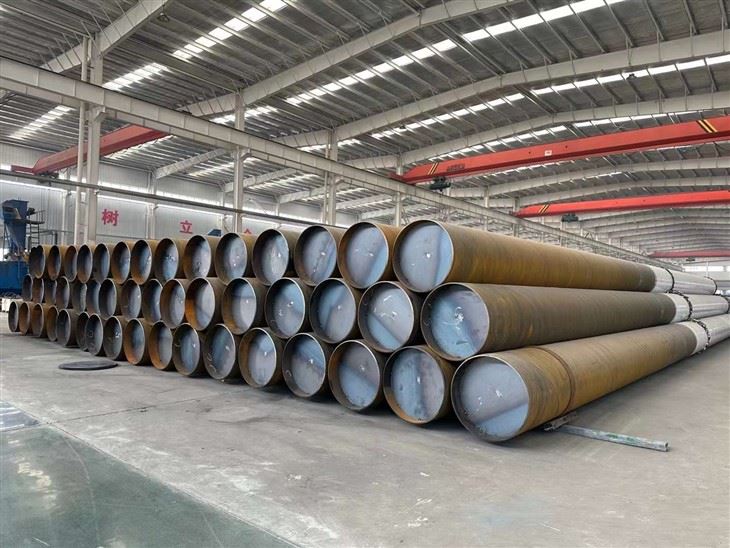
Tianjin Brisk Steel is one of theASTM A53 Gr.B Helical Weld Carbon Steel Pipe in China. Our products are mainly exported to the Middle East, Southeast Asia, Europe, New Zealand, and other regions.If you would like to learn more about our products, feel free to contact us and send your purchase list.


Quick Spec Table
| Property | Typical Range |
|---|---|
| Weld process | Helical / spiral submerged arc welding (SSAW / SAWH) |
| Grade | ASTM A53 Grade B chemistry and mechanical properties |
| Outside diameter | Roughly 219 mm – 2540 mm (8" – 100"), mill-dependent |
| Wall thickness | 6 mm – 25.4 mm typical |
| Length | 6 m – 18 m, single or double random |
| Yield strength (Gr. B) | 240 MPa minimum |
| Tensile strength (Gr. B) | 415 MPa minimum |
| Finish | Black, oiled, or hot-dip galvanized |
| Companion standards on same product line | API 5L (for pipeline service), ASTM A252 (for piling) |
A Point Worth Clarifying Up Front
ASTM A53 as written defines three manufacturing types - Type F (furnace-butt-weld), Type E (electric-resistance-weld), and Type S (seamless) - and doesn't explicitly name helical/spiral welding as a fourth type. In practice, though, this combination is genuinely common and accepted across the industry in a specific way: mills producing large-diameter helical-seam pipe frequently manufacture and test it to meet A53 Grade B's chemical composition and mechanical property requirements, issuing certification against those requirements even though the weld process itself sits outside A53's formal type list.
This is different from stamping a plate mismatch onto a product - it's closer to using A53 Grade B as the accepted chemistry/strength reference point for a large-diameter product that A53's own scope doesn't reach on size (A53 caps at NPS 26" / 660 mm; helical-seam pipe routinely runs well past that). The practical result is a product that behaves like A53 Grade B in terms of material properties, produced by a process A53 doesn't size for. Reputable suppliers are explicit about this distinction on the mill certificate; less careful ones blur it. Knowing the difference protects you either way.
Where This Product Sits Among the Three Large-Diameter Specs
Helical-seam pipe certified to A53 Grade B isn't the only spec option on an SSAW line - it's one of three common paths, and picking the right one depends on service:
ASTM A53 Grade B (general purpose) - the default reference when the application is structural, mechanical, or general fluid conveyance (non-critical water, air, low-pressure steam) and doesn't require the pipeline-grade documentation of API 5L or the pile-specific mechanical testing of A252. This is the "good general-purpose steel pipe, properly certified" option.
API 5L (pipeline transmission) - the correct spec once the pipe is actually carrying oil or gas under transmission-line pressure. API 5L's PSL1/PSL2 testing regime and grade ladder (A, B, X42 through X70) are built specifically for pipeline integrity requirements that A53 doesn't test for.
ASTM A252 (piling) - the correct spec for foundation and structural piling, where the governing requirement is column strength and driveability rather than pressure containment. A252's grades (1, 2, 3) are defined by minimum yield and tensile strength rather than pipeline service categories.
A single SSAW mill line can produce pipe to any of these three specs at the same diameter and wall thickness - what changes is the testing regime, documentation, and certification, not necessarily the physical pipe. Ordering by the correct spec name matters because it determines what gets tested and what the mill certificate can legally claim.
How Helical Weld Differs From Straight-Seam A53 Pipe in Practice
Forming geometry. Helical (spiral) welding forms the tube by winding a steel strip at an angle and welding the continuous helical seam, versus straight-seam processes that weld a single longitudinal joint. This lets mills produce large-diameter pipe from strip narrower than the finished pipe's circumference - the reason SSAW dominates large-diameter, cost-sensitive production.
Weld length and inspection scope. A helical seam is considerably longer per unit of pipe length than a straight seam, which means more total weld to inspect. Reputable SSAW mills run continuous automated ultrasonic testing along the spiral seam during production rather than spot-checking, precisely because the seam length makes sampling less representative than it would be on a short straight seam.
Roundness and out-of-roundness tolerance. The spiral-forming process tends to produce very consistent roundness compared to some straight-seam large-diameter processes, which is part of why SSAW is often preferred for large-diameter water and low-pressure gas mains even outside pure cost considerations.
Length flexibility. Helical-seam pipe can be produced in longer continuous lengths than straight-seam large-diameter pipe, since the coil-fed spiral process doesn't have the same plate-length constraint that JCOE-formed LSAW pipe does.
FAQ
Q: Does ASTM A53 officially cover helical/spiral welded pipe?
A: A53's formal type list covers furnace-butt-weld, electric-resistance-weld, and seamless - it doesn't explicitly define helical welding as a fourth type. In practice, large-diameter helical-seam pipe is widely manufactured and certified to A53 Grade B's chemistry and mechanical property requirements as an accepted industry convention, even though the weld process itself falls outside the standard's formal type definitions.
Q: What's the difference between A53 Grade A and Grade B for helical weld pipe?
A: Grade B has higher minimum yield and tensile strength (240 MPa / 415 MPa) than Grade A, and is the more commonly specified grade for large-diameter helical pipe used in structural or higher-stress general applications. Grade A is more common where cold bending or coiling is required.
Q: Should I use A53 Gr.B or API 5L for a water transmission pipeline?
A: For genuine transmission-line service under significant pressure, API 5L is the correct spec - it includes pipeline-specific testing (PSL1/PSL2) that A53 doesn't perform. A53 Grade B is more appropriate for lower-pressure or non-critical water conveyance where full pipeline certification isn't required.
Q: Can A53 Grade B helical weld pipe be used for piling?
A: It can be used structurally, but if the application is specifically foundation or structural piling, ASTM A252 is the standard actually written for that use, with grade definitions and testing aimed at pile driving and column strength. Specify A252 by name if piling is the intended use.


Hot Tags: astm a53 gr.b helical weld carbon steel pipe, China astm a53 gr.b helical weld carbon steel pipe manufacturers, suppliers, factory, chemical industry steel pipe, flanged lsaw pipe, spiral lsaw pipe, spiral steel pipe, steel pipe for underground, steel pipe with jointed structure