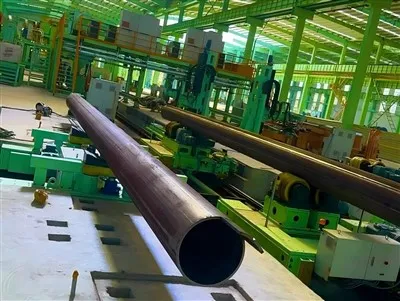
Tianjin Brisk Steel is one of the manufacturers of LSAW Pipe for Hydropower Pressure Pipeline in China. Our products are mainly exported to the Middle East, Southeast Asia, Europe, New Zealand, and other regions.If you would like to learn more about our products, feel free to contact us and send your purchase list.


Product Overview
Engineered for the demanding conditions of hydroelectric power generation, this LSAW (longitudinal submerged arc welded) steel pipe serves as penstock and pressure conduit for conveying water from reservoirs or forebays down to turbine units. Formed via JCO/UOE process and welded internally and externally by submerged arc welding, the pipe withstands substantial hydrostatic head, water hammer effects, and dynamic loading typical of high-head hydropower installations, while maintaining structural stability across varied terrain and elevation changes.
Key Features
- High Head Pressure Capacity: Engineered wall thickness and steel grade combinations allow the pipe to sustain significant hydrostatic pressure generated by high-elevation reservoirs and penstock drops.
- Fatigue and Impact Resistance: Steel with good toughness properties resists cyclic stress from water hammer surges and turbine load fluctuations without premature fatigue cracking.
- Weld Seam Reliability: Full-thickness penetration welding, verified through radiographic and ultrasonic testing, ensures the seam withstands sustained internal pressure over decades of operation.
- Terrain Adaptability: Pipe sections can be fabricated with bends, reducers, and branch fittings to follow steep mountainside routing common in hydropower penstock layouts.
- External Protection Options: Anti-corrosion coatings and cathodic protection compatibility support buried or exposed installation across mountainous and humid environments.
Technical Specifications
| Item | Specification |
|---|---|
| Outer Diameter | 500mm – 4000mm (project-specific) |
| Wall Thickness | 8mm – 60mm |
| Length | Per project design (standard or custom segments) |
| Applicable Standards | EN 10224, project-specific hydropower codes |
| Design Pressure | Determined by head height and safety factor per project |
| Fittings | Bends, tees, reducers, manifolds fabricated to layout drawings |
Application Scenarios
This pipe type is commonly specified for:
- Penstock pipelines connecting reservoirs to powerhouse turbines
- Pressure shaft lining for underground hydropower tunnels
- Surge tank connecting pipework
- Diversion and pressure pipeline segments in run-of-river hydropower schemes
- Pumped-storage hydropower pressure conduits
Why Choose This Pipe
Hydropower penstock failure carries severe safety and financial consequences, making weld quality and material traceability non-negotiable. Each pipe segment undergoes rigorous hydrostatic testing and non-destructive examination, with mill certificates documenting steel chemistry and mechanical performance - supporting engineering firms and hydropower project owners in meeting strict dam safety and pressure vessel design requirements.
FAQ
Q: What's the maximum head (water pressure) this pipe can withstand?
A: Maximum allowable pressure depends on the combination of diameter, wall thickness, and steel grade selected. For high-head projects (500m+), thicker walls and higher-strength steel grades (Q345 and above) are typically specified. Our engineering team can recommend the appropriate wall thickness based on your project's head height and safety factor requirements.
Q:Can this pipe handle water hammer surge pressure during sudden turbine shutdown?
A: Yes, when designed with appropriate wall thickness and steel toughness properties, the pipe can accommodate transient pressure spikes from water hammer effects. Surge pressure calculations should be incorporated into the design phase alongside normal operating pressure to determine final specifications.
Q:How are pipe sections joined on-site for long penstock runs?
A: Sections are typically joined by field welding (butt welding with beveled ends) or, in some designs, flanged connections at access points. Field weld joints are inspected using the same NDT standards (UT/RT) applied during factory production to maintain seam integrity along the full penstock length.
Q: What surface protection is recommended for exposed (above-ground) penstock sections?
A:For above-ground sections exposed to weather, epoxy or polyurethane paint systems are commonly applied externally, while buried sections typically use 3PE or FBE coating with cathodic protection. Coating selection depends on site environmental conditions and project specification.


Hot Tags: lsaw pipe for hydropower pressure pipeline, China lsaw pipe for hydropower pressure pipeline manufacturers, suppliers, factory