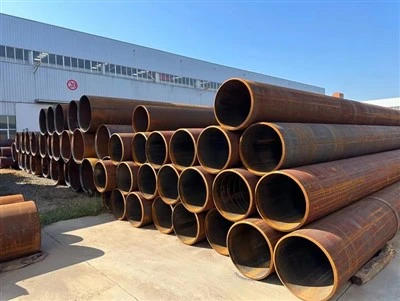
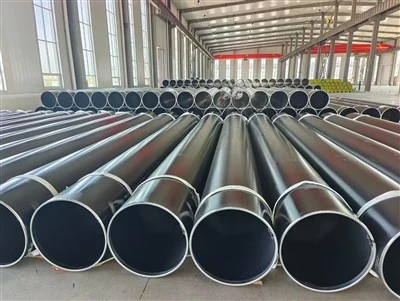
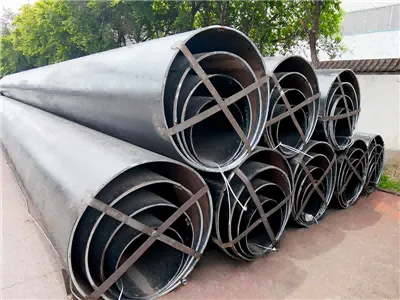
Tianjin Brisk Steel is one of the manufacturers of Cold Formed LSAW Pipe in China. Our products are mainly exported to the Middle East, Southeast Asia, Europe, New Zealand, and other regions.If you would like to learn more about our products, feel free to contact us and send your purchase list.
PRODUCT
Tianjin Brisk Steel focus on produce and supply hollow section and steel pipe


Core Manufacturing Process (Cold Forming Line)
JCOE (Most common cold-forming process)
- Incoming steel plate flaw detection → Edge milling (beveling)
- Step-by-step cold forming: J-pressing → C-pressing → O-forming (mechanical pressing at ambient temperature throughout; no heating)
- Pre-tack welding for positioning → Double-sided submerged arc welding (DSAW) (internal and external)
- Cold expansion: Core cold-working process to eliminate residual forming stresses and ensure roundness and dimensional accuracy
- Weld seam UT/RT inspection, hydrostatic testing, beveling, and anti-corrosion coating
UOE (Cold-forming process for large-diameter, high-volume production)
- Steel plate undergoes U-pressing followed by O-forming; subsequent welding and cold expansion processes are identical to JCOE
- Key distinction: Differs from hot-rolled coiled pipe and hot-rolled seamless pipe; LSAW relies entirely on cold forming at ambient temperature, hence the designation "Cold Formed"
LSAW JCOE Production Process

LSAW UOE Production Process

International Standards Implemented
Oil and Gas Pipelines
- API 5L PSL1 / PSL2 (ISO 3183): X42, X52, X60, X65, X70, X80
Pressure Vessels / Pressure Piping
- ASTM A671, ASTM A672, ASTM A252 (for Piling)
Steel Structure Engineering
- EN 10217, EN 10210, GB/T 9711
European Standard Structural Materials
- S275JRH, S355J2H, P265GH, P355NL
Key Performance Advantages
- Controllable cold-forming stresses: The cold expansion process relieves forming stresses, resulting in minimal tolerances for roundness and straightness.
- The premier choice for thick-walled, large-diameter applications: Formed from a single medium-to-heavy plate, offering superior suitability for high-pressure, thick-walled service compared to ERW (High-Frequency Welded) pipe.
- Double-sided submerged arc welding (DSAW) ensures deep weld penetration and high toughness; PSL2-grade compliance meets requirements for extreme cold and sour oil/gas environments.
- Utilizes full-plate base material without steel strip overlaps, ensuring material uniformity and excellent fatigue and seismic resistance.
- Compatible with 3LPE, FBE, and coal tar epoxy anti-corrosion coatings; suitable for long-distance onshore and subsea pipelines.
FAQ
Q: What is the main structural benefit of choosing a cold-formed LSAW pipe over a hot-extruded seamless pipe for large diameters?
A: While seamless pipes excel in small-to-medium diameters, producing large-diameter (>16") heavy-wall seamless pipes is extremely costly and constrained by mill size limits. Cold-formed LSAW pipes bridge this gap efficiently. By cold-forming heavy steel plates, LSAW achieves ultra-large diameters (up to 60" or more) and thick walls at a significantly lower cost while providing uniform wall thickness that is often superior to large seamless extrusions.
Q: How does the "Mechanical Expansion" ratio affect the physical properties of a cold-formed LSAW pipe?
A: Mechanical expansion typically expands the pipe circumference by 0.6% to 1.5%. This controlled cold work slightly elevates the minimum yield strength of the steel matrix through strain hardening. More importantly, it normalizes residual stress gradients created during plate bending and longitudinal welding, ensuring the pipe stays perfectly round and dimensionally stable during secondary cutting or field welding.
Q: What non-destructive testing (NDT) matrix is standard for cold-formed LSAW pipes intended for critical infrastructure?
A: To guarantee 100% defect-free seam integrity, our production lines apply a comprehensive NDT matrix. Following cold expansion and hydrostatic testing, 100% of the longitudinal seam undergoes continuous automated Ultrasonic Testing (UT). Additionally, the pipe ends and repair zones are verified using High-Definition Radiographic Testing (RT/X-ray), and the beveled faces are checked via Magnetic Particle Inspection (MPI).
Q: Can cold-formed LSAW pipes be used for low-temperature or subsea applications without risking brittle fracture?
A: Yes, absolutely. By using TMCP micro-alloyed steel plates with fine-grain structures, our cold-formed LSAW pipes can be certified for low-temperature impact toughness. They routinely pass Charpy V-notch impact tests at -20C to -50C (absorbing 27 Joules to 40 Joules), making them fully compliant with offshore wind foundations, subsea pipelines, and arctic structural designs.


Hot Tags: cold formed lsaw pipe, China cold formed lsaw pipe manufacturers, suppliers, factory, austenitic stainless steel lsaw pipe, austenitic stainless steel pipe, coupled steel pipe, low maintenance lsaw pipe, safe steel pipe, socket welded steel pipe