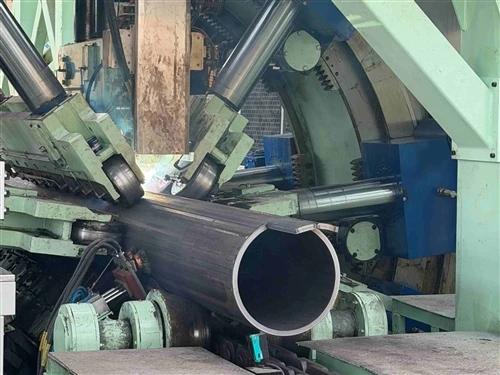
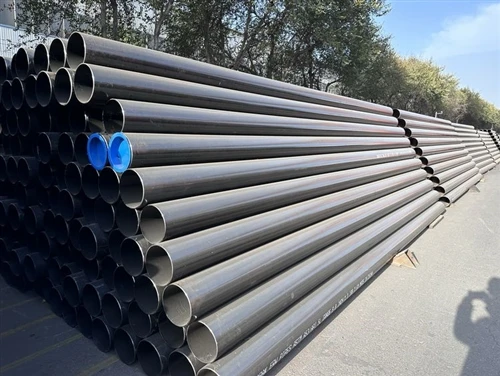
Pipelines are the backbone of oil, gas and bulk-liquid transport, and welded steel pipe is the product that makes most of them possible. This guide explains why pipeline transport is so cost-effective, where welded pipe beats seamless, how the main welding processes differ, and how to specify and buy the right pipe for your project.
Why Do Pipelines Outperform Rail and Road for Oil, Gas and Bulk Media?
Pipeline transport is a continuous, automated system rather than a series of trips. That gives it three structural advantages:
- Lower infrastructure investment. For the same annual capacity, a pipeline generally needs less capital than a railway line, because it needs no rolling stock, no marshalling yards and a narrow construction corridor.
- Simple and fast to build. Most lines are buried, so they are protected from weather and third-party interference, run reliably year-round, and can be routed across plains, hills, deserts and wetlands. Construction is largely repetitive: weld, inspect, coat, lower, backfill.
- Lower operating cost. Pumping and compressor stations are monitored remotely through SCADA systems, so labor per tonne-kilometer is small. Overall cost per tonne-kilometer is normally lower than rail and road, and higher only than long-distance ocean shipping.
The range of media keeps widening. Crude oil, natural gas and refined products are the core cargo, but liquid chemical feedstocks, water, and even solids in slurry form (ore concentrate, coal slurry) are now moved through pipelines. Commonly cited figures put the pipeline share of onshore crude oil and natural gas transport at 85-90 percent in some major markets, though the share varies widely by country and should be treated as approximate.
What Is Driving the Shift to Large-Diameter, High-Pressure Line Pipe?
Throughput rises steeply with diameter. For a given pressure drop, flow capacity increases roughly with diameter to the power of 2.5, so a wider pipe carries far more than the extra steel would suggest. Higher operating pressure raises capacity further and reduces the number of compressor stations. Both trends push pipe specifications towards larger outside diameters, higher-strength grades (X65, X70, X80) and tighter toughness control, and both favor welded pipe, because that is where the large-diameter capacity sits.
Why Choose Welded Pipe Over Seamless Pipe?
| Factor | Welded pipe | Seamless pipe |
|---|---|---|
| Production route | Strip or plate is formed and welded | Solid billet is pierced and rolled |
| Equipment | Lighter, fewer stages, easy to automate | Heavy piercing and rolling mills |
| Continuous, high-volume output | Excellent | Limited by mill cycle |
| Cost in common sizes | Usually lower | Usually higher |
| Diameter coverage | Roughly 10 mm to over 3,000 mm | Usually limited to about 660 mm |
| Wall thickness (mass production) | About 0.5 to 35 mm; heavier walls from specialist lines | Wide range, strong in thick-wall small bore |
| Wall uniformity | Very consistent, because it starts from rolled strip | Can show eccentricity |
In simple terms, welded pipe wins on cost, size range and consistency, while seamless keeps a place in small-diameter, thick-wall, high-pressure or high-temperature service where a specification demands it. Modern welded pipe is fully accepted in demanding standards such as API 5L PSL2, including sour and offshore service when the additional requirements are specified.
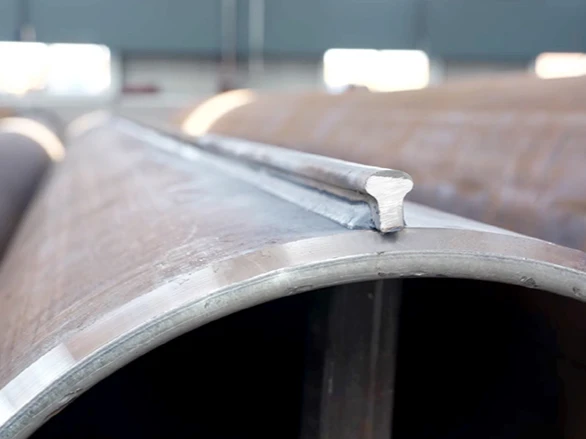
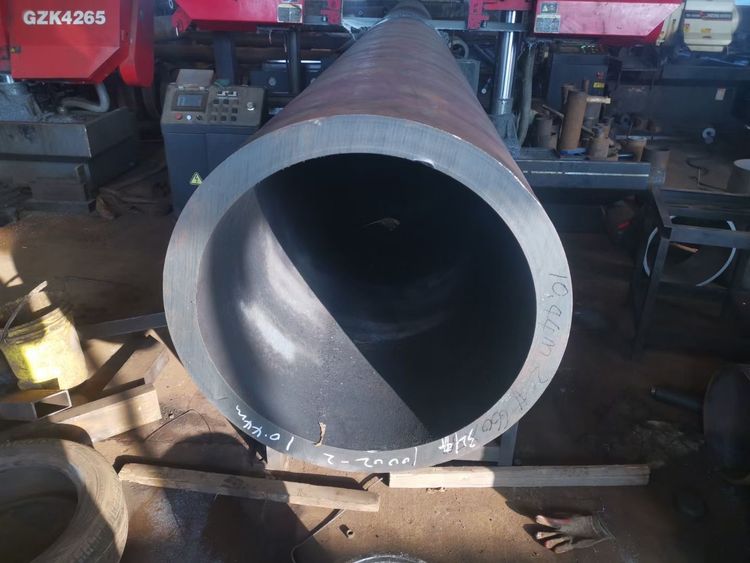
How Is Welded Steel Pipe Classified by Manufacturing Process?
Forming and welding are the two core operations, so the process families are defined by how the seam is made. The main welding methods are furnace welding and electric welding. Gas welding and atomic-hydrogen welding are now rarely or never used for pipe production.
| Process family | Seam type | Typical size (approx.) | Typical use |
|---|---|---|---|
| Furnace welding (continuous butt weld) | Forge-welded butt seam | Up to about 114 mm (4 in) OD | Low-pressure water, gas, structural and scaffold tube |
| Furnace welding (lap weld) | Forge-welded lap seam | Historic; largely displaced | Legacy low-pressure lines |
| Electric resistance welding, ERW/HFW | Resistance-welded, no filler | About 10 to 660 mm OD | Line pipe, casing, tube, structural sections |
| Induction welding | Induction-heated, no filler | Similar to HFW | Line pipe and tube |
| Submerged arc welding, LSAW | One longitudinal seam | About 400 to 1,600 mm OD | High-pressure oil and gas trunk lines |
| Submerged arc welding, SSAW/HSAW | Helical seam | About 200 to over 3,000 mm OD | Water, slurry, low to medium pressure lines, piling |
| Gas metal arc, TIG | Arc weld with filler or autogenous | Thin wall, small to medium | Stainless and specialty tube |
Furnace Welding: Simple, Economical, Small Diameter
In furnace welding, heated strip (skelp) is formed into a tube and its edges are forge-welded together without filler metal. In the continuous butt-weld process, skelp heated in a furnace to roughly 1,300 degC is drawn through forming and welding rolls, so the edges are pressed together into a butt seam. Drawing-type lines (chain-furnace and continuous-furnace machines) and continuous roll-forming lines are the two main equipment types. Lap welding overlaps the edges before they are welded between a roll and a mandrel. Furnace-welded pipe is economical and suits low-pressure conveyance, such as water, air, low-pressure gas and general structural use (ASTM A53 Type F is a familiar example).
Electric Welding: ERW, HFW and Induction
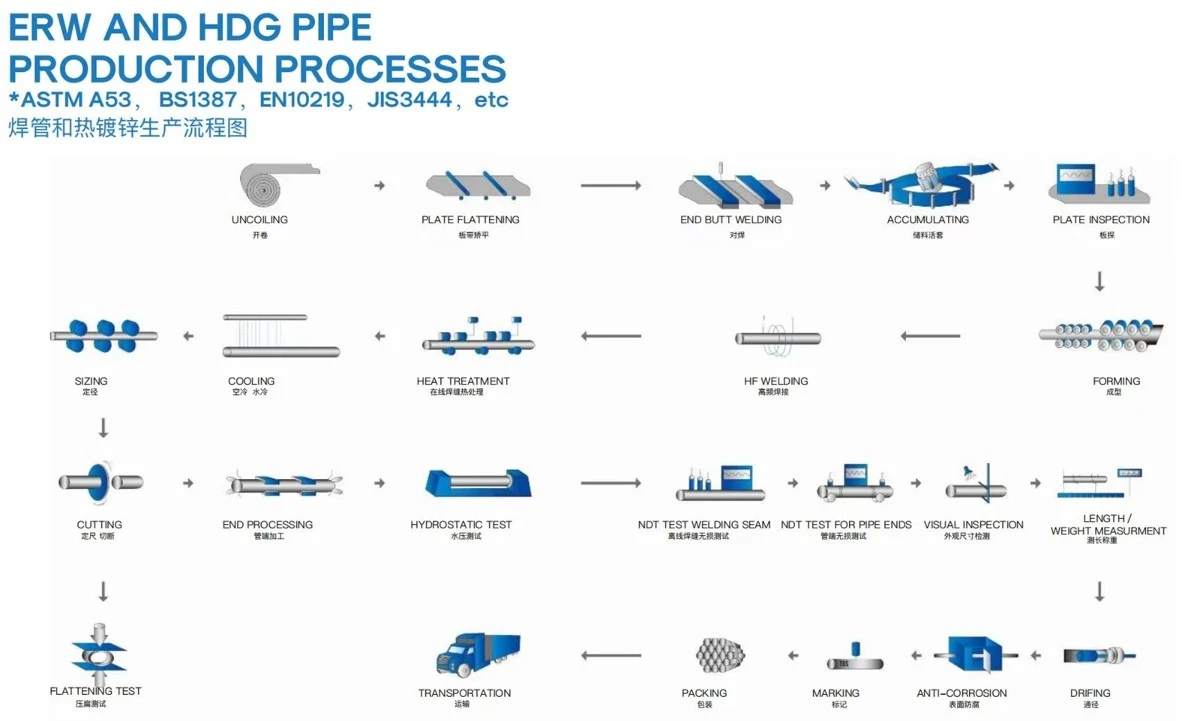
Electric resistance welding (ERW) heats the strip edges by passing current through them, then squeezes the edges together. Low-frequency ERW is largely obsolete for line pipe because of seam defects, while high-frequency welding (HFW) dominates modern practice. HFW can use contact electrodes or an induction coil, so induction welding is a variant of the same principle. Advantages of HFW include no filler metal, high speed, an automatic and continuous line, and in-line seam heat treatment and non-destructive testing. HFW is the workhorse for line pipe up to about 24 inches (610 mm) and beyond at some mills.
Arc Welding: SAW, Gas-Shielded and Open Arc
Submerged arc welding (SAW) is the leading method for large-diameter pipe. A wire electrode burns under a blanket of granular flux, which stabilizes the arc and shields the weld pool. SAW pipe comes in two forms:
- LSAW (longitudinal SAW): plate is formed into a cylinder by the UOE, JCOE or bending-press process, then welded inside and outside along a straight seam. Wall thickness of 50 mm or more is possible. It is the usual choice for high-pressure gas trunk lines.
- SSAW/HSAW (spiral or helical SAW): coil is wound helically and welded along a spiral seam. One coil width can make many pipe diameters, so very large sizes are economical. It is widely used for water, slurry, low to medium pressure oil and gas lines, and piling.
Gas-shielded arc welding (GMAW/MAG, and TIG for stainless and thin-wall tube) produces clean, high-quality seams for specialty pipe. Open-arc welding, which does not use a flux blanket or shielding gas, has largely been replaced by shielded methods for pipe production.
Gas Welding and Atomic-Hydrogen Welding: Historical Only
Oxy-acetylene and water-gas welding of pipe seams belong to earlier production eras. Atomic-hydrogen arc welding, because of its low productivity, has been eliminated from commercial pipe manufacture. If a quotation offers pipe made by one of these methods, ask the supplier to confirm the actual process and standard.
Which Welded Pipe Type Suits Which Application?
| Application | Common choice | Reason |
|---|---|---|
| Water, air, low-pressure gas, small bore | Furnace-welded or ERW | Lowest cost |
| Oil and gas gathering lines, mid-size (up to about 24 in) | HFW/ERW | Good quality, high output |
| High-pressure gas trunk lines | LSAW | Heavy wall, high grade, controlled toughness |
| Large water transmission, slurry, low to medium pressure | SSAW | Very large diameters at competitive cost |
| Piling and structural use | SSAW, HFW, or LSAW | Strength and size flexibility |
| Stainless process piping | TIG or gas-shielded arc | Clean weld, corrosion resistance |
How Do You Buy Welded Steel Pipe Correctly? An 8-Step Checklist
- Define the service. List the medium, design pressure, temperature, and any H2S, CO2 or chloride content. Service conditions decide the standard, grade and testing.
- Select the standard and grade. Common choices are API 5L / ISO 3183 for line pipe (PSL1 or PSL2, grades from B to X80), ASTM A53 for general low-pressure use, ASTM A252 for piles, and EN 10217 / EN 10208 in European projects. Sour service needs PSL2 with the sour-service annex, and offshore lines need the offshore annex.
- Size the pipe. Work out outside diameter and wall thickness from your hydraulic and pressure design, applying the design factor in the code you follow (B31.4, B31.8 or a local equivalent).
- Choose the process. Use the table above. For high-pressure gas trunk lines confirm the owner's specification before accepting SSAW.
- Specify testing. Ask for hydrostatic test, weld-seam non-destructive testing (ultrasonic or radiographic), tensile, Charpy impact, and, for gas lines, drop-weight tear testing where required. Ask for EN 10204 3.1 certificates, or 3.2 with third-party witness for critical work.
- Specify coating and ends. State the external coating (3LPE, 3LPP, FBE), internal lining if required, bevel angle and root face, and the length range.
- Qualify the manufacturer. Check the API 5L license where the project requires it, quality management certification, coil or plate source, traceability by heat number, and inspection capability.
- Compare total cost. Include coating, freight, packing, inspection and welding productivity, not only the price per tonne.
Three mistakes that raise cost. First, buying by price per tonne without checking that the wall thickness meets the nominal. Second, accepting a certificate without confirming that the tests were done on the finished pipe. Third, choosing a process that does not match the code requirement, which forces re-approval late in the project.
Getting an Accurate Quotation
To receive a fast, accurate quotation for welded steel pipe, send us the following:
- Standard and grade (for example API 5L PSL2 X65)
- Outside diameter, wall thickness and length range
- Process preference or service conditions (medium, pressure, temperature)
- Coating, end finish and certificate type
- Quantity, delivery schedule and destination port
Related : LSAW Pipe