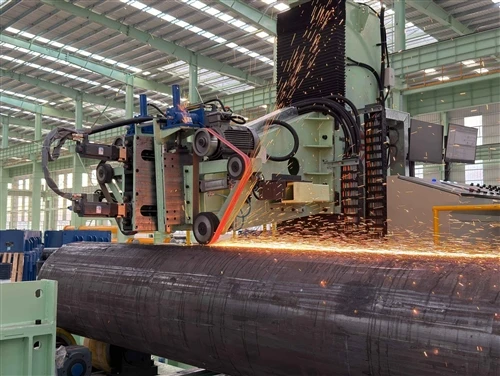
Anyone sourcing structural steel for an overseas project has run into this designation family: S355JR, S355J0, S355J2. Because all three share the "S355" prefix, two opposite but equally wrong assumptions tend to follow. One is that the suffix is cosmetic and any of the three can be substituted freely. The other is that J2 is simply "the better version," so specifying it everywhere removes any risk of getting the grade wrong. Neither holds up once you look at what the suffix actually certifies.
One small but important note before going further: the correct designation is S355J0, with a numeral zero as the final character - not the letter "O." It's a detail that gets typed incorrectly often enough on purchase orders and shop drawings that it's worth flagging on its own.
What the JR, J0, and J2 Suffixes Actually Certify
Under the European structural steel system, an S355 designation breaks down into three components. S denotes structural steel. 355 is the minimum yield strength, in MPa, guaranteed within a specified thickness range. The suffix - JR, J0, or J2 - is where the three grades actually diverge, and it has nothing to do with strength. It specifies the impact toughness class: the minimum energy the material must absorb in a Charpy V-notch test, verified at a defined test temperature.
| Grade | Minimum absorbed energy | Test temperature |
|---|---|---|
| S355JR | 27 J | +20°C |
| S355J0 | 27 J | 0°C |
| S355J2 | 27 J | -20°C |
Read plainly: JR confirms adequate toughness at room temperature, J0 confirms it still holds at 0°C, and J2 confirms it still holds at -20°C. In terms of guaranteed low-temperature performance, the ranking runs J2 above J0 above JR. But that ranking is specifically about verified toughness at colder temperatures - it does not mean every project needs J2, and it does not mean J2 can be substituted for a specified JR or J0 grade without the engineer's written sign-off, even though it looks like an upgrade on paper.
Same Yield Strength, Very Different Failure Behavior
Under normal loading, structural steel is expected to yield and deform visibly before it fails - that ductile behavior is what most structural design assumes and relies on. But under certain conditions - low temperature, thick sections, welding defects, stress concentrations, and dynamic or impact loading - steel can instead fail by brittle fracture, a failure mode with a very different signature: little or no visible deformation beforehand, a sudden onset, rapid crack propagation once initiated, and - critically - a nominal stress that may still be below the material's yield strength when it happens. This is precisely why brittle fracture is dangerous: the usual warning signs of impending failure aren't present.
The Charpy V-notch test exists to screen for this risk. A notched sample is struck and fractured at a controlled temperature, and the energy the material absorbs during that fracture is measured. What separates S355J2 from S355JR isn't higher load-bearing capacity - it's documented proof that the steel still absorbs adequate energy, and therefore still resists brittle fracture, at a temperature 40°C colder than what JR is verified against.

(As shown in the impact-energy-versus-temperature chart above, each grade's curve sits roughly 20°C to the left of the previous one - the same underlying material behavior, verified at progressively colder crossing points.)
Is S355J2 Always "Stronger" Than S355JR?
The honest answer depends on which property you're asking about.
On yield strength, all three grades sit in the same S355 family and, within a given product type and thickness range, carry essentially the same minimum yield strength. But there's a detail buyers frequently miss regardless of which suffix they're ordering: S355 is not a flat 355 MPa across every thickness. The guaranteed minimum yield strength decreases as plate thickness increases under the governing product standard. This matters most for heavy base plates, thick gusset plates, and rolled heavy sections - the actual thickness in hand needs to be checked against the standard's table, not assumed from the "355" in the name.
On low-temperature toughness, J2 genuinely does outperform JR - it's verified colder, and is generally the more suitable choice for cold climates, thick sections, and demanding welded connections. But S355J2 only certifies performance down to -20°C under the specified test conditions. It is not a blanket guarantee for any temperature below that, and treating a -20°C rating as if it covers -35°C service is its own kind of misapplication.
Choosing the Right Grade for an Overseas Project
Selection should follow the actual service conditions, not a single variable like "how cold does it get there."
For stable indoor environments with light, simply loaded members and thinner sections, some project specifications do permit S355JR. For general outdoor structures, the choice between J0 and J2 typically follows the site's minimum design temperature together with the connection details involved. For genuinely cold-climate projects, J2 is usually the starting point - while keeping in mind its -20°C limit is a defined boundary, not an open-ended cold-weather guarantee.
Where it gets more nuanced is thick plates and critical connections. Even on a project in a warm climate, factors like heavy section thickness, tension members, heavily loaded crane girders, long-span trusses, highly restrained welded joints, and fatigue or dynamic loading can each independently justify a higher toughness class - regardless of how mild the regional climate is. "It's hot here, so JR everywhere is fine" is exactly as unreliable a shortcut as "always specify J2 to be safe."

(The decision map above reflects this: the climate-based branch is the starting point, but the override condition at the bottom applies regardless of which branch a project starts on.)
Where Procurement and Design Review Most Often Go Wrong
Reading only "S355" and skipping the suffix. JR, J0, and J2 sit at similar strength levels but represent genuinely different verified test temperatures - treating them as interchangeable because the leading number matches is the single most common misread on this designation family.
Confirming the grade but not the plate thickness. A thin plate satisfying the required yield strength doesn't guarantee a thick plate of the same grade satisfies the same number - thicker sections carry a lower guaranteed minimum yield under the governing standard, and this needs checking against the actual thickness ordered, not assumed from the nominal grade.
Overlooking delivery condition. Common delivery conditions include +AR (as-rolled), +N (normalized or normalized-rolled), and +M (thermomechanically rolled). The same grade supplied under different delivery conditions can behave differently in welding and in toughness - this is a separate variable from the JR/J0/J2 suffix and needs its own confirmation on the order.
Treating a measured test result as a certified upgrade. If a specific batch of S355JR happens to test well at -20°C, that single result does not make it S355J2. An overseas technical reviewer or third-party inspector is checking the governing standard, the qualified test conditions, and full material traceability - not one favorable number pulled from a mill's internal record.
Assuming a higher grade can be freely substituted. Even when J2 genuinely offers better low-temperature performance than what's specified, substituting it in without the engineer's or client's written approval bypasses the design and procurement review process the project actually relies on.
What to Confirm on the Mill Test Certificate
Because the suffix is the whole point of this designation family, the mill test certificate needs to actually document it - not just state a grade that implies it. A usable certificate for overseas project approval should show: the specific product standard and edition the material was tested against; the actual delivery condition (+AR, +N, or +M) rather than leaving it blank or assumed; the thickness-specific yield and tensile results tied to the exact plate or section thickness supplied, not a generic grade value; and the Charpy V-notch result reported at the qualified test temperature for the ordered suffix, with the actual absorbed energy value shown rather than a simple pass/fail note. Heat number traceability back to that specific certificate matters as well, particularly on projects where a third-party inspector will cross-check documentation against physical markings on the delivered plate. A certificate that states "S355J2" without showing the -20°C test result and the actual energy absorbed is not equivalent, from a review standpoint, to one that shows the full record - even if the material itself is genuinely compliant.
The Practical Takeaway
The real difference between S355JR, S355J0, and S355J2 comes down to one sentence: broadly similar yield strength, but a different guaranteed temperature at which the material's resistance to brittle fracture has actually been verified. JR suits milder, less demanding conditions; J0 confirms performance down to 0°C; J2 confirms it down to -20°C - and none of that changes because a country happens to have a hot climate on average.
Selecting the right grade for an overseas project means weighing the minimum design temperature together with plate thickness, stress state, connection and welding details, and whether dynamic or fatigue loading is present - not defaulting to whichever grade sounds safest. Genuinely professional material selection isn't about reflexively specifying the highest available class; it's about finding the grade that satisfies safety and approval requirements while keeping procurement and cost within reason.