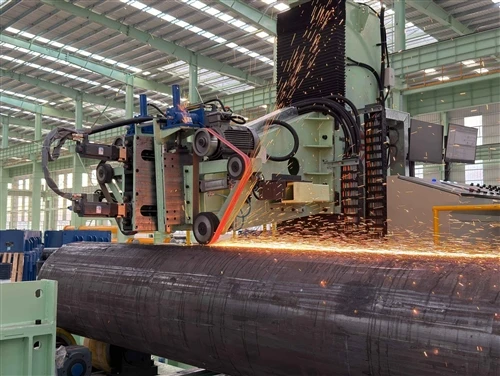
Straight seam welded pipe is one of the most widely used steel tubular products in the world. It carries water under city streets, gas through distribution networks and oil across continents, and it forms the columns, frames and supports of buildings, bridges and machines. Yet the name describes only the geometry of the weld. Two very different production routes sit behind it, and they serve different sizes, wall thicknesses and duties. This guide explains what the term means, how each route works, what the pipe is good at, where it is used, and which technical points decide whether a pipe suits your project.
What Is Straight Seam Welded Pipe?
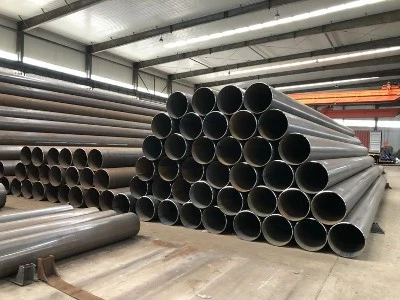
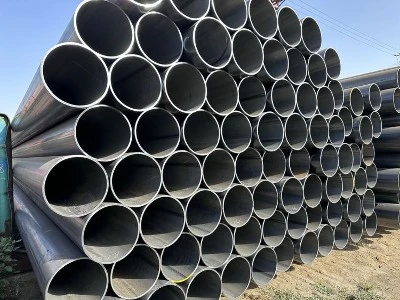
Straight seam welded pipe is steel pipe whose weld runs parallel to the pipe axis. It is made from flat steel, either hot-rolled coil (strip) or plate, which is formed into a cylinder and joined along a single longitudinal seam. Hot-rolled and cold-rolled steel can both be used as feedstock, depending on the wall thickness and the surface finish required.
This is different from spiral (helical) welded pipe, where the seam winds around the pipe like a screw thread, and different from seamless pipe, which has no weld at all. Because the seam is straight, the pipe diameter is set by the width of the plate or the forming tools rather than by the width of a coil, which allows one coil or plate width to be turned into a single, well-defined size.
One practical point is worth stating early. "Straight seam" is a description, not a specification. It does not tell a mill which tests to run, which steel to use or which tolerances apply. Those requirements come from a product standard such as API 5L, ASTM A53, EN 10217, EN 10219, GB/T 3091 or AWWA C200, and they are covered in the buying guide below.
Straight seam welded pipe is produced by two main families of process:
- High-frequency welded pipe (ERW or HFW). Strip is formed into a tube and its edges are joined by high-frequency electric current and pressure, with no filler metal.
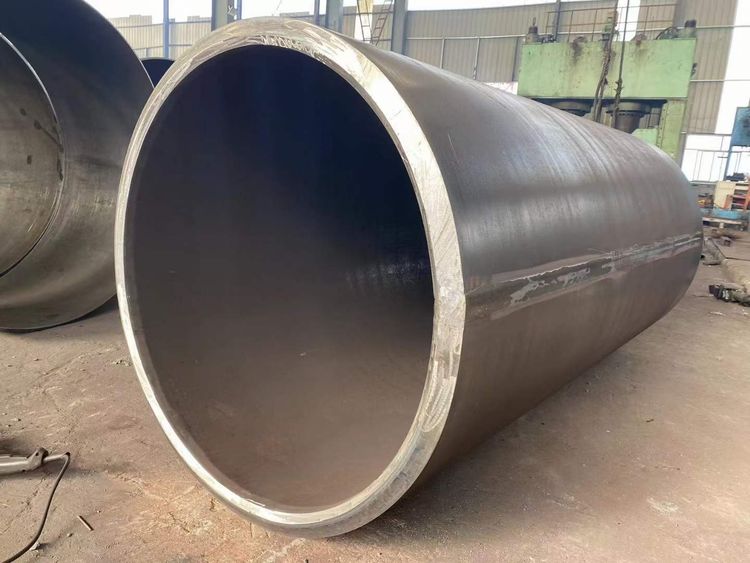
- Longitudinal submerged arc welded pipe (LSAW, also written SAWL). Plate is formed into a cylinder and welded on the inside and outside by submerged arc welding with filler wire and flux. Large-diameter LSAW pipe is most often formed by the JCO process, sometimes called JCOE when the final cold expansion step is included.
How Is Straight Seam Welded Pipe Made?
The ERW / HFW Route
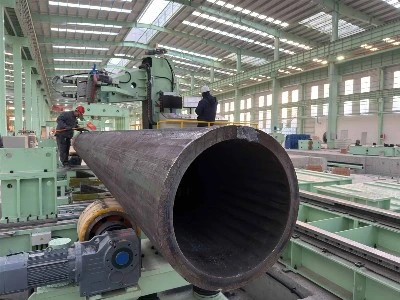
ERW production is a continuous line, and it is the reason this pipe is economical in large volumes.
- Uncoiling and slitting. A hot-rolled coil is unwound, leveled and slit to the width that matches the pipe's circumference. Edge condition at this stage matters, because the edges become the weld.
- Forming. A series of rolls bends the strip progressively into an open round tube.
- High-frequency welding. Current concentrated at the two strip edges heats them to welding temperature, and squeeze rolls forge them together. No filler metal is added, which keeps the weld narrow.
- Scarfing. Cutters remove the flash pushed out on the outside and inside of the weld.
- Seam heat treatment. The weld zone is heat treated, usually by induction, to refine its structure and temper the hard, fast-cooled material.
- Sizing and straightening. Sizing rolls bring the pipe to final diameter and roundness.
- Testing and cutting. The seam is tested for its full length by ultrasonic or eddy current methods, then the pipe is cut to length, finished at the ends and hydrostatically tested where the standard or order calls for it.
ERW lines can also reshape a round tube into square and rectangular hollow sections, which is why the same process feeds both pipe and structural tube markets.


The LSAW Route with JCO Forming
LSAW is a plate-based, batch process built for large diameters and heavy walls.
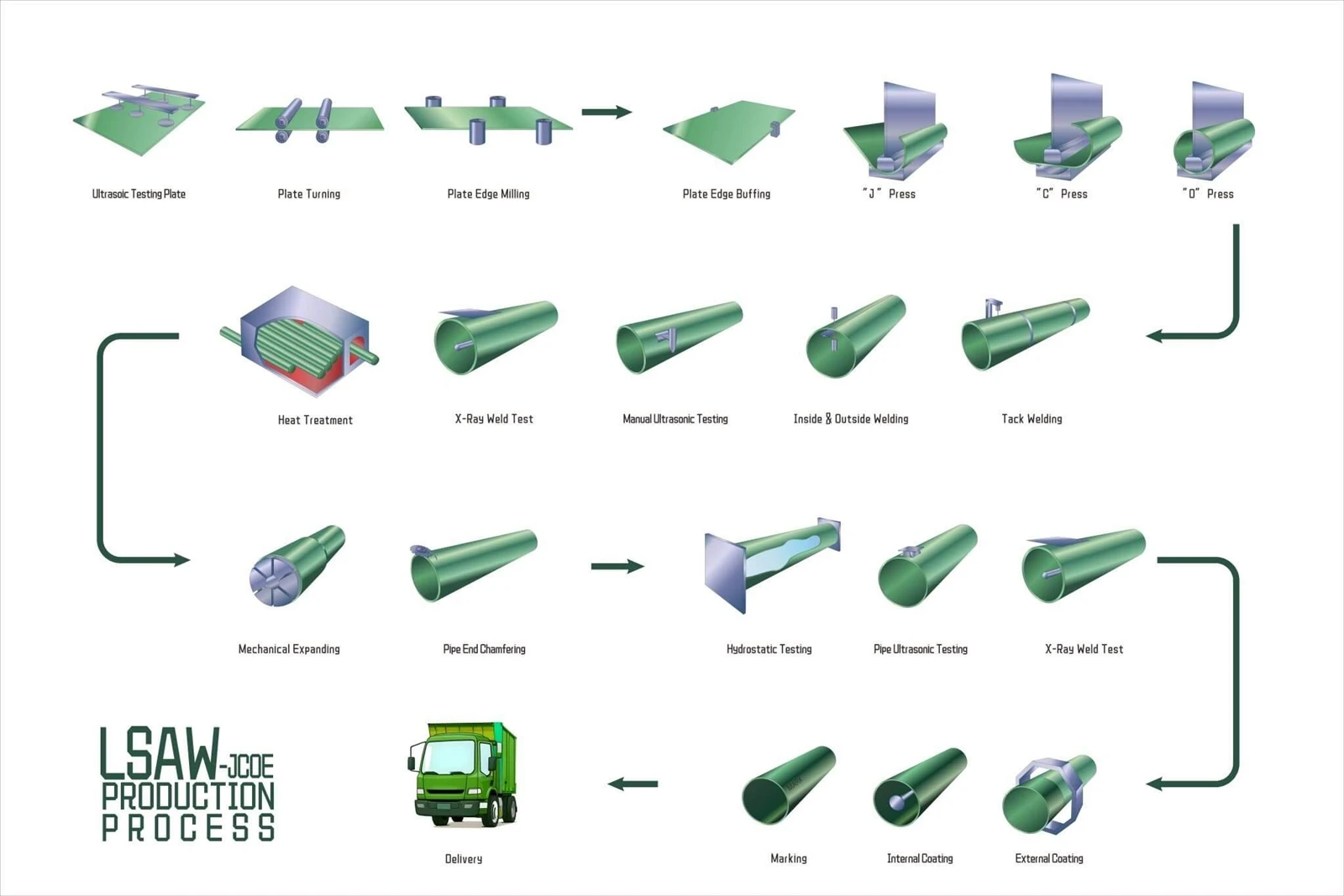
- Plate inspection and edge milling. Plate is tested ultrasonically, then milled to exact width with machined weld bevels.
- Edge crimping and JCO forming. The plate edges are pre-bent, then a press forms the plate in stages into a J, a C and finally an O shape.
- Seam closing. A continuous tack weld closes the seam so that it stays aligned during final welding.
- Inside and outside submerged arc welding. One weld pass is made from the inside and one from the outside, overlapping in the middle of the wall. This gives full penetration in thick plate.
- Weld testing. The weld seam is inspected by ultrasonic and radiographic methods.
- Cold expansion. The pipe is expanded by roughly one percent, which improves roundness, sets the final diameter and reduces residual stress.
- Hydrostatic test, end finishing and coating. Each pipe is pressure tested, ends are faced and beveled, and coating or lining is applied when specified.
Key Characteristics of Straight Seam Welded Pipe
Uniform wall and good dimensional accuracy. Strip and plate are rolled to tight thickness tolerances before the pipe is formed, so the wall of the finished pipe is consistent around the circumference and along its length. This is a real advantage over some seamless processes, where wall eccentricity can occur.
Efficient and economical production. The ERW line runs continuously, and LSAW uses plate that is widely available in many grades and thicknesses. Compared with seamless pipe of the same size, welded pipe usually offers lower cost and shorter lead times, particularly in larger diameters.
Wide size and grade flexibility. Diameter and wall can be tuned to the job, from small tubes for building services to large-diameter line pipe. Steel grades range from plain carbon steel to high-strength micro-alloyed grades.
A defined weld zone that is controlled by testing. The seam is the part of a welded pipe that needs the most attention, so standards require seam inspection and, for ERW, seam heat treatment in many grades. A pipe made and tested to the right standard performs reliably.
Natural limits. ERW wall thickness and diameter have practical ceilings, and very thick walls or very large diameters are LSAW territory. Straight seam pipe is also not the first choice for the highest-pressure, high-temperature service where seamless pipe is specified.
| Feature | ERW / HFW | LSAW (JCO) |
|---|---|---|
| Feedstock | Hot-rolled strip (coil) | Steel plate |
| Approximate OD range | About 21 to 610 mm | About 406 mm and above |
| Approximate wall range | Thin to medium, commonly up to about 20 mm | Medium to very thick, to 50 mm and beyond |
| Welding method | High-frequency resistance, no filler | Submerged arc, inside and outside, with filler |
| Seam testing | Ultrasonic or eddy current, full length | Ultrasonic and radiographic |
| Typical standards | ASTM A53, API 5L, EN 10217, EN 10219, GB/T 3091, GB/T 13793 | API 5L, AWWA C200, EN 10219, ASTM A252 |
| Typical use | Distribution lines, building services, structural tube | Trunk lines, water transmission, large piles |
Size and wall limits are approximate and vary by mill and by standard.
Where Is Straight Seam Welded Pipe Used?
- Municipal water supply and drainage. Small and medium ERW pipe serves distribution mains and building water services. Large LSAW pipe, often built to AWWA C200, carries bulk water transmission.
- Low-pressure fluid, gas and air transport. ERW pipe made to ASTM A53, GB/T 3091 or EN 10217 carries water, air, steam condensate and low-pressure gas in industrial plants and buildings.
- Oil and gas lines. ERW pipe to API 5L is used for gathering and distribution lines, while large-diameter LSAW pipe is chosen for trunk lines where diameter and wall are high.
- Heating and building services. Heating circuits, fire-protection piping and HVAC systems use ERW pipe, often galvanized.
- Building and bridge structures. Columns, bracing, roof trusses, bridge supports and temporary works use round pipe directly. Square and rectangular hollow sections made on ERW lines serve the same market.
- Machinery, agricultural and electrical uses. Equipment frames, greenhouse structures, conveyor supports and cable conduits use straight seam pipe because it is easy to cut, bend and weld.
- Piling and foundations. Large LSAW pipe, often built to ASTM A252, is driven as piles for ports, bridges and offshore structures.
| Service | Usual straight seam product | Common specification |
|---|---|---|
| Water and drainage mains | ERW (small and medium), LSAW (large) | ASTM A53 |
| Gas distribution | ERW | API 5L |
| Oil and gas trunk lines | LSAW | API 5L |
| Building and bridge structure | ERW, LSAW | EN 10219, ASTM A500 |
| Machinery and agriculture | ERW | EN 10217 |
How Do You Specify Straight Seam Welded Pipe? A Professional Buying Guide
Technical misunderstandings, not price, cause most problems with welded pipe orders. These are the points that standards and applications actually turn on.
Name the standard and grade, not only the shape. An order that says "straight seam pipe, 20 inch" leaves chemistry, strength, testing and tolerances open. A designation such as API 5L Grade B PSL1 or EN 10217-1 P235TR1 fixes them. Standards also differ in what they test, so two pipes with the same size can have different requirements.
Choose the process route by diameter and wall first. ERW normally runs up to about 610 mm OD and moderate wall. Above that, or where the wall is thick, LSAW is the practical route. Between about 400 and 610 mm both exist, and the decision depends on wall, grade and pressure.
Check how the standard treats the weld seam. Seam test coverage differs. ERW pipe is tested over the full seam length by ultrasonic or eddy current methods, and some standards require the ERW weld zone to be heat treated. For LSAW, standards call for ultrasonic testing of the weld, with radiography of the pipe ends. In gas service or at low temperatures, check whether impact testing of the weld and body is required, as in API 5L PSL2. This matters most in pressure service, because hoop stress acts directly across a longitudinal seam.
Design with minimum wall, not nominal wall. Standards allow wall thickness to vary. ASTM A53, for example, permits wall thickness as much as 12.5 percent under nominal. A calculation that uses nominal wall overstates capacity, so apply the standard's permitted tolerance in your design.
Understand what the mill hydrostatic test means. The mill test pressure is a proof test calculated by the standard from wall thickness, diameter and a stated percentage of specified minimum yield strength, with a minimum hold time. It is not the same as the maximum operating pressure. Your design code sets operating pressure, so confirm the test pressure and hold time meet that code.
Ask for ductility tests when the pipe will be formed. Pipe that will be cold bent, flared, flattened or expanded needs adequate seam ductility. Many standards include flattening or bend tests for this reason. If your fabrication involves tight bends or end forming, confirm that the standard requires the test and specify bend capability.
Match the end finish to the joining method. Plain ends suit mechanical couplings and sleeves. Beveled ends are needed for butt welding, and the bevel angle and root face should be stated. Grooved joints need close outside diameter and roundness control. Threaded ends apply to small bores. Stating this in the order avoids rework at site.
Select coating and lining for the environment. Buried pipe needs external protection, commonly 3-layer polyethylene or fusion-bonded epoxy. Potable water pipe often needs an internal lining or cement mortar that meets drinking-water approvals. Galvanized pipe suits fencing, scaffolding and building services, but galvanizing affects welding, so weld joints need a plan for repair.
Define length requirements precisely. "Random length" is defined differently across standards, so a range such as 6 to 12 meters, a fixed length or a double-random length should be written into the order, along with the length tolerance.
Summary
Straight seam welded pipe is a large family, not a single product. ERW pipe brings continuous production and economy to small and medium sizes, while LSAW pipe brings full-thickness submerged arc welding and cold expansion to large diameters and heavy walls. Both rely on a controlled, tested weld seam. The way to buy well is to specify the standard and grade, pick the route by size and wall, read how the standard handles seam testing, wall tolerance and hydrostatic testing, and match end finish and coating to how the pipe will be joined and where it will live.