Surface preparation rarely gets the attention it deserves in steel pipe procurement conversations, yet it's arguably the single largest determinant of whether a coating system lasts the pipeline's design life or fails within a few years. This piece looks specifically at abrasive blasting - the mechanical process that gets a pipe surface ready for FBE, 3PE, or any other coating system to actually bond.


Why Surface Preparation Determines Coating Performance
A coating doesn't adhere to steel through simple contact - it bonds mechanically and chemically to whatever surface condition it's applied over. Mill scale, rust, oil residue, and even fine dust between the steel and the coating layer act as a barrier that prevents proper adhesion.
Independent studies across the coatings industry consistently attribute the majority of premature coating failures to inadequate surface preparation rather than to the coating material itself. A premium FBE or 3PE system applied over an improperly blasted surface will underperform a mid-grade coating applied over a correctly prepared one - the surface prep step sets the ceiling on everything that follows it.
This is why surface preparation specifications exist as their own contractual line item, separate from the coating specification. A pipe order can meet every chemical and mechanical requirement in its steel standard and still fail in service if the blasting step before coating was rushed or under-specified.
The Sandblasting Process
Abrasive blasting works on a straightforward physical principle: propelling hard particulate media at high velocity against the steel surface to mechanically remove mill scale, rust, and old coating residue, while simultaneously roughening the bare steel to create a surface profile the new coating can key into.
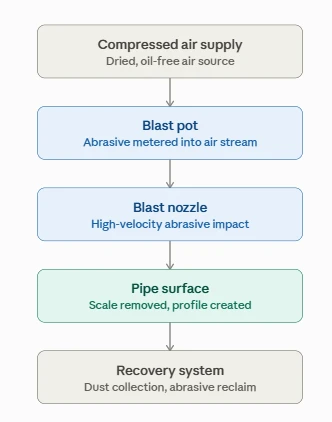
Compressed, oil-free air drives the abrasive through the nozzle at velocities typically in the range of 60–110 m/s. On modern pipe production lines, this isn't a manual operation with an operator walking the pipe - most mills run pipe through an enclosed, rotating wheelabrator-type chamber where multiple blast wheels or nozzles fire continuously as the pipe passes through, giving a consistent 360-degree result rather than the variability of hand-held blasting.
Abrasive Media Types and Selection
Not all abrasive is interchangeable, and the choice affects both the cleaning result and the surface profile left behind:
- Steel grit - angular particles that cut aggressively and produce a sharp, angular surface profile; favored where maximum mechanical anchor for the coating is the priority
- Steel shot - rounded particles that clean effectively but leave a smoother, more rounded profile; often blended with grit to balance cleaning speed against profile sharpness
- Copper slag and coal slag - single-use mineral abrasives, common where recycling steel media isn't practical; generally produce a lower, less angular profile than steel media
- Garnet - a harder, low-dust mineral abrasive used where profile consistency and low free silica content matter, including in enclosed environmental-sensitive settings
- Aluminum oxide - a fine, hard abrasive used for lighter cleaning tasks or where a finer surface finish is required rather than an aggressive profile
Steel grit and shot dominate industrial pipe coating lines because the media is magnetically recoverable and reusable, which keeps large-scale operations economical - mineral abrasives are typically reserved for field touch-up work or facilities without a recovery system.
Surface Cleanliness Standards
Cleanliness is graded, not binary - a pipe can be "blasted" and still fail to meet the grade a coating specification actually requires.
The equivalent SSPC designations (SP7, SP6, SP10, SP5 respectively) describe the same four tiers under the North American standard system. Most pipeline coating specifications for FBE or 3PE call for Sa2.5 as the baseline requirement, with Sa3 reserved for high-performance or highly corrosive service environments where any residual staining is unacceptable. Specifying "sandblasted" without naming a grade leaves the actual cleanliness result to the blasting operator's judgment rather than a verifiable standard.
Surface Profile: The Anchor Pattern
Cleanliness and profile are two separate outcomes of the same process, and both matter independently. Surface profile refers to the peak-to-valley roughness the blasting leaves behind - typically measured in micrometers or mils - which gives the coating a mechanical key to grip rather than a smooth surface it can only adhere to chemically.
Too shallow a profile starves the coating of mechanical anchorage, leading to disbondment under stress or thermal cycling. Too deep a profile leaves peaks that can puncture through a thin coating film, creating holidays (pinholes) at the exact points meant to protect the steel. Coating manufacturers publish a target profile range for each product - commonly 50–100 micrometers for FBE systems - and the blasting parameters (abrasive type, size, air pressure, dwell time) are tuned to hit that range rather than simply blasting until the surface looks clean.
Equipment Systems: Manual, Cabinet, and Automated Pipe Lines
- Open (portable) blasting - hand-held nozzle work, used for field touch-up, repairs, and small-batch or irregular-shaped items; result quality depends heavily on operator technique and consistency
- Blast room/cabinet systems - an enclosed chamber where operators blast parts with contained dust and full abrasive recovery; used for batch processing of fittings, flanges, and shorter pipe sections
- Automated wheelabrator pipe lines - pipe passes continuously through a chamber with multiple centrifugal blast wheels arranged to cover the full circumference; this is the standard method for coating-line pretreatment because it delivers uniform coverage and profile at production speed, with abrasive continuously recovered, screened, and recirculated
Mill-applied FBE and 3PE coating lines are built around this automated approach specifically because manual blasting introduces surface variability that a continuous coating process can't tolerate at scale.
Quality Control and Inspection
Verifying blast quality isn't a visual judgment call at a properly run facility - it relies on measurable checks:
- Visual comparators - standard photographic references (per ISO 8501-1 or SSPC-VIS) used to compare the blasted surface against the specified cleanliness grade under proper lighting
- Surface profile gauges - a needle-type profilometer or replica tape method measures the peak-to-valley height against the coating manufacturer's target range
- Dust and contamination testing - a pressure-sensitive tape lift test or air-blow check confirms residual dust levels are within the coating's application tolerance
- Soluble salt testing - conductivity meters or patch test kits detect surface chloride contamination, which can cause coating blistering (osmotic blistering) even on a visually clean, correctly profiled surface
Skipping the salt contamination check is a common gap - a surface can pass a visual cleanliness inspection and a profile check while still carrying enough soluble chloride to cause premature coating failure months into service.
Common Defects and How They Occur
- Flash rust - surface oxidation that begins within hours of blasting in humid conditions, before the coating is applied; the delay between blasting and coating is a critical process window, not a scheduling convenience
- Under-blasting - insufficient dwell time or worn abrasive leaves scale or rust remnants, most often at pipe ends or weld seams where blast coverage is geometrically harder to achieve
- Over-blasting - excessive profile depth from oversized abrasive or excessive pressure, risking coating puncture at peak points
- Embedded abrasive - media fragments lodged in the steel surface, typically from abrasive that has broken down excessively through repeated recycling without adequate screening
- Inconsistent profile across the pipe body - uneven wheel wear or misaligned nozzles on an automated line producing a profile gradient rather than a uniform result
Matching Blast Preparation to the Coating System
Different coating systems specify different blast requirements, and treating "blast to Sa2.5" as a universal answer misses the point that each coating has its own optimum:
- FBE coatings generally require Sa2.5 minimum with a tightly controlled 50–100 micrometer profile, since FBE relies heavily on mechanical anchorage for adhesion
- 3PE systems require a similar cleanliness grade but often specify a slightly coarser profile to help the adhesive layer key into the steel beneath the polyethylene topcoat
- Galvanizing does not typically use abrasive blasting as its primary preparation - pickling in acid is the standard route - though blasting can be used ahead of duplex systems combining galvanizing with a top coat
Buyers specifying a coating system without confirming the blast requirement that goes with it are leaving a critical variable to the applicator's default practice rather than a verified spec.
Safety and Environmental Considerations
Abrasive blasting generates significant airborne dust and, depending on the abrasive type, can produce respirable crystalline silica exposure risks for operators. Enclosed automated systems with dust collection are favored not only for surface quality consistency but because they contain this exposure far more effectively than open blasting. Spent abrasive and collected dust also require proper disposal or recycling, particularly when the removed material includes old coating residues or heavy metal-containing paints from repair and maintenance work rather than new pipe production. Facilities operating under recognized environmental and occupational safety management systems typically document abrasive recovery rates and dust emission controls as part of their standard operating procedure, not as a one-off compliance exercise.
Blast-to-Coat Time Window and Rework Economics
The interval between blasting and coating is a specification detail in its own right, not just a scheduling preference. In humid or coastal conditions, freshly blasted steel can begin showing visible flash rust within two to four hours; in dry conditions, that window can extend to a full shift or more. Coating specifications typically define a maximum allowable delay, and exceeding it means the surface no longer meets the cleanliness grade it was blasted to - even though nothing was done to it in the meantime.
This is the practical reason mill-applied coating lines are built as a continuous sequence rather than as separate operations: pipe moves from the blast chamber directly into the coating station within minutes, eliminating the flash rust window almost entirely. Field-applied coatings and repair work don't have this luxury, which is why field crews are trained to coat within a tightly controlled window after blasting, sometimes re-verifying cleanliness grade immediately before application rather than relying on the original blast inspection.
When the window is missed, the only correct fix is re-blasting, not simply wiping the surface down or accepting light surface oxidation as cosmetic. Re-blasting consumes abrasive, adds cycle time, and on a production line delays the whole batch behind it - which is why realistic scheduling between the blast station and the coating station is treated as a process control parameter on well-run lines, not an afterthought filled in after the fact.
Surface preparation looks like a preliminary step on a project timeline, but in practice it's the variable that determines whether every dollar spent on the coating system afterward actually pays off in service life.