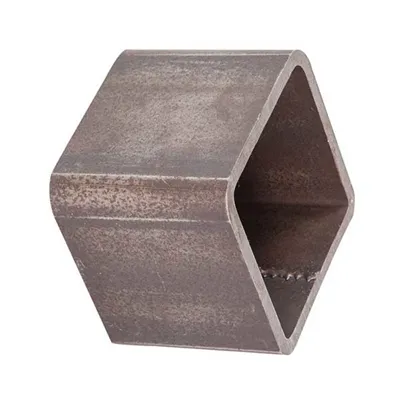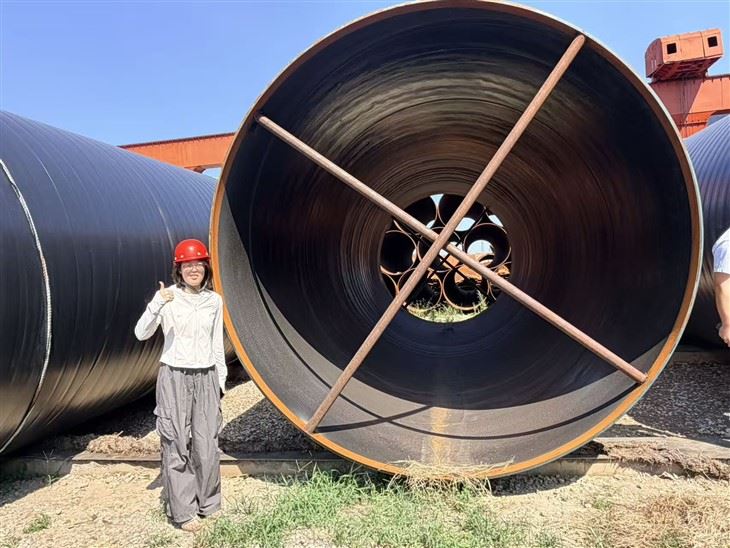
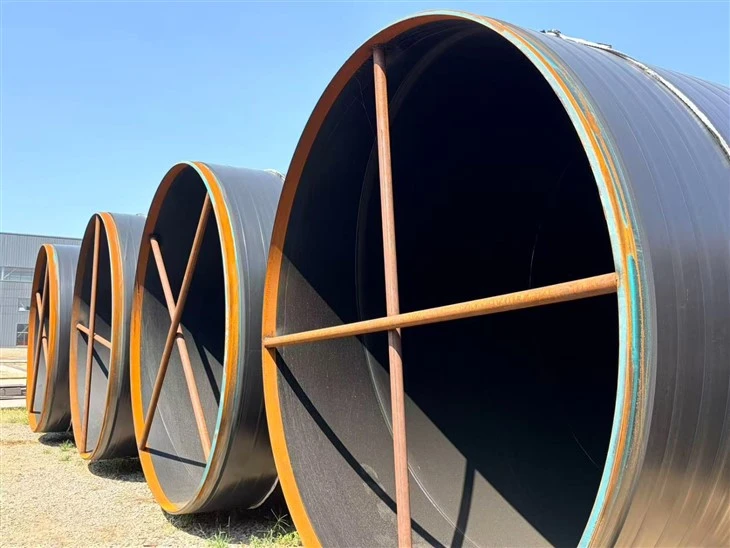
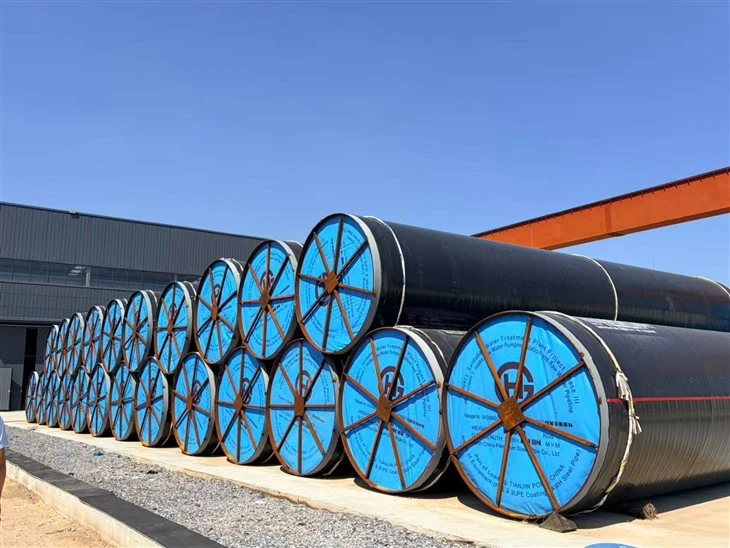
Tianjin Brisk Steel is one of the Large‑diameter SSAW Steel Pipe in China. Our products are mainly exported to the Middle East, Southeast Asia, Europe, New Zealand, and other regions.If you would like to learn more about our products, feel free to contact us and send your purchase list.


Where diameter starts changing the sourcing conversation
| Diameter band | What typically changes |
|---|---|
| Up to ~24" (610 mm) | Standard SSAW or ERW/LSAW alternative; standard container shipping, standard test bed |
| 24"-48" (610-1,220 mm) | SSAW becomes the more coil-efficient route; still fits most mills' standard hydrotest bed and container/flat-rack shipping |
| 48"-80" (1,220-2,032 mm) | Nesting inside a shipping container is usually no longer possible; breakbulk or flat-rack freight becomes standard; confirm the mill's test bed rating covers the length and pressure you need |
| Above 80" (2,032 mm) | Oversize-load road permitting is common for inland transport; some mills switch from full-length hydrostatic testing to code-permitted alternative verification at this scale - confirm which method applies before ordering |
Hydrostatic test bed capacity is a real differentiator between suppliers
The core of SSAW production is simple geometry: a coil of a fixed width can be wound into a wide range of pipe diameters just by changing the angle at which it spirals into the forming head - a steeper angle produces a smaller diameter from the same coil, a shallower angle produces a larger one. That's what lets us reach diameters well beyond what a straight-seam process could produce from the same starting coil width, and it's also why SSAW mills are more common at large diameter than small: below about 16 inches, the spiral geometry works against you (more weld seam per unit length of pipe, tighter forming radius), so ERW or LSAW is usually the better economic choice at small diameter even where SSAW is technically possible.
This matters for order planning in one practical way: the diameter and wall thickness you want aren't independent of the coil we have on hand. A given coil width has a workable range of diameters it can be wound into; asking for a diameter and wall combination outside that range for the coil width we're running isn't usually a quality problem, it's a scheduling one - we may need a different coil width queued, which affects lead time more than it affects the finished pipe's spec compliance.
Handling and installation: what a heavier, thinner-relative-wall pipe means on site
Large-diameter pipe carries proportionally more weight per meter than small-diameter pipe of the same wall thickness ratio, and the practical handling implications show up in a few places:
- Lifting and rigging - crane capacity and sling configuration need to match the actual weight per length, not an assumption carried over from a smaller-diameter job. We provide weight-per-meter figures with every large-diameter quote specifically so this can be checked against site equipment before delivery, not after.
- Storage and dunnage spacing - large-diameter, relatively thin-wall pipe can develop ovality from its own weight if stored on dunnage spaced too far apart, particularly in stacked storage. Support spacing recommendations scale with diameter and wall thickness together, not diameter alone.
- Field girth-weld time per joint - a large-diameter girth weld has more weld metal to deposit per joint than a small-diameter one, which affects field production rate planning more than most contractors expect when they scale up a schedule built around a smaller-diameter project.
- Deflection under backfill load - for buried large-diameter pipe, the ring stiffness that resists ovalization under soil load becomes a real engineering variable rather than a formality, and bedding/backfill design should be checked against the specific wall thickness and diameter combination rather than assumed from a smaller pipe's installation spec.
FAQ
Q: What's the largest diameter you can produce and test in-house?
A: We produce SSAW pipe up to 3,048 mm (120") OD and hydrotest up to our full production range at standard length in-house. For special lengths or diameters near the top of that range, we confirm test bed fit directly at quotation rather than assuming standard capability applies.
Q: Does large-diameter pipe ship in standard containers?
A: Below roughly 48 inches OD, usually yes. Above that, breakbulk or flat-rack ocean freight and, for inland transport, oversize-load permitting typically become part of the shipping plan. We quote the freight method alongside the pipe price so it's not a separate surprise later.
Q: How much heavier is large-diameter pipe per meter, and does that change how it should be stored?
A: Weight per meter scales with both diameter and wall thickness, and we provide that figure with every quote. For stacked storage, dunnage spacing needs to account for both, since large-diameter, relatively thin-wall pipe is more prone to developing ovality from its own weight over long storage periods than smaller pipe is.
Q: Does large-diameter pipe need special handling equipment on site?
A: Crane capacity and sling configuration should be checked against the actual weight per length we provide, not assumed from a smaller-diameter project. We're glad to review this with your site team before delivery if useful.


Hot Tags: large‑diameter ssaw steel pipe, China large‑diameter ssaw steel pipe manufacturers, suppliers, factory, API5L X52M PSL2 LSAW PIPE, corrosion resistant hollow section, EN 10210 S355J0H HOLLOW SECTION, hollow section wholesaler, lightweight hollow section, strong hollow section