


Tianjin Brisk Metalwork Co., Ltd. is one of the leading manufacturers and suppliers of en 10210 circular hollow section in China. We have world-leading production equipment and strong manufacturing capabilities. Please feel free to buy bulk durable en 10210 circular hollow section from our factory.


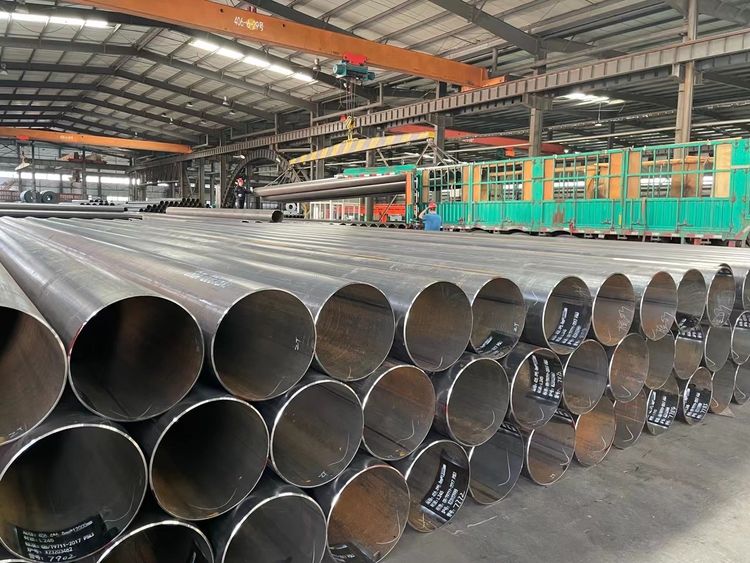

What Sizes and Grades Do We Supply?
We run EN 10210 CHS across a wide OD window, produced through two different manufacturing routes depending on diameter:
- Outer diameter: 21.3mm - 610mm (with our welded route, larger sizes available on request)
- Wall thickness: 2mm - 40mm
- Standard lengths: 6m and 12m, random or fixed length on request
- Grades: S235JRH, S275J0H/J2H, S355J2H, S355NH, S355NLH
The "H" in each grade suffix simply confirms the section is hollow-section-rated under EN 10210, and the N/NL suffixes tell you the impact-test temperature the material is qualified to (NH = 0degC, NLH = -20degC or lower on request). If your project spec calls out a design temperature, tell us the number and we will match the grade to it rather than defaulting to the cheapest option that technically satisfies the room-temperature yield.
Why Do We Manufacture EN 10210 CHS Two Different Ways?
This is the part buyers rarely get explained clearly, and it is the actual difference between how we build small-diameter and large-diameter round hollow section under the same standard.
Below roughly 400-450mm OD, we produce EN 10210 CHS as genuinely seamless pipe: a solid billet is pierced and rolled to final round dimensions with no weld seam anywhere in the wall. There is nothing to normalize away because there is no cold-work or weld structure introduced in the first place - the hot-forming process itself delivers the required mechanical properties.
Above that ceiling, seamless piercing mills run out of capacity, so we form the tube from plate or coil (ERW or LSAW, depending on OD and wall thickness) and then run it through a normalizing furnace at 580-650degC. This resets the grain structure that welding and cold-forming disturbed, bringing the mechanical properties of the welded tube up to the same level the standard requires - which is why a normalized welded EN 10210 CHS and a seamless EN 10210 CHS of the same grade carry the same guaranteed yield, tensile, and impact values on the mill certificate, even though they were made completely differently.
The practical upshot for you: you do not need to choose seamless vs. welded when you write your PO. Tell us the OD, grade, and design temperature, and we select the correct production route to hit those numbers - you get one certificate format either way.
Why Does Normalizing Matter More on Round Tube Than It Sounds?
On square and rectangular hollow section, the difference between hot-finished (EN 10210) and cold-formed (EN 10219) shows up mainly at the four corners, where the cold-bending radius concentrates strain and locally reduces toughness. Circular hollow section has no corners - the cross-section is uniform all the way around, so if a CHS were cold-formed and left untreated, the reduced ductility and elevated yield from cold work would be spread evenly through the entire wall rather than concentrated in four spots.
That is precisely why EN 10210 CHS is the standard of choice for round tube in low-temperature, cyclic-load, or seismic applications - offshore jacket bracing, crane booms, bridge bearings, wind-turbine tower internals - where you need the whole circumference to behave predictably at low temperature, not just the corners. Normalizing restores a fine, uniform grain structure across the full wall, which is what lets us certify NH (0degC) and NLH (down to -20degC, colder on request) impact values on CHS with confidence, batch after batch.
How Do We Control Quality From Coil or Billet to Finished Pipe?
- Incoming material check: ladle and coil chemistry verified against the target grade before it enters production
- Forming: hot piercing/rolling for seamless sizes; ERW or LSAW forming for welded sizes, with continuous weld-seam monitoring
- Normalizing (welded route only): furnace temperature and dwell time logged per batch, traceable to heat number
- Weld seam NDT: 100% ultrasonic testing on welded CHS before and after normalizing
- Dimensional inspection: OD, wall thickness, and ovality checked at set intervals along every length
- Mechanical testing: yield, tensile, elongation and Charpy impact tested per batch/heat, at the temperature specified by grade (0degC for NH, -20degC or lower for NLH)
- Documentation: EN 10204 3.1 mill test certificate issued per heat, covering both chemistry and mechanical results
Where Does EN 10210 CHS Actually Get Used?
Structural bracing on offshore and coastal platforms, where sub-zero design temperatures and cyclic wave loading rule out un-normalized tube. Crane booms and lifting structures, where guaranteed toughness under repeated dynamic loading is a safety requirement, not a nice-to-have. Bridge piers, bearings, and expansion-joint sleeves, where the round profile handles multi-directional loading better than a box section. Amusement-ride and high-cycle-fatigue structures, where the combination of a smooth round profile and certified toughness reduces the risk of fatigue crack initiation over the structure's service life.
Case in point: a crane-boom fabricator ordered 406.4mm OD x 14mm WT CHS in S355NLH, rated to -20degC. That OD sits just above our seamless piercing-mill ceiling, so we produced it through the welded-and-normalized route - ERW-formed, furnace-normalized at 600degC, 100% weld-seam UT, and batch Charpy testing confirming above 40J at -20degC. We delivered 7.8 tonnes in 12m lengths, and because of the normalizing step the mechanical test results matched what the same customer had previously received on a seamless order at a smaller OD - same grade, same guaranteed toughness, different production route, one certificate format.
FAQ
Q: Does the mill certificate show both chemistry and impact test results?
A: Yes. Every EN 10210 CHS shipment ships with an EN 10204 3.1 certificate covering full chemical composition and the mechanical/impact results for that heat, whether the pipe was produced seamless or welded-and-normalized.
Q: Can you supply NLH grade down to colder than -20degC?
A: S355NLH is our standard low-temperature offering, tested at -20degC. Colder impact-test temperatures can be arranged on request - confirm the design temperature when you send your inquiry so we can quote the right test protocol.
Q: Can seamless and welded-and-normalized CHS be combined on one purchase order?
A: Yes, and it is common on projects that span a wide OD range. Each production batch still carries its own heat-traceable certificate, but we consolidate documentation and shipping under a single order.
Q: Do lead times differ between the two production routes?
A: Welded-and-normalized CHS generally has a shorter lead time at large OD, since seamless piercing capacity at those diameters is limited across the industry. For OD under the seamless ceiling, lead times are comparable.


Hot Tags: en 10210 circular hollow section, China en 10210 circular hollow section manufacturers, suppliers, factory


