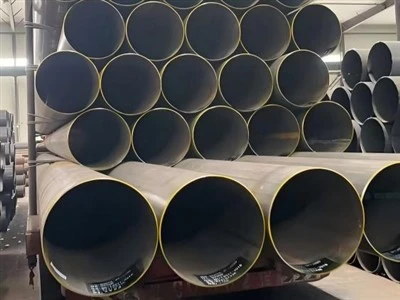
As a seasoned supplier of LSAW pipes, I've witnessed firsthand the significance of adhering to strict quality standards in the industry. LSAW (Longitudinal Submerged Arc Welded) pipes are widely used in various sectors, including oil and gas, construction, and infrastructure development. Ensuring the quality of these pipes is not just a matter of compliance; it's a commitment to safety, reliability, and customer satisfaction.
Material Quality
The foundation of a high-quality LSAW pipe lies in the raw material. We source our steel from reputable mills that meet international standards. The steel should have the right chemical composition and mechanical properties. For example, the carbon content affects the strength and weldability of the pipe. Too much carbon can make the pipe brittle, while too little can result in insufficient strength.
The mechanical properties, such as yield strength, tensile strength, and elongation, are also crucial. Yield strength indicates the point at which the steel begins to deform permanently, while tensile strength is the maximum stress the steel can withstand before breaking. Elongation measures the ability of the steel to stretch without breaking. These properties are determined through rigorous testing, including tensile tests, hardness tests, and impact tests.
Welding Quality
Welding is a critical process in the manufacturing of LSAW pipes. The quality of the weld directly affects the integrity and performance of the pipe. We use advanced submerged arc welding technology, which ensures a high-quality, consistent weld. The welding parameters, such as current, voltage, and welding speed, are carefully controlled to achieve the desired penetration and fusion.
Non-destructive testing (NDT) methods are used to inspect the welds for any defects. These methods include ultrasonic testing (UT), radiographic testing (RT), and magnetic particle testing (MT). UT uses high-frequency sound waves to detect internal flaws, such as cracks and porosity. RT uses X-rays or gamma rays to create an image of the internal structure of the weld. MT is used to detect surface and near-surface defects in ferromagnetic materials.
Dimensional Accuracy
Dimensional accuracy is another important quality standard for LSAW pipes. The outer diameter, wall thickness, and length of the pipe must meet the specified requirements. Any deviation from these dimensions can affect the fit and performance of the pipe in its intended application.
We use precision measuring equipment to ensure the dimensional accuracy of our pipes. The outer diameter is measured using calipers or laser scanners, while the wall thickness is measured using ultrasonic thickness gauges. The length of the pipe is measured using a tape measure or a length-measuring device.
Surface Finish
The surface finish of the LSAW pipe is also important. A smooth, clean surface not only enhances the appearance of the pipe but also improves its corrosion resistance. We use various surface treatment methods, such as shot blasting and painting, to achieve the desired surface finish.
Shot blasting is a process that uses high-velocity steel shots to clean and roughen the surface of the pipe. This process removes any rust, scale, or other contaminants and creates a surface profile that is suitable for painting. Painting is a protective coating that is applied to the surface of the pipe to prevent corrosion. We use high-quality paints that are specifically designed for use in harsh environments.
Coating Quality
In addition to surface treatment, the quality of the coating is also crucial. The coating should provide long-term protection against corrosion, abrasion, and chemical attack. We use a variety of coating materials, such as epoxy, polyethylene, and fusion-bonded epoxy (FBE), depending on the specific requirements of the application.
The coating should be applied evenly and smoothly to ensure proper adhesion and protection. We use advanced coating equipment and techniques to ensure the quality of the coating. After the coating is applied, it is tested for thickness, adhesion, and impact resistance.
Standards Compliance
Our LSAW pipes comply with a variety of international standards, including ASTM, API, and EN. These standards ensure that our pipes meet the highest quality and safety requirements. For example, ASTM A252 Piling Pipe and ASTM A252 Steel Pile Pipe are commonly used in piling applications, where the pipes need to have high strength and durability.
We also have a quality management system in place that is certified to ISO 9001:2015. This system ensures that our manufacturing processes are consistent and that our products meet the specified quality standards. We conduct regular internal audits and external inspections to maintain the effectiveness of our quality management system.


Testing and Inspection
Testing and inspection are an integral part of our quality control process. We conduct a series of tests and inspections at various stages of the manufacturing process to ensure the quality of our pipes. These tests include chemical analysis, mechanical testing, non-destructive testing, and hydrostatic testing.
Chemical analysis is used to determine the chemical composition of the steel. This test ensures that the steel meets the specified requirements and that there are no harmful impurities. Mechanical testing, such as tensile tests and hardness tests, is used to determine the mechanical properties of the steel. Non-destructive testing is used to detect any internal or surface defects in the pipe. Hydrostatic testing is used to test the pressure resistance of the pipe.
Conclusion
In conclusion, the quality standards for LSAW pipes are comprehensive and rigorous. As a supplier of LSAW PIPE, we are committed to meeting these standards to provide our customers with high-quality, reliable products. Our focus on material quality, welding quality, dimensional accuracy, surface finish, coating quality, standards compliance, and testing and inspection ensures that our pipes meet the needs of our customers in various industries.
If you are in the market for high-quality LSAW pipes, we invite you to contact us to discuss your specific requirements. Our team of experts is ready to assist you in finding the right pipe solution for your project. We look forward to the opportunity to work with you and to provide you with the best products and services in the industry.
References
- American Society for Testing and Materials (ASTM) standards.
- American Petroleum Institute (API) standards.
- European Committee for Standardization (EN) standards.
- ISO 9001:2015 Quality management systems - Requirements.