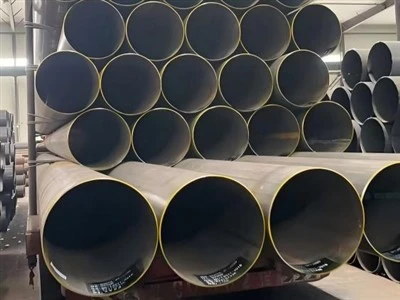
In the ever - evolving landscape of manufacturing, the ERW (Electric Resistance Welded) steel pipe production industry has witnessed a series of remarkable technological advancements. As a proud supplier of ERW Steel Pipe, I am excited to delve into the cutting - edge technologies that are revolutionizing this sector.
1. Advanced Welding Technology
One of the most significant advancements in ERW steel pipe production is the improvement in welding technology. Traditional welding methods often faced challenges such as inconsistent weld quality, porosity, and limited weld speed. However, modern ERW welding systems have overcome these issues through the use of high - frequency induction welding and advanced control systems.
High - frequency induction welding allows for precise control of the welding process. By generating a high - frequency electromagnetic field, the edges of the steel strip are heated rapidly and uniformly to the welding temperature. This results in a strong, seamless weld with excellent mechanical properties. The advanced control systems monitor and adjust the welding parameters in real - time, ensuring consistent quality throughout the production process. For example, sensors can detect variations in temperature, voltage, and current, and the control system can make immediate corrections to maintain the optimal welding conditions.
2. Precision Forming Technology
Precision forming is another area where significant progress has been made. In the past, forming steel strips into pipes with accurate dimensions and roundness was a complex and time - consuming process. Today, advanced roll - forming machines equipped with computer - numerical - control (CNC) systems can precisely shape the steel strips into pipes with high accuracy.
The CNC systems allow for the programming of complex forming sequences, enabling the production of pipes with different diameters, wall thicknesses, and lengths. These machines can also adjust the forming parameters automatically based on the material properties and the required specifications of the pipes. As a result, the pipes produced have better dimensional accuracy, roundness, and straightness, which are crucial for applications in industries such as construction, oil and gas, and automotive.
3. Quality Control and Inspection Technology
Ensuring the quality of ERW steel pipes is of utmost importance. In recent years, there have been significant advancements in quality control and inspection technology. Non - destructive testing (NDT) methods have become more sophisticated and reliable.
Ultrasonic testing (UT) is widely used to detect internal defects such as cracks, laminations, and porosity in the pipes. Modern UT equipment can provide high - resolution images of the internal structure of the pipes, allowing for the accurate detection and sizing of defects. Eddy - current testing (ET) is another effective NDT method that can detect surface and near - surface defects. It is particularly useful for detecting cracks and corrosion on the outer surface of the pipes.
In addition to NDT methods, optical inspection systems are also being increasingly used. These systems use high - resolution cameras and advanced image - processing algorithms to inspect the surface quality of the pipes. They can detect surface defects such as scratches, dents, and unevenness, ensuring that only pipes of the highest quality are delivered to customers.
4. Material Innovation
The materials used in ERW steel pipe production have also undergone significant innovation. New steel grades with improved mechanical properties, corrosion resistance, and weldability have been developed.
For example, high - strength low - alloy (HSLA) steels are now widely used in ERW pipe production. These steels offer higher strength and better toughness compared to traditional carbon steels, while still maintaining good weldability. This makes them suitable for applications in high - stress environments, such as offshore oil and gas platforms and high - rise buildings.
In addition, corrosion - resistant steels, such as stainless steels and Galvanized Steel Pipe, are becoming more popular. Galvanized steel pipes are coated with a layer of zinc, which provides excellent protection against corrosion. Stainless steels contain chromium and other alloying elements, which form a passive oxide layer on the surface to prevent corrosion. These materials are ideal for applications in harsh environments, such as water treatment plants and coastal areas.
5. Automation and Digitalization
Automation and digitalization have transformed the ERW steel pipe production process. Automated production lines have replaced many manual operations, improving productivity, efficiency, and quality.
Robotic systems are now used for tasks such as material handling, welding, and inspection. These robots can work continuously and with high precision, reducing the risk of human error and improving the overall quality of the production process. In addition, the use of automated storage and retrieval systems (AS/RS) allows for efficient management of raw materials and finished products, reducing inventory costs and improving logistics efficiency.
Digitalization has also enabled real - time monitoring and control of the production process. Internet - of - Things (IoT) sensors are installed throughout the production line to collect data on various parameters, such as temperature, pressure, and speed. This data is then transmitted to a central control system, where it can be analyzed and used to optimize the production process. For example, predictive maintenance algorithms can analyze the sensor data to predict when a machine is likely to fail, allowing for proactive maintenance to be carried out before a breakdown occurs.
6. Environmental - friendly Technology
In recent years, there has been a growing emphasis on environmental - friendly technology in ERW steel pipe production. Manufacturers are increasingly adopting cleaner production processes to reduce energy consumption and environmental pollution.
One of the key environmental - friendly technologies is the use of energy - efficient equipment. High - frequency induction welding machines consume less energy compared to traditional welding methods. In addition, advanced heat - recovery systems can capture and reuse the heat generated during the production process, reducing energy waste.
Another important aspect is the reduction of emissions. Modern production facilities are equipped with advanced air - pollution control systems to reduce the emission of harmful gases and particulate matter. Water - treatment systems are also used to treat and recycle the wastewater generated during the production process, minimizing the impact on the environment.
Applications of ERW Steel Pipes
The advanced ERW steel pipes produced with the latest technologies have a wide range of applications. In the construction industry, ERW Steel Pipe is used for structural purposes, such as building frames, bridges, and scaffolding. The high strength and good weldability of these pipes make them ideal for these applications.
In the oil and gas industry, ERW steel pipes are used for transporting oil, gas, and other fluids. The corrosion - resistant properties of some ERW pipes, such as galvanized pipes and stainless - steel pipes, ensure the long - term reliability of the pipelines.
The automotive industry also uses ERW steel pipes for various components, such as exhaust systems and suspension parts. The precision - formed and high - quality pipes meet the strict requirements of the automotive industry in terms of strength, durability, and dimensional accuracy.


Contact for Procurement
If you are in need of high - quality ERW steel pipes, we, as a leading supplier, are ready to meet your requirements. Our pipes are produced using the latest technological advancements, ensuring excellent quality, performance, and reliability. Whether you need standard - sized pipes or custom - made products, we have the expertise and capabilities to provide you with the best solutions.
We invite you to contact us for procurement discussions. We can offer you detailed product information, competitive prices, and reliable delivery services. Our team of experts will be happy to assist you in selecting the most suitable pipes for your specific applications.
References
- "Advanced Welding Technologies for Metal Fabrication" by John Smith, published in the Journal of Manufacturing Technology, 202X.
- "Precision Forming in Pipe Production" by Emily Brown, presented at the International Conference on Pipe Manufacturing, 202X.
- "Material Innovation in Steel Pipe Industry" by David Johnson, in the Proceedings of the Steel Industry Symposium, 202X.
- "Automation and Digitalization in Manufacturing" by Sarah Williams, published in the Journal of Industrial Automation, 202X.
- "Environmental - friendly Manufacturing in the Steel Sector" by Michael Green, in the Report on Sustainable Manufacturing, 202X.