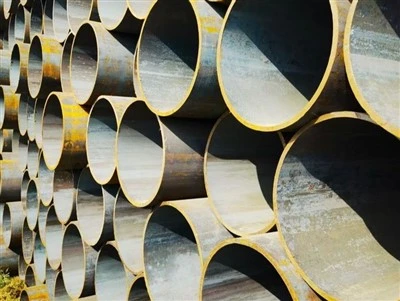
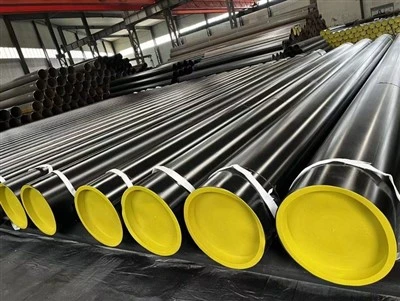
Tianjin Brisk Metalwork Co., Ltd. is one of the leading manufacturers and suppliers of astm a106 seamless carbon steel pipe specifications in China. We have world-leading production equipment and strong manufacturing capabilities. Please feel free to buy bulk durable astm a106 seamless carbon steel pipe specifications from our factory.
Tianjin Brisk Steel is one of the ASTM A106 Seamless Carbon Steel Pipe Specifications in China. Our products are mainly exported to the Middle East, Southeast Asia, Europe, New Zealand, and other regions.If you would like to learn more about our products, feel free to contact us and send your purchase list.


Quick Reference Table
| Parameter | Grade A | Grade B | Grade C |
|---|---|---|---|
| Carbon (max) | 0.25% | 0.30% | 0.35% |
| Manganese | 0.27–0.93% | 0.29–1.06% | 0.29–1.06% |
| Silicon (min) | 0.10% | 0.10% | 0.10% |
| Yield Strength (min) | 30,000 psi (207 MPa) | 35,000 psi (241 MPa) | 40,000 psi (275 MPa) |
| Tensile Strength (min) | 48,000 psi (330 MPa) | 60,000 psi (415 MPa) | 70,000 psi (485 MPa) |
| Production Method | Seamless only | Seamless only | Seamless only |
| Size Range | 1/8" – 48" NPS | 1/8" – 48" NPS | 1/8" – 48" NPS |
Every grade is silicon-killed by requirement - an easy line to overlook on a mill test report, but the deoxidation practice that gives A106 its grain structure and high-temperature stability.
Hot-Finished vs. Cold-Drawn
A106 is seamless by definition, but the standard permits two distinct finishing routes after piercing, and the choice affects dimensional accuracy more than it affects chemistry:
- Hot-finished: The pipe is rolled and sized while still hot from the piercing mill, then air-cooled. This is the standard, lower-cost route and covers the large majority of stocked A106 sizes.
- Cold-drawn: The hot-finished pipe is drawn through a die at room temperature to bring it to tighter OD and wall tolerances, then normalized. Cold-drawn A106 costs more and typically runs on longer lead time, but it is the route to specify when a downstream process (precision bending, tight-fit instrumentation tubing, small-bore high-pressure assemblies) can't absorb hot-finished tolerance variation.
Neither route changes the grade's chemistry or minimum mechanical properties - A106 Grade B hot-finished and A106 Grade B cold-drawn meet the same strength requirements. The difference is entirely in how tightly the final dimensions are held, which is a distinction that gets lost when "A106 Grade B" is specified without a finishing condition.
Dimensional Tolerances
A106 follows the NPS/Schedule wall system under ASME B36.10M rather than a direct OD callout. Key tolerance bands:
| Dimension | Hot-Finished | Cold-Drawn |
|---|---|---|
| Outside Diameter | ±0.75% (NPS 1/8–1½), tighter % as size increases | ±0.4% or better, size-dependent |
| Wall Thickness | -12.5% of nominal (no plus limit) | -10% of nominal (no plus limit) |
| Straightness | 0.2% of total length | Tighter, per purchase agreement |
The wall thickness tolerance is the one most commonly miscalculated on a design review - a Schedule 40 wall is not guaranteed to measure Schedule 40 everywhere on the pipe. Pressure design calculations that use nominal wall without applying the allowable-minus figure are effectively designing against a wall thickness the pipe isn't required to deliver.
Testing: More Than "Hydrostatic or Nothing"
A106 gives the mill a choice of acceptance test, and this is where buyers who assume there's only one path get an unwelcome surprise:
- Hydrostatic test - every length pressure-tested to the formula stress specified in the standard.
- Nondestructive electric test (eddy current or ultrasonic) - an alternative to hydrostatic, provided it's supplemented by a hydrostatic test of at least one length per lot, or as otherwise agreed.
A mill certificate should state plainly which method was used and, when NDE was chosen, the acceptance criteria and reference standard applied. A purchase order that just says "test per A106" without naming a preferred method leaves that decision to the mill - usually fine, but worth confirming when the end application (steam service, refinery piping) has its own inspection expectations layered on top of the base ASTM requirement.
Delivery Condition and Heat Treatment
Grade B and C pipe over certain wall thicknesses may require normalizing, and hot-finished pipe produced above a specified finishing temperature threshold can be furnished as-rolled without separate heat treatment, provided mechanical properties are met. This is a separate question from post-weld heat treatment applied after field fabrication - A106's delivery condition governs the pipe's as-shipped metallurgical state, not what happens to it after a fabricator cuts and welds it into a system.
A Small-Bore Case That Illustrates the Tolerance Gap
A fabricator ordered A106 Grade B for a 2" NPS, Schedule 160 instrument air header, specifying only grade and schedule with no finishing condition. The mill shipped hot-finished pipe - fully compliant with the order as written - but the OD variation across the lot was enough that several lengths would not seat cleanly in pre-machined compression fittings sized to a tighter tolerance band. Re-ordering as cold-drawn resolved the fit issue with the same grade, same schedule, and no chemistry change. The order hadn't specified anything wrong; it simply hadn't specified the one dimensional detail the application actually needed.
Frequently Asked Questions (FAQ)
Q: Is cold-drawn A106 automatically better than hot-finished?
A: Not in strength or chemistry - both meet the same grade requirements. Cold-drawn simply holds tighter dimensional tolerance at a higher price and longer lead time, so it's worth specifying only when the application genuinely needs that precision.
Q: Does A106 require normalizing on every order?
A: No. Normalizing requirements in A106 are tied to grade and wall thickness thresholds, and hot-finished pipe produced above the qualifying finishing temperature can meet requirements without a separate heat-treat step. The mill certificate should state the delivery condition either way.
Q: Can eddy current testing replace hydrostatic testing entirely?
A: Not fully on its own - A106 requires the nondestructive electric test option to be supplemented by hydrostatic testing of at least one length per lot unless otherwise agreed between purchaser and manufacturer. A cert that shows only NDE with no supplemental hydrostatic reference is worth a direct question to the mill.
Q: Why does my A106 Schedule 40 wall measure thinner than the nominal number?
A: Because the standard permits wall thickness to run up to 12.5% under nominal on hot-finished pipe (10% on cold-drawn) with no plus-side limit specified. This is a normal, standard-compliant tolerance, not a defect - but it needs to be accounted for in the pressure design calculation rather than assumed away.


Hot Tags: astm a106 seamless carbon steel pipe specifications, China astm a106 seamless carbon steel pipe specifications manufacturers, suppliers, factory, seamless pipe hoist, seamless pipe industry, seamless pipe information, seamless pipe inspection, seamless pipe inventory, seamless pipe joint