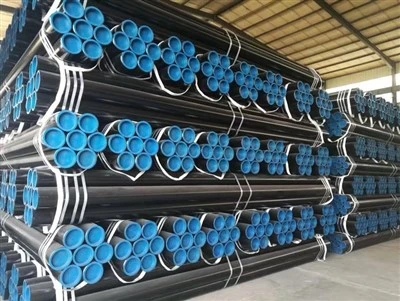
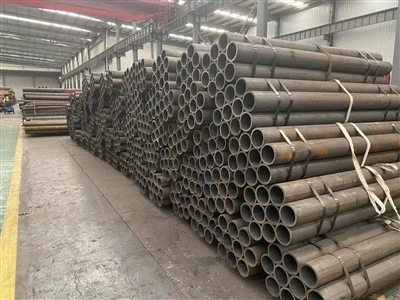
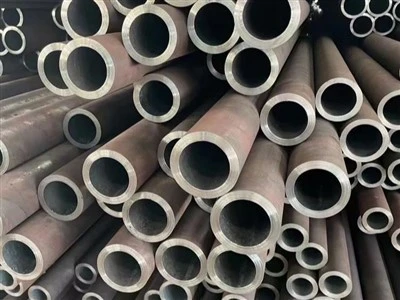
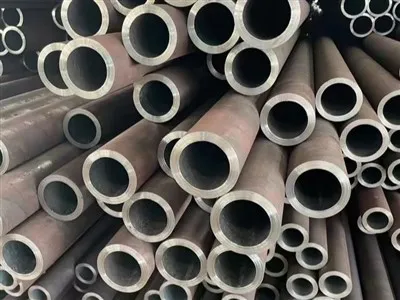
Tianjin Brisk Steel is one of the API 5L Seamless Carbon Steel Line Pipe in China. Our products are mainly exported to the Middle East, Southeast Asia, Europe, New Zealand, and other regions.If you would like to learn more about our products, feel free to contact us and send your purchase list.


Quick Spec Reference
| Item | Grade B Requirement |
|---|---|
| Specification | ASTM A106 Grade B |
| Manufacturing process | Seamless (hot-worked, then cold-drawn or as-finished) |
| Carbon, max | 0.30% |
| Manganese | 0.29% – 1.06% |
| Phosphorus, max | 0.035% |
| Sulfur, max | 0.035% |
| Silicon, min | 0.10% (silicon-killed steel required) |
| Tensile strength, min | 60,000 psi (415 MPa) |
| Yield strength, min | 35,000 psi (240 MPa) |
| Hardness, max | 197 HB |
| Size range | NPS 1/8" – 48" (larger sizes limited by seamless production capability) |
| NDE / hydrostatic | Hydrostatic test, or nondestructive electric test as an alternative per spec allowance |
Why Grade B Ended Up as the Default
Grade A and Grade B share the same production route and size range; the real difference is carbon content and the resulting strength - Grade A is lower-carbon and lower-strength, intended mainly for pipe that will be cold-bent after delivery, since lower carbon bends more predictably without cracking. Grade C sits above Grade B in strength and is comparatively rare, ordered mainly where a specific higher allowable stress is needed to reduce wall thickness on a large-diameter, high-pressure line. Grade B's strength-to-formability balance covers the overwhelming majority of steam, hot water, and hydrocarbon service piping without needing either trade-off, which is why it became the default rather than a deliberate first choice on most jobs.
The Silicon-Killed Steel Requirement, and Why It's There
A106 requires Grade B to be made from silicon-killed steel - meaning the melt is deoxidized with silicon before casting, rather than left as rimmed or capped steel. This isn't a minor chemistry footnote: killed steel produces a more uniform grain structure and avoids the gas porosity and segregation that can occur in unkilled steel, which matters directly for a pipe that will see repeated thermal cycling in steam or hot process service. If a mill certificate doesn't show a silicon content at or above the 0.10% minimum, that's worth querying before accepting the heat - it's one of the more overlooked line items on a chemistry report next to the more obviously-checked carbon and manganese figures.
The Two "Grade B" Pipes That Are Not Interchangeable
This is a mix-up worth flagging directly: ASTM A106 Grade B and API 5L Grade B are different specifications that happen to share a grade letter and a similar strength level. API 5L Grade B is a line-pipe specification covering both seamless and welded pipe, built around transmission pipeline service - external corrosion allowance assumptions, pipeline-specific hydrostatic test methods, and PSL1/PSL2 testing tiers. A106 Grade B is a seamless-only specification for pressure piping inside a plant or facility, built around ASME B31.1/B31.3 piping-code service, not buried transmission-line service. The two overlap in strength numbers closely enough that a purchasing document written loosely - "Grade B pipe, 60,000 psi tensile" - can get filled with the wrong one if the supplier doesn't ask which standard governs. A receiving inspector checking a mill cert against a piping class sheet that calls for A106 will reject an API 5L Grade B heat, and the reverse mismatch causes the same problem on a pipeline job.
Frequently Asked Questions (FAQ)
Q: Can A106 Grade B pipe be field cold-bent?
A: It's possible but less forgiving than Grade A due to the higher carbon content; if a job involves significant field bending, Grade A or a hot-bending procedure is generally the safer choice, and either way a qualified bending procedure should be used regardless of grade.
Q: Does Grade B pipe come hydrostatically tested by default?
A: The specification allows either a hydrostatic test or a nondestructive electric test as an alternative - the mill certificate should state which one was actually performed, since the two aren't automatically interchangeable for every project's acceptance criteria.
Q: What causes a Grade B heat to fail acceptance most often?
A: In practice, incomplete documentation - missing hardness values or an unclear heat-treatment condition - causes more receiving-inspection holdups than actual out-of-spec chemistry, which is relatively rare from established mills.
Q: Is silicon content something I actually need to check, or is it a formality?
A: It's worth checking. The silicon-killed steel requirement affects grain structure and porosity resistance in a pipe that will see repeated thermal cycling, so a cert showing silicon below the 0.10% minimum is a genuine compliance issue, not a rounding footnote.


Hot Tags: astm a106 grade b seamless steel pipe, China astm a106 grade b seamless steel pipe manufacturers, suppliers, factory, seamless pipe compressor, seamless pipe development, seamless pipe function, seamless pipe safety, seamless pipe thickness, seamless pipe turbine