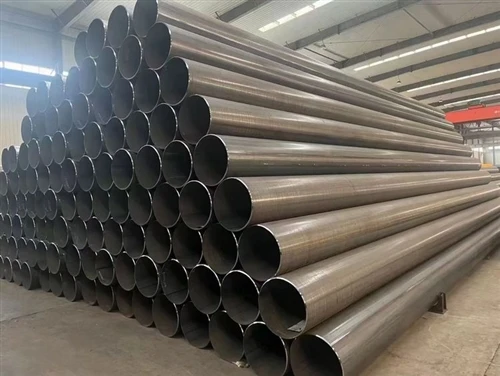
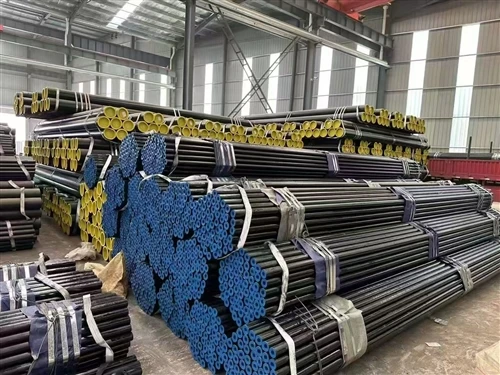
Production equipment of LSAW steel pipe:
Plate edge milling machine
The milling machine mills the two sides of the plate to exacting standards in order to meet width, edging and groove shape specifications.
Edge crimping machine
The crimping machine crimps the edges of the plate to form the required curvature.
Tack welding machine
The two edges of the open seam pipe are brought together by the tack welding machine. then welded by the tack welder using a metal active - gas arc welding("MAG" )process.
Forming machine
Utilizes the "JCO" process to bend and form the crimped steel plate into a steel pipe.
Interior welding machine
The interior longitudinal seam of the pipe is welded from the inside by fixing 4 welding heads while moving pipe and using submerged-arc welding process.
End facing machine
The machine levels the pipe end with rotating cutter heads to ensure that required groove and edge specifications are met.
Hydrostatic tester
Using end face sealing technology eliminates blind zones during hydrostatic testing. The tester is also equipped with automatic recording and storing functions.
Expanding machine
The pipe is subjected to full-length expansion to increase the precision of the pipe dimensions and to improve the internal stress distribution.
The specific process steps of LSAW steel pipe are as follows:
1. Plate Probe: This is used for manufacturing the large diameter LSAW joints right after it enters the production line which is the initial full-board ultrasonic testing.
2. Milling: The machine used for milling does this operation through two-edged milling plate to meet the requirements of the plate width and the sides parallel to the shape and degree.
3. Pre-curved side: This side is achieved by using a pre-bending machine on the pre-bending plate edge. The plate edge needs to meet curvature requirement.
4. Forming: After the pre-bending step, in the first half of the JCO molding machine, after stamped steel, it is pressed into a "J" shape while the on the other half of the same steel plate it is bent and pressed into a "C" shape, then the final opening forms an "O" shape.
5. Pre-welding: This is to make a welded pipe steel a straight seam after it has been formed and then use gas welding seam (MAG) for continuous welding.
6. Inside weld: This is done with a tandem multi-wire submerged arc welding (about four wire) on the inner part of the straight seam welded steel pipe.
7. Outside Weld: Outside weld is the tandem multi-wire submerged arc welding on the outer part of the LSAW steel pipe welding.
8. Ultrasonic Testing: Outside and inside of the straight seam welded steel pipe and both sides of the base material are welded with 100% inspection.
9. X-ray inspection: X-ray industrial TV inspection is carried out on the inside and outside using image processing system to make sure there is detection sensitivity.
10. Expansion: This is for accomplishing submerged arc welding and straight seam steel pipe length hole diameter so as to improve the steel tube's size precision and improve the distribution of stress in the steel tube.
11. Hydraulic test: This is carried out on the hydraulic test machine for steel after expanding by-root test for ensuring the steel pipe meets the standard requirements with the machine having an automatic recording and storage capabilities.
12. Chamfering: This involves the inspection carried out on the steel pipe at the end of the whole process.
LSAW steel pipe Manufacturing Process:
Longitudinally Submerged Arc Welded Process Flow
LSAW (Longitudinally Submerged Arc Welded Steel pipes) in leaflets plate as raw material, the steel plate in the mold or molding machine pressure (volume) into using double-sided submerged arc welding and flaring from production.
The LSAW process of welded pipe includes UOE and JCOE.
UOE LSAW pipe forming process:
The three main forming processes of UOE LSAW steel pipe forming process include: steel plate pre-bending, U forming and O forming. Each process adopts a dedicated forming press to complete the three processes of pre-bending the edge of the steel plate, U forming and O forming in sequence to deform the steel plate into a circular tube.
JCOE LSAW pipe forming process:
Forming: After several steps of stamping on the JC0 forming machine, first half of the steel plate is pressed into a "J" shape, then the other half of the steel plate is pressed into a "J" to form a "C" shape, and finally pressurized from the middle to form An open "0"-shaped tube blank is formed.