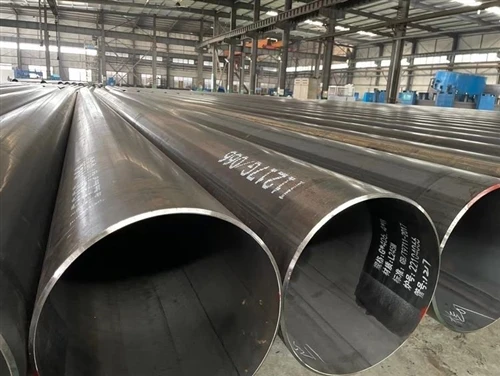
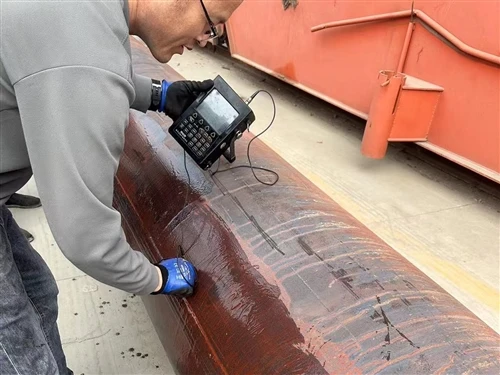
Most buyers of large diameter welded pipe look at three numbers: outside diameter, wall thickness and steel grade. Fewer ask what happened to the pipe after the seam was welded. For LSAW (longitudinal submerged arc welded) line pipe, one of the last forming steps is cold expansion. It decides how round the pipe is, how closely it holds its diameter, and it quietly changes the strength of the steel in ways that matter for coating, external pressure and field welding.
This article explains what cold expansion is, what it changes in the pipe, where it can cause problems, and how to specify it on a purchase order.
What Is Cold Expansion in LSAW Pipe Production?
In JCOE and UOE production, a steel plate is bent into a tube and the seam is welded inside and outside. The tube that comes off the welding station is not yet a finished product. Forming leaves springback, small ovality and locked-in residual stress, and the weld shrinks as it cools.
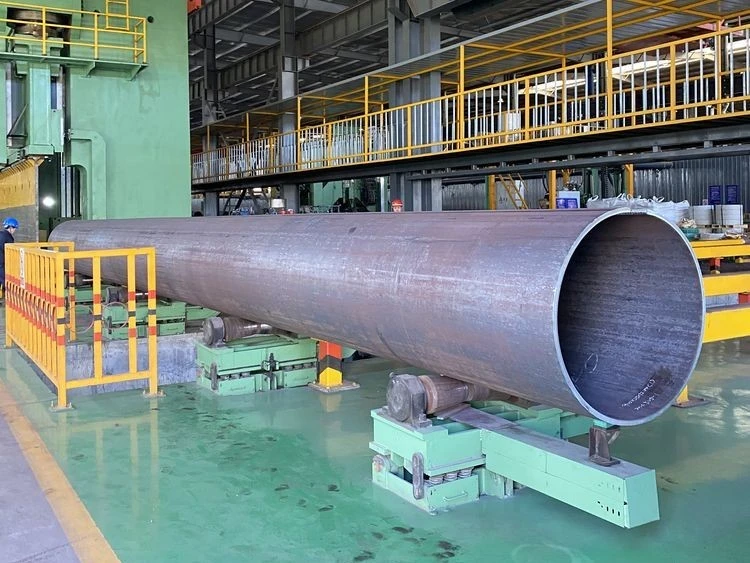
Cold expansion corrects this. A mechanical expander, built from segmented heads, is pushed inside the pipe and opened outward. It stretches the whole circumference plastically, at room temperature, by a small percentage, usually working along the pipe in overlapping steps.
Hydraulic expansion in a closed die is another route, but the goal is the same: bring the pipe permanently to its target diameter.
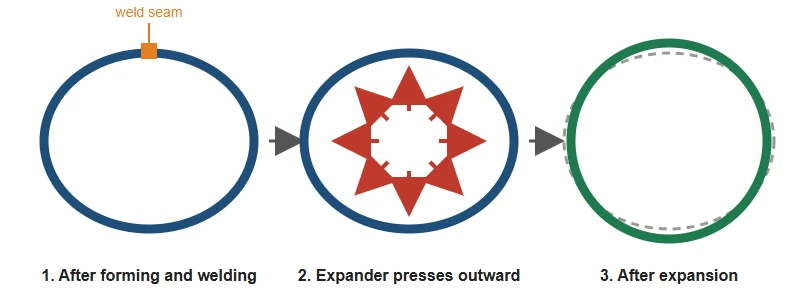
Expansion ratios are usually of the order of one percent of the circumference, and line pipe standards place an upper limit on the ratio, with figures around 1.5 percent commonly quoted. The exact range depends on the edition of the standard and on your order, so confirm it in the specification you buy to. It is a small strain, but applied to every point of the pipe wall, so its effects are large.
Why Do Mills Expand Pipe at All?
Cold expansion has four jobs:
- Diameter control: the expander sets the diameter, so pipes from different plates and different shifts end up at the same size.
- Roundness: the pipe is pushed to a circle, which reduces ovality.
- Stress relief: the plastic strain evens out residual hoop stress left by forming and welding.
- Proof loading: the pipe, including the seam, is loaded beyond its working stress at the mill, which shows up gross defects early.
The same step has side effects, covered below. The table summarises them.
| Property | Effect of Cold Expansion | Why It Matters |
|---|---|---|
| Outside diameter | Set to the target, with a narrower spread | Girth weld fit-up, coating, bend radius |
| Roundness (ovality) | Reduced | High-low misalignment at joints |
| Residual stress | Reduced and more even | Distortion, cracking risk in service |
| Hoop tensile yield | Raised (work hardening) | Pressure design, grade verification |
| Compressive yield | Lowered (Bauschinger effect) | Collapse under external pressure |
| Wall thickness | Thins by a fraction of a percent | Minimum wall check |
| Toughness, ductility | Slightly reduced by cold work | Low-temperature and fracture performance |
How Does Expansion Improve Roundness and Diameter Control?
A pipe formed from plate carries the memory of its bending. Slight differences in plate yield strength, thickness and forming force make each pipe spring back by a different amount, so the pipes leaving the weld station are not identical.
Expansion removes that variation. Because every pipe is pushed out to the same tool size, the springback differences are replaced by plastic deformation to a common diameter. The result is a tighter diameter spread and a better circle, particularly at the pipe ends.
This matters most at the girth weld. When two ends meet, any difference in circumference shows up as high-low misalignment, which the welder must correct or accept. Pipe standards therefore give tighter diameter tolerances at the ends than on the body, and expansion is one of the ways a mill meets them. Good roundness also helps internal lining, automatic welding and pigging.
What Happens to Residual Stress?
Bending a plate into a tube puts one side of the wall in tension and the other in compression, and welding adds shrinkage stress along the seam. A pipe with high residual stress can distort when cut, bevelled or machined, and can carry elevated stress into service.
Expansion stretches the whole wall past yield, so the stress distribution is redistributed and reduced. It does not make the pipe stress-free, but the pipe leaves the expander with a more even and generally lower residual hoop stress than it entered with. That is one reason expanded pipe is common in high-pressure line pipe.
What Happens to Strength?
Expansion adds a plastic strain of about one percent in the hoop direction, so the steel work hardens. Two effects follow.
Hoop tensile yield strength rises. The steel resists the same tensile load better after being stretched. That is helpful for internal pressure, which loads the wall in hoop tension. It also means that tensile test results taken on finished pipe differ from results on the original plate.
Compressive yield strength falls. A metal that has been strained in tension and then loaded in compression starts to yield earlier than it would have done otherwise. This is the Bauschinger effect, and it applies to the hoop direction of an expanded pipe: the stretch of expansion lowers the compressive yield for later loading in the opposite sense.
For a land pipeline carrying oil or gas under internal pressure, this trade-off is usually acceptable. For other duties, it needs attention.
Why Does Expansion Matter for External Pressure and Collapse?
Pipe under external pressure, such as subsea pipelines or deep casing, fails by collapse, which depends on compressive strength in the hoop direction. Published studies of UOE-type pipe have reported reductions in compressive yield strength and collapse pressure of up to roughly ten to twenty percent compared with the same steel before expansion, depending on the steel and the expansion ratio.
Two practical consequences follow:
- A standard tensile test, which loads the steel in tension, does not show the compressive loss.
- Designers of external-pressure service often specify compression testing or collapse testing on finished pipe, and some rely on a later heating step to recover part of the loss.
How Does Coating Heat Change the Pipe?
Fusion bonded epoxy and three-layer polyethylene systems cure at elevated temperature, often around 200 to 250 degC at the pipe surface. For a pipe that has been cold worked, that heat causes strain aging: carbon and nitrogen atoms in the steel migrate to dislocations created by the expansion and pin them.
The outcome is typically:
- Yield strength increases compared with the as-expanded pipe, sometimes enough to approach or exceed the upper limit of the specified range.
- The yield-to-tensile ratio increases, so the steel has less reserve between yield and ultimate.
- Toughness may fall slightly.
- Part of the compressive yield loss is recovered, which can be useful for collapse-sensitive pipe.
So the properties of a pipe leaving the expander are not always the properties of the coated pipe you install. If your pipe will be heated by coating, say so at enquiry.
What About Wall Thickness, Length and Toughness?
Plastic stretching in the hoop direction slightly thins the wall, by a fraction of a percent. Mills account for this in plate selection, but you should check the minimum wall tolerance against measured wall after expansion.
Cold work also reduces ductility and toughness somewhat. Modern line pipe steels, with low carbon and fine grain, have large reserves, so the loss is rarely a problem within the normal expansion range. It is another reason standards cap the expansion ratio.
Does Expansion Test the Seam?
Expansion and hydrostatic testing both load the seam above its working stress. A seam with a serious flaw is more likely to open at the mill than in the trench, which is a genuine benefit.
Because expansion itself can open or grow small flaws, line pipe specifications for SAW pipe call for seam non-destructive testing after expansion and hydrostatic test, not only after welding. Confirm the exact clause and sequence in the edition on your order, and check that the inspection report states when the testing was done.
Is Every LSAW Pipe Cold Expanded?
No. Cold expansion is a standard step in line pipe production, where diameter control and pressure performance matter. Structural and piling pipe may be supplied expanded or unexpanded, depending on the specification and the roundness needed. Other processes follow different logic: ERW pipe is sized by rolling, and spiral SSAW pipe normally has its diameter set by forming rather than by a separate expansion step.
State on your enquiry whether you need cold-expanded pipe, because it changes both the process route and the test list.
Summary
Cold expansion turns a welded tube into a pipe of known diameter and good roundness, reduces residual stress and proves the seam under load. It also raises hoop tensile yield, lowers compressive yield, thins the wall slightly and makes the steel more sensitive to coating heat. For internal-pressure land pipelines these effects are well understood and usually favourable. For external pressure, thick coatings applied at high temperature or demanding fabrication, they need to be written into the specification.
If you are specifying large diameter LSAW pipe and want to confirm which expansion route, tests and coating-heat checks apply, send us your specification and our engineers will reply with a quotation.
Related:SAWL Steel Pipe