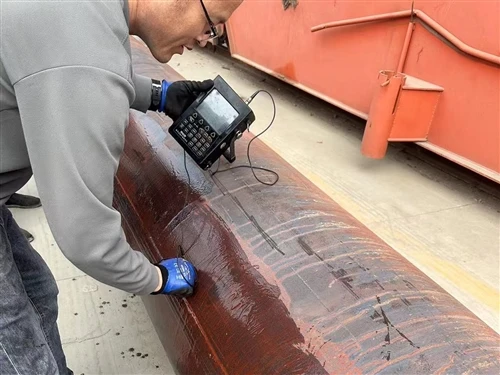
The main differences between Hydrostatic Test and NDT (Non-Destructive Tests) are outlined in detail below. These two inspection techniques serve complementary but distinct roles for ASTM A53 Type E ERW steel pipe and other welded tubular products.
Core Purpose
- Hydrostatic Test (Hydrotest): It is a pressure-based performance test. Its primary goal is to verify the overall structural integrity and leak tightness of a complete pipe under predefined test pressure. It simulates real working pressure conditions to prove that the pipe can hold fluid without seepage or rupture. This test answers one practical question: will this pipe leak or burst under service pressure?
- NDT (Non-Destructive Tests): NDT methods detect hidden internal, subsurface or surface imperfections in the weld seam or base metal, without applying hydraulic pressure to the pipe. Typical defects captured include microcracks, incomplete fusion, porosity, slag inclusions, misalignment and lack of penetration. NDT assesses material and weld quality, rather than direct pressure tightness. It answers: are there hidden manufacturing flaws inside the pipe wall or weld?
Inspection Scope & Coverage
- Hydrotest: Covers the entire pipe body as a whole. Pressure acts uniformly on every section of the pipe, including base metal, weld seam and pipe ends. It gives a global pass/fail result for the full length of the pipe, but cannot pinpoint the exact location or size of a buried internal defect that does not penetrate the wall.
- NDT: Usually targets localized critical zones. For ERW pipe, the highest priority inspection zone is the longitudinal weld seam. Inspectors scan specific areas rather than the full pipe body in every case. NDT can locate, size and document individual defects, which allows manufacturers to repair or reject defective segments before final acceptance.
Execution Sequence & Timing in Production
- Hydrotest: Performed at the later stage of production, after welding, sizing, straightening and end finishing are finished. For most export pipe orders, it acts as a final acceptance check before packing and shipment. For site piping projects, hydrotest is also carried out before system commissioning.
- NDT: Mostly performed right after welding, while the weld zone is still accessible, and generally before hydrostatic testing. Online UT or ET is integrated directly into the ERW production line to inspect every weld seam continuously. If critical defects are found at this stage, defective pipes can be isolated early, avoiding wasted time and risk during subsequent hydrotesting. Some supplementary NDT such as visual inspection can also be repeated after hydrotest.
Note: Both are "non-destructive", but hydrotest can cause damage if material is defective. NDTs are safer and more localized.
Commonly Used NDT Methods for Steel Pipe
- RT (Radiographic Testing): Captures an X-ray or gamma-ray film image of internal weld defects; widely used for critical welded joints.
- UT (Ultrasonic Testing): Uses high-frequency sound waves to detect subsurface flaws; the primary mandatory weld inspection method for ASTM A53 NPS 2+ ERW pipe.
- ET (Eddy Current Testing): Electromagnetic inspection for near-surface discontinuities, popular for high-speed ERW inline inspection.
- PT (Liquid Penetrant Testing): Finds open surface cracks and pores, suitable for surface-only checks.
- MT (Magnetic Particle Testing): Detects surface and shallow subsurface flaws on ferromagnetic steel materials.
- VT (Visual Testing): Basic visual examination for surface imperfections, weld bead shape, scratches and dimensional defects.
Summary
- Hydrotest = checks system strength and leak-proof status.
- NDT = checks weld and material quality before final testing.
Note: Hydrotest validates pressure containment, but it won't detect subsurface or planar defects unless they propagate into a leak. That's where NDTs like UT and RT are critical-they can reveal internal flaws that may not cause immediate failure but could lead to long-term issues under cyclic loading or thermal stress.