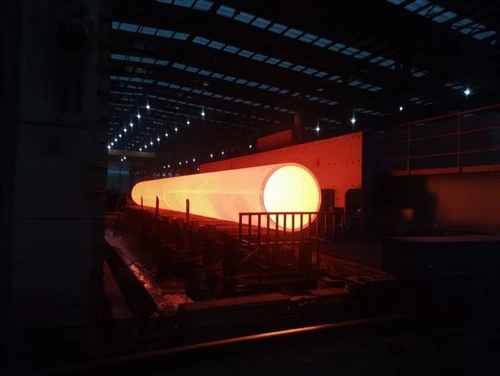
Mild Steel (MS) Hollow Section, also known as HSS, covers Square Hollow Section (SHS), Rectangular Hollow Section (RHS) and Circular Hollow Section (CHS). Thanks to outstanding torsional resistance, high strength-to-weight ratio and superior workability, MS hollow sections are widely adopted in architectural curved structures, handrails, vehicle frames, agricultural equipment, bridge arches and industrial machinery frames worldwide.
Brisk Steel, a professional manufacturer & exporter of EN 10210, EN 10219, ASTM A500, AS 1163 standard MS hollow sections, summarizes all mainstream industrial bending techniques for MS hollow sections in this guide. We elaborate working principles, pros & cons, applicable scenarios, and match each bending method with our factory's MS hollow section material performance to help global buyers, fabricators and engineers select the optimal forming solution efficiently.
All our MS hollow sections adopt S235, S275, S355 series mild steel, with stable ductility and uniform wall thickness, which greatly reduces bending defects like flattening, wrinkling or cracking during cold/hot forming. Our factory supports pre-bending customized processing for all hollow section sizes, delivering finished curved components to cut clients' on-site fabrication cost.
Classification of MS Hollow Section Bending Technologies
All bending processes fall into two core categories: Cold Bending (Room-Temperature Forming) and Hot/Induction Bending (High-Temperature Forming). Cold bending dominates mass light-to-medium wall hollow section fabrication, while hot/induction bending serves heavy-wall, large-diameter or ultra-tight bend radius projects.
Cold Bending Series (Most Widely Used for Brisk Steel Standard MS HSS)
Cold bending processes are executed at ambient temperature without overall heating. They retain original mechanical properties of MS hollow sections, deliver smooth surface finish and lower production cost. Four mainstream cold bending techniques are applied globally:
Rotary Draw Mandrel Bending

Working Principle: The MS hollow section is firmly clamped on a rotary forming die, pulled and wrapped around the fixed radius die. A segmented steel mandrel is inserted inside the hollow tube during bending to support inner walls, eliminate ovality, wall thinning and wrinkles.
Advantages
- Achieves tight bend radii (minimum 1.5× outer diameter) with ultra-high dimensional precision
- Minimal cross-section deformation; consistent smooth surface for exposed architectural components
- High repeatability for mass production of uniform bent parts (handrails, equipment frames)
- Compatible with all Brisk Steel thin & medium-wall SHS/RHS/CHS
Disadvantages
- Custom die sets required for each bend radius, higher initial tooling investment
- Not suitable for ultra-large-radius long-length curved profiles
Best Matching Brisk Steel MS HSS: Thin-wall CHS, small-size SHS/RHS (wall thickness ≤12mm), architectural decorative bent parts
Three-Roll Roll Bending (Pyramid Roll Bending)
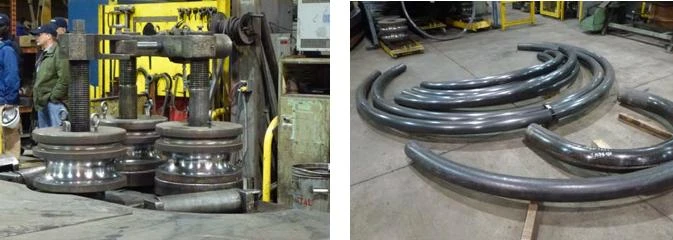
Working Principle: Three triangular-arranged rollers apply gradual pressure to the MS hollow section via multiple repeated feeding passes, forming continuous large-radius arcs or full circular rings without fixed forming dies.
Advantages
- Unlimited adjustable bend radius; perfect for long-span gentle curves (arched canopies, bridge girders)
- Low tooling cost, no custom dies needed for different radii
- Processes full-length hollow sections up to 12m standard factory length supplied by Brisk Steel
Disadvantages
- Cannot produce sharp or tight-angle bends; minimum bend radius limit is 20× section outer size
- Slight springback requires repeated calibration for precise curvature
Best Matching Brisk Steel MS HSS: Medium-wall large-size CHS/RHS, solar bracket arches, building facade curved beams
Press / Ram Point Bending
Working Principle: A hydraulic ram exerts concentrated point load on fixed MS hollow section to form single-angle bends or large-radius gentle camber. Simple V-shaped dies are used for basic angular forming without internal mandrel support.
Advantages
- Lowest equipment & processing cost for simple single bends
- Fast processing for small-batch basic structural brackets
Disadvantages
- Severe hollow section flattening & cross-section distortion without mandrel
- Poor surface finish; only applicable for hidden structural non-aesthetic components
Best Matching Brisk Steel MS HSS: Thick-wall industrial support frames, low-aesthetic temporary structural parts
Stretch Bending
Working Principle: Two end clamps stretch the MS hollow section under constant tension while bending around a forming mold, evenly distributing tensile stress across the section surface.
Advantages
- Near-zero springback, ultra-precise complex 3D curved profiles
- Uniform wall thickness distribution after forming
Disadvantages
- Expensive specialized equipment; only for high-end automotive & aerospace small-batch parts
Best Matching Brisk Steel MS HSS: High-precision vehicle chassis hollow section components
Hot & Induction Bending (For Heavy-Duty Thick-Wall MS Hollow Section)
Local Induction Bending
Working Principle: An electromagnetic induction coil locally heats a narrow bending zone of MS hollow section to 800–950°C, reducing steel yield strength dramatically, then forms large or tight radii under mechanical force, followed by controlled water quenching.
Advantages
- Ideal for Brisk Steel heavy-wall MS HSS (wall thickness ≥16mm, OD ≥300mm) that cannot be cold-bent
- Low residual stress after forming, avoids cracking risks for high-load structural pipe piles
- Produces tight radii on large structural hollow sections for oil & gas, municipal bridge projects
Disadvantages
- Heating & quenching creates surface oxidation scaling; extra shot blasting finishing required
- Longer production cycle and higher energy cost vs cold bending
Best Matching Brisk Steel MS HSS: Thick-wall EN 10210 hot-finished hollow sections, offshore structural bollards, large bridge arch supports
Whole Furnace Hot Bending
Working Principle: Entire MS hollow section is heated uniformly in a furnace before bending on roller or press equipment. Rarely used in modern steel fabrication due to poor dimensional control.
Advantages: Extremely high malleability for ultra-thick oversized hollow sections
Disadvantages: Severe thermal deformation, heavy oxidation, inconsistent mechanical properties post cooling
Key MS Hollow Section Physical & Mechanical Properties Affecting Bending Performance (Brisk Steel Standard Index)
The bending forming effect directly depends on base material ductility, yield strength and wall thickness tolerance. All Brisk Steel MS hollow sections strictly comply with EN 10219 (cold-formed) and EN 10210 (hot-finished) mechanical standards:
- Yield Strength:
- S235JR/H: ≥235MPa - Excellent ductility, easiest cold bending, minimal cracking risk
- S275JR/H: ≥275MPa - Balanced strength & workability, mainstream grade for general bending projects
- S355JR/H: ≥355MPa - High structural strength; cold bending requires mandrel support to prevent wall fracture
- Elongation Rate ≥24%: Our raw mild steel guarantees sufficient plastic deformation during bending without brittle failure
- Dimensional Uniformity: Controlled wall thickness tolerance ±0.3mm eliminates uneven stress concentration during forming, a core advantage of Brisk Steel's continuous rolling production line
- Surface Quality: Smooth oxide-free surface reduces friction scratches during rotary draw & roll bending, cutting post-bending polishing workload
Core Advantages of Brisk Steel MS Hollow Section for All Bending Processes
Compared with inferior low-grade hollow sections from generic suppliers, our MS HSS delivers stable bending performance across all forming techniques:
- Consistent Raw Material Quality We source certified low-carbon mild steel slabs with stable chemical composition (low carbon & sulfur content), avoiding hard brittle zones that cause bending crack defects.
- Precise Rolling Dimensional Control Uniform wall thickness and symmetric cross-section geometry eliminate uneven deformation during roll or rotary draw bending; less mandrel wear and higher finished bend yield rate.
- Full Range Size & Grade Compatibility Supply thin-wall decorative CHS/SHS for cold mandrel bending, medium-wall profiles for roll bending, and heavy-wall hot-finished hollow sections for induction bending, covering all client forming demands in one-stop supply.
- In-House Pre-Bending Processing Service Our factory owns complete CNC rotary draw benders, three-roll bending machines and induction heating bending equipment. We provide pre-bent finished hollow section components, saving overseas fabricators workshop labor, equipment investment and delivery lead time.
- Complete Standard Certification All bent hollow sections come with EN 10204 3.1B MTR certificates, third-party inspection reports, fully compliant with EU, Australian, American engineering acceptance standards for exported bent structural parts.
Global Application Scenarios for Bent Brisk Steel MS Hollow Sections
- Architectural & Construction: Curved facade beams, arched canopy frames, stainless-clad handrails, curved stair stringers
- Municipal & Infrastructure: Bridge arch supports, traffic bollards, solar panel curved mounting brackets
- Industrial Manufacturing: Agricultural machinery frames, warehouse rack curved supports, equipment protective frames
- Transportation & Energy: Truck & trailer bent chassis components, low-pressure fluid pipeline bent supports
Conclusion
Selecting the correct bending technique for MS hollow section relies on bend radius requirement, wall thickness, aesthetic demand and project budget: cold rotary draw mandrel bending for tight-radius decorative parts, three-roll bending for long gentle arches, induction bending for heavy-wall large structural hollow sections.
Brisk Steel's standardized, high-ductility MS hollow sections are fully adaptable to all mainstream industrial bending processes. We integrate raw hollow section supply and professional pre-bending processing to deliver customized curved steel components for global construction, fabrication and engineering clients. Contact our technical team to get professional bending solution recommendations matched with your hollow section specifications.