Search for "pipe expansion" in a steel-sourcing context and you will land on two completely different manufacturing processes that happen to share a name. One is a finishing step applied to welded pipe (ERW, LSAW, SSAW) to correct roundness and dimensional accuracy after forming. The other is a size-extension process applied to seamless pipe, used to make a diameter larger than a rotary piercing mill can produce in one pass. Both involve pushing or drawing a pipe's diameter outward - and that is where the similarity ends. Confusing the two, or assuming "expanded pipe" always means the same thing, is a real source of miscommunication at quotation stage, particularly for buyers new to line pipe procurement.
This article separates the two processes, explains what each one changes about the finished pipe, and lays out what to check before specifying or accepting either type on a project.
Cold Expansion: A Sizing Step for Welded Line Pipe
Cold expansion - sometimes called cold sizing or mechanical expanding - is applied to welded pipe (most commonly LSAW and SSAW, occasionally large-diameter ERW) immediately after forming and welding, while the pipe is at ambient temperature. The pipe is loaded onto a hydraulic expander fitted with a segmented die or expanding head. The head is inserted into the pipe and mechanically forced outward in a series of controlled steps along the pipe's length, plastically deforming the pipe wall outward by a small, precisely controlled amount.

The purpose is almost entirely dimensional. Plate-formed and coil-formed pipe (JCOE, UOE, or spiral forming) comes out of the welding line with some out-of-roundness, residual forming stress, and diameter variation along its length - the plate or coil never bends into a perfectly uniform circle on the first pass. Cold expansion corrects this by forcing the entire pipe body into a much tighter, more consistent circular tolerance, typically to within a fraction of a percent of the nominal outside diameter.
API 5L formally recognizes this step: a pipe that has undergone this process is designated "CE" (cold expanded) on its marking and certification, and the standard defines the cold-expansion ratio - the percentage increase in circumference or diameter achieved during the process - as a value the manufacturer must declare and hold consistent within a test unit. In practice, this ratio is small, typically in the range of roughly 0.3% to 1.5%, since the goal is precision correction, not major size change. A ratio increase beyond a defined threshold from one test unit to the next requires starting a new test unit under API 5L's testing framework, because the mechanical properties of the pipe can shift with the amount of cold work applied.
That shift is the second effect worth understanding. Cold working steel through plastic deformation increases yield strength in the direction of expansion (the material work-hardens), which is generally a welcome side effect for a pipe that will see internal pressure. It also introduces some anisotropy - the pipe's compressive yield strength in some directions can be somewhat reduced relative to its tensile yield strength, an effect metallurgists refer to as the Bauschinger effect. For most line pipe applications this is well within the acceptable envelope and is factored into design codes; it becomes a more pointed engineering question only in specialty cases such as high-collapse-resistance service, where a designer may want visibility into exactly how much cold expansion was applied.
Hot Expansion: Extending Seamless Pipe Beyond the Piercing Mill's Reach
Hot expansion solves an entirely different problem. Rotary piercing mills - the machines that convert a solid round steel billet into a hollow seamless shell - have a practical diameter ceiling. Most mills top out at producing seamless pipe up to roughly 20 inches (508 mm) OD in a single hot-rolling pass. Demand for large-diameter seamless pipe exists regardless - certain oil and gas transmission projects, and specialty applications where a welded alternative is not acceptable, call for seamless pipe well beyond that ceiling, up to around 40 inches (1016 mm).

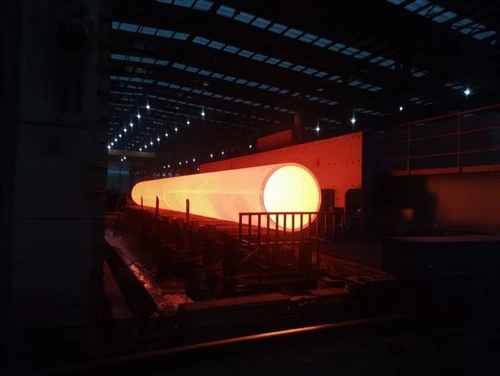
Hot expansion is the process that bridges that gap. A standard hot-rolled seamless "mother pipe," produced at or near the piercing mill's maximum diameter, is reheated - typically using mid-frequency induction heating - to a hot-working temperature, then passed through a mechanical expansion mill where an internal mandrel or expanding tool forces the heated pipe wall outward to the target larger diameter. The wall thickness reduces proportionally as the diameter increases, following the same volume-conservation logic as any hot-forming process.
The appeal is straightforward: it produces a genuinely seamless pipe (no weld seam at any diameter) at sizes a piercing mill cannot reach directly, generally at a lower cost than the alternative large-diameter seamless routes, and with reasonable production efficiency. This is why hot-expanded seamless pipe has found a steady market, particularly from Chinese seamless mills that have built specific capability around this process.
It also comes with trade-offs that a buyer specifying "seamless" for a demanding application should know about. The mother pipe carries non-metallic inclusions - sulfides, oxides, and silicates - that are a normal, low-level feature of any steelmaking process. During hot expansion, the elevated temperature and deformation can flatten these inclusions into thin, plate-like shapes aligned with the expansion direction, a phenomenon that can promote delamination (internal separation along the rolling plane) under certain stress conditions. Uneven cooling after expansion can also leave residual stresses in the pipe wall, more pronounced than in a mother pipe that was never re-worked. For general-purpose seamless applications, properly controlled hot expansion produces pipe that performs reliably within its rated specification. But for sour service - environments involving H2S where hydrogen-induced cracking (HIC) and sulfide stress cracking (SSC) resistance are the governing concern - the inclusion-flattening effect is a recognized point of caution in the industry, and some project specifications exclude hot-expanded pipe from HIC/SSC-critical service entirely, or require additional qualification testing before accepting it.
Inspection Differences That Follow From Each Process
The two processes also change what inspection needs to focus on after the fact. After cold expansion, dimensional inspection (out-of-roundness, diameter along the pipe length, straightness) is the primary check, since the process is mechanical and does not introduce the metallurgical concerns that come with reheating. Ultrasonic testing of the weld seam and body still follows the same requirements as any welded pipe, but there is no additional metallurgical re-qualification driven by the sizing step itself.
After hot expansion, ultrasonic testing takes on a more specific role: it is the practical way to check for the delamination risk described above, since flattened inclusions and internal separations are not visible from the outside. A mill running a disciplined hot-expansion process will UT scan the final expanded pipe, not only the mother pipe before expansion, precisely because the expansion step itself is what introduces the risk being checked for. If a supplier's quality documentation only shows testing on the mother pipe stage, that is worth raising as a question before placing an order for expanded seamless pipe intended for demanding service.
Lead time and cost also diverge in a way that matters at quotation stage. Cold expansion is a fast, in-line finishing step integrated into the welded pipe production sequence, adding negligible time and cost relative to the base pipe. Hot expansion is a separate reheating and forming operation performed on an already-complete mother pipe, which adds a distinct production stage, extends lead time compared to standard seamless sizes, and is reflected in a real cost premium over pipe that falls within the piercing mill's native diameter range - a premium that is often the deciding factor in whether a project chooses hot-expanded seamless or switches to a large-diameter welded alternative instead.
Two Processes, Two Different Questions to Ask
Because "expanded pipe" can mean either of these, the questions a buyer should ask depend entirely on which one applies to the product being quoted.
For cold-expanded welded pipe, the relevant questions are dimensional and mechanical: what cold-expansion ratio was applied, is it declared on the mill certificate as API 5L requires, and does the resulting property profile (particularly if compressive loading or collapse resistance matters for the application) fall within what the project's design basis assumes. This is routine information for a mill to provide and rarely a point of real concern for standard transmission or distribution service.
For hot-expanded seamless pipe, the relevant questions go further: is the pipe hot-expanded or original mother-pipe diameter (the mill certificate and PO should say so explicitly, since the two are not interchangeable for every application), and if hot-expanded, is the intended service sour, high-toughness-critical, or otherwise sensitive to inclusion orientation and residual stress. If the answer to that last question is yes, it is worth asking the supplier directly whether the specific project or grade has a documented history of successful HIC/SSC testing on hot-expanded material, rather than assuming general API 5L compliance settles the question.
Matching the Process to the Scenario
- Standard Transmission Lines (Non-Sour): Welded LSAW/SSAW pipe with standard cold expansion is the default, cost-effective choice.
- Sour Service (H2S / NACE MR0175): Avoid hot-expanded seamless pipe due to inclusion-flattening and delamination risks; opt for non-expanded seamless or cold-expanded welded pipe with a verified expansion ratio.
- General Industrial & Structural (>20" Seamless): Hot-expanded seamless pipe is ideal and economical here, provided full UT coverage is confirmed.
- High-Collapse Applications (Deepwater / Casing): Verify the cold-expansion ratio against design specs, as cold expansion lowers compressive yield strength (Bauschinger effect).
- Standard Sizes (≤20" High-P/High-T): Standard non-expanded seamless pipe is the standard solution-expansion processes are unnecessary.
- Budget-Constrained Large Seamless Specs: Hot-expanded seamless pipe provides a cost-effective choice when "seamless" is strictly required and service conditions permit.
Core Principle: Pipe selection must be driven by service demands (pressure, temperature, H2S exposure, external collapse risk), matching the manufacturing process to the operational environment.