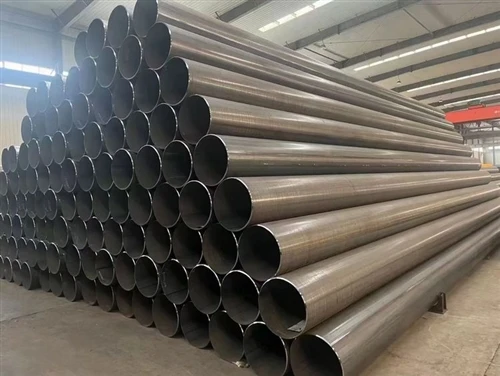
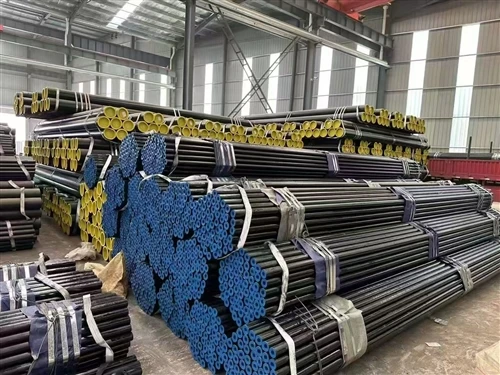
The core process of ERW is high-frequency resistance welding, which is characterized by high efficiency, low cost, and high dimensional accuracy. It is widely used, typically for fluid transport and structural support applications.
The complete manufacturing process of ERW steel pipes can be divided into five core stages: raw material preparation, forming, welding, finishing and inspection.
Preparing Raw Materials
Using carbon structural steel hot-rolled strip, it is necessary to check the chemical composition, mechanical properties, and quality in advance, ensuring that the steel has no cracks, folds, or Layered. Before the strip enters the next stage, the steel edges should be deburred, the surface of the strip should be cleaned through pickling to remove the oxide scale, and the edges on both sides of the strip should be Chamfer.

Product Forming
The strip steel passes through guide rollers into the forming unit. The roll profile of each set gradually changes, transforming the strip steel from a flat plate into a U-shape, and then transitioning to an O-shape. The forming process is carried out through cold working, which ensures the dimensional accuracy and mechanical properties of the steel pipe, ultimately forming a closed-round pipe billet.

Welded Steel Pipe
The closed round pipe billet passes through a high-frequency induction coil, and the high-frequency current concentrates on the surface layer of the strip edges. At this point, the strip edges are rapidly heated, reaching a welding temperature of 1300~1450°C. The heated pipe billet then enters the extrusion rolls, where the pressure generated by the rolls can press the two molten edges of the strip together to form a weld seam. The weld seam needs to be removed from the welded pipe by a scraping device, followed by medium-frequency annealing treatment in the weld area.

Adjusting Size
After welding, the steel pipes are cut by a flying saw to meet standard requirements. The pipes then enter a multi-roll straightening machine to adjust their curvature. After forming, the steel pipes need to be galvanized.

Inspection and Testing
Check the outer diameter, wall thickness, length, straightness, etc., of the steel pipes using calipers, thickness gauges, and laser diameter measuring instruments, and perform flaw detection with ultrasound. Take a small number of samples for tensile testing, flattening testing, hydraulic Testing, and chemical composition analysis.

Bundle and package the steel pipes that have passed inspection.