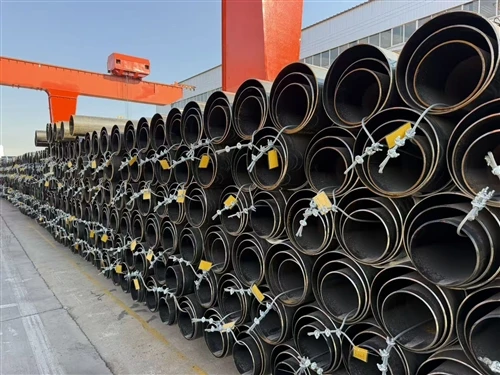
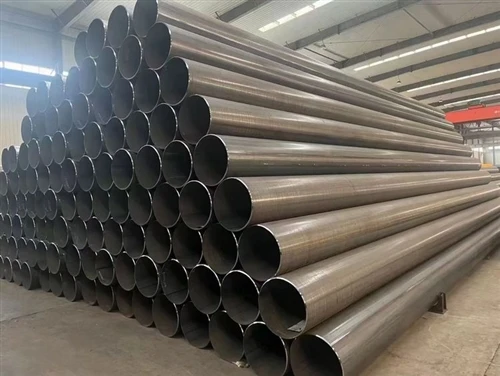
Square and round steel tube are the two most widely used hollow-section shapes in structural, mechanical, and general fabrication work, and they are frequently interchangeable on paper - both come in comparable steel grades, both are produced by similar welding processes, and both are available across an enormous size range from small handrail tube to large structural columns. But "interchangeable" doesn't mean "equivalent." The shape difference between them changes how each one behaves under load, how it looks, how it connects to other components, and how much it costs to fabricate - often in ways that matter more to a specific project than the steel grade does.
This comparison works through the real, practical differences between square and round steel pipe: how they're made, how they perform structurally, where each one is the obviously better choice, and what to check before ordering either one.

Manufacturing: Same Process, Different Final Shape
Both square and round steel tube typically start life the same way. Flat steel strip or coil is fed through a series of forming rolls that progressively curl it into a tube shape, and the seam is closed by electric resistance welding (ERW) or, for larger diameters, submerged arc welding. For round pipe, that's the finished shape. Square (and rectangular) tube takes one additional step: the round welded tube is passed through a second set of forming rolls that reshape it into a square or rectangular cross-section while the weld seam is still hot or shortly after.
This extra forming step is why square tube of a given wall thickness and steel weight generally costs a small premium over round pipe of comparable material - there's more processing involved, and the corner-forming step adds tooling and process control requirements that straight round tube doesn't need. It's a modest cost difference in most cases, but it's real, and it's one of the first things procurement teams notice when comparing quotes for functionally similar structural members in each shape.
Seamless production is available for both shapes as well: seamless round pipe is pierced and rolled directly from a solid billet, while seamless square tube starts as seamless round pipe and is then hot-formed into a square cross-section - a more specialized, lower-volume product than either seamless round or welded square tube.
Structural Performance: Where the Real Difference Lives
This is where square and round tube genuinely diverge, and it's the single most important factor in choosing between them for any load-bearing application.
Round tube resists bending equally in every direction. Because a circle has no preferred axis, a length of round pipe carrying a bending load behaves identically no matter which direction that load comes from. This makes round tube a naturally efficient shape for columns, posts, and any member expected to see load from multiple or unpredictable directions - wind loads on a pole, for example, which can come from any compass direction over the life of the structure.
Square tube also resists bending equally along both of its principal axes (since all four sides are equal), which gives it much of round tube's directional evenness while adding flat faces - a genuine hybrid of round tube's balanced behavior and rectangular tube's connection-friendly geometry. This is different again from rectangular tube, which has unequal sides and therefore a genuinely stronger and weaker bending axis, a distinction covered in more depth in [our dedicated rectangular hollow section guide].

Torsional (twisting) resistance favors round shapes slightly. For a given amount of steel, a circular cross-section is marginally more efficient at resisting torsion than a square one, because material is distributed at a more consistent radius from the center. In practice this difference is small enough that it rarely drives the shape decision on its own, but it does show up in applications like drive shafts, torque tubes, and rotating equipment components, where round tube is almost always the default for exactly this reason.
Section efficiency (strength per unit weight) is close between the two shapes for equivalent outside dimension and wall thickness, with round tube holding a small theoretical edge in pure axial and torsional loading, and square tube holding a practical edge wherever flat-face connections reduce the amount of additional steel (gusset plates, base plates) needed to join members together.
Fabrication and Connections
This is where square tube's flat faces become a real practical advantage. Bolting, welding, or clamping a bracket, plate, or secondary member to a square tube is straightforward - the flat face provides full, even contact for a bolted connection or a fillet weld along a clean, predictable line. Doing the same on round tube requires either a curved saddle plate shaped to match the pipe's radius, or accepting a less-than-full-contact connection, both of which add fabrication time and cost.
This single factor explains why square and rectangular tube dominate general building framing, machinery frames, and fabricated equipment, where members are constantly being bolted or welded to other flat components - while round tube holds its ground in applications like handrails, fencing, and piping systems, where either the connections are simpler (post caps, fittings designed specifically for round stock) or the round profile itself is functionally necessary (as in any application carrying flowing liquid or gas, where round is the only practical shape).
Aesthetics and Architectural Use
Square tube's flat, crisp lines read as more "structural" and modern in exposed architectural applications - visible steel framing, staircases, and feature columns in commercial and residential design frequently specify square or rectangular hollow section specifically for this look. Round tube carries a different visual character: softer, more traditional, and often specified deliberately for railings, canopies, and structures where a rounder, less angular profile suits the design intent. Neither is objectively "better" here - this is a genuine aesthetic decision that architects and designers make project by project, and it's worth raising early with the design team rather than assuming structural or cost factors will settle it alone.
Cost and Availability
Round pipe is generally the more widely stocked and lower-cost option at a given wall thickness and steel grade, for the manufacturing reasons described above - fewer forming steps, broader production base, and higher overall production volumes across most markets. Square tube costs modestly more for the same steel weight due to the additional forming step, though the gap narrows considerably at larger, more commonly used structural sizes where both shapes are produced at high volume.
For projects where either shape would technically work - a fence post, a simple support column, a piece of equipment framing with no strong directional load - the cost and lead-time difference can reasonably tip the decision toward round pipe. For projects where flat-face connections, architectural exposure, or specific structural detailing matter, square tube's advantages usually outweigh the modest cost premium.
Inspection and Maintenance Differences
Once either shape is in service, how it's checked and maintained diverges slightly too. Round tube's continuous curved surface has no corners, which means no localized stress concentration points from the forming process itself - a factor that matters in fatigue-sensitive applications like rotating shafts or members subject to constant vibration, where a smooth, corner-free profile reduces the number of potential crack-initiation sites. Square tube's corners, by contrast, are inherently a mild stress concentration relative to the flat faces, though this is well understood and accounted for in standard design codes and rarely becomes a practical issue outside of genuinely cyclic, high-fatigue service.
For coating inspection and maintenance, square tube's flat faces are easier to visually inspect for coating breakdown or corrosion - a flat surface shows a clear, even coating line, while a curved surface can hide thin spots or holidays (coating gaps) that are harder to spot without close inspection. This is a minor factor for most projects but can matter for long-service infrastructure where periodic recoating and inspection are part of the maintenance plan from the outset.
Buying Guide: Choosing Between Square and Round Pipe
1. Identify the load pattern first. If the member will see load primarily from one clearly dominant direction with some connection complexity involved, square tube's flat-face connections often win. If the load is genuinely multi-directional or the piece needs to resist twisting (torque tubes, rotating shafts), round tube's balanced and torsion-efficient geometry is usually the better engineering fit.
2. Confirm how the piece will connect to everything around it. Count the number of bolted or welded connections the member will need. More connections generally favors square tube, since each one is simpler and cheaper to detail and fabricate on a flat face than on a curved one.
3. Settle the aesthetic question with the design team early, particularly for any exposed structural application, rather than assuming the engineering answer will also be the visual answer - sometimes it won't, and that's a legitimate trade-off to make consciously.
4. Match wall thickness and grade to the actual design loads, not just the shape. Both square and round tube are available across comparable grade ranges (mild steel through higher-strength low-alloy grades) under the same major standards (EN 10210/10219, ASTM A500/A501, and regional equivalents) - the shape decision and the grade/thickness decision are independent and should each be driven by their own criteria.
5. Get comparative quotes for both shapes when the choice is genuinely open. Where either shape would work technically, ask your supplier to quote both - the price and lead-time gap varies by size and market conditions, and it's not always as large as assumed.
6. Confirm finish and corrosion protection needs are met equally well in either shape. Both square and round tube are available black, hot-dip galvanized, or painted, so finish generally isn't a differentiator in the shape decision itself.
7. For piping or fluid-carrying applications, round is not really a choice - it's a requirement. Any application moving liquid or gas needs a round cross-section for consistent flow characteristics and standard fitting compatibility; the square-vs-round question only applies to structural and fabrication uses, not to piping.