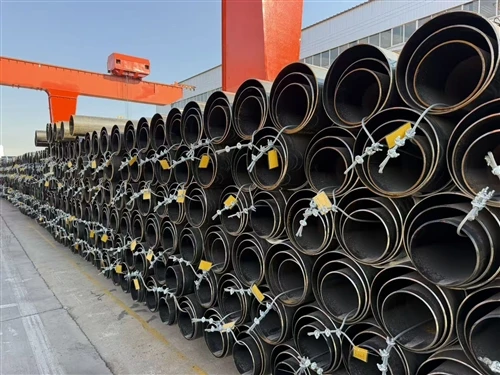
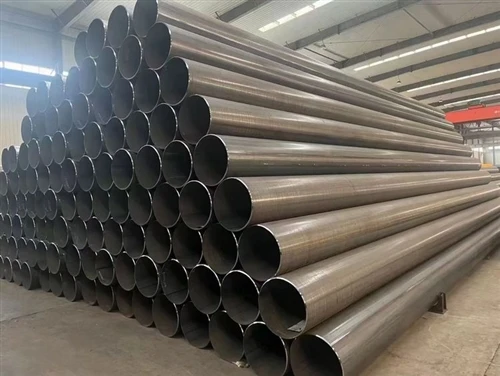
ASTM A500 and ASTM A252 are both widely recognized carbon steel tubular standards for construction, yet they are engineered for entirely different working conditions.
Core Design Purpose & Typical Applications
ASTM A500
It defines cold-formed hollow structural sections (HSS), including round, square and rectangular tubing. This standard is made for above-ground structures. Typical usage: building frames, trusses, support columns, bridge superstructure components, towers and canopies. It is designed for static structural load, precise fabrication, welding and bolted connections. The dimensional consistency and section properties are critical for structural calculation under AISC 360 design code.
ASTM A252
This specification is exclusively for steel pipe piles for deep foundation. The pipe works underground as driven piles. It can either carry load alone or serve as a hollow casing to be filled with cast-in-place concrete to form composite piles. It is engineered to survive repeated hammer impact during pile driving, soil squeezing and long-term underground vertical & lateral loads. Common projects: high-rise foundations, bridge piers, seawalls, cofferdams and retaining walls.
Chemical Composition Rules
| Element | ASTM A500 | ASTM A252 | |
| Grade B and Grade D | Grade C | Grade 1, Grade 2, and Grade 3 | |
| Carbon | 0.30 % max | 0.27 % max | - |
| Manganese | 1.40 % max | 1.40 % max | - |
| Phosphorus | 0.045 % max | 0.045 % max | 0.050 % max |
| Sulfur | 0.045 % max | 0.045 % max | - |
| Copper | 0.18 % min | 0.18 % min | - |
Notes: The chemical composition requirements for ASTM A252 are relatively simple because A252 steel pipe is primarily used as a permanent load-bearing member or as a shell for concrete piles, and the emphasis is on ensuring the pipe's load-carrying capacity and durability.
Mechanical Performance
| Tensile | ASTM A500 | ASTM A252 | ||||
| Grade B | Grade C | Grade D | Grade 1 | Grade 2 | Grade 3 | |
| Tensile strength | 400 MPa min | 425 MPa min | 400 MPa min | 345 MPa min | 415 MPa min | 455 MPa min |
| Yield strength | 315 MPa min | 345 MPa min | 250 MPa min | 205 MPa min | 240 MPa min | 310 MPa min |
Notes: ASTM A500 needs tensile testing, it mandates flattening, flaring, and crush tests. These requirements ensure that the tubing possesses superior ductility and resistance to crushing, enabling it to withstand high loads and complex structural environments. In contrast, the ASTM A252 standard does not include these additional testing requirements.
Dimensional Tolerance
| Standard | ASTM A500 | ASTM A252 |
| Shape | Round, square, rectangular, and special shapes | Round |
| Dimension | Periphery 88 in. [2235 mm] or less and wall thickness 1 in. [25.4 mm] or less | Not required |
- ASTM A500: Wall thickness tolerance is -10%. Strict control on straightness, roundness and end squareness, required for precision above-ground fabrication.
👉 Read more: [ASTM A500 ERW Round Structural Pipe | Brisk Steel]
- ASTM A252: Wall thickness tolerance is -12.5%, looser than A500. No mandatory straightness tolerance. When doing pile capacity calculation, engineers must deduct this thickness loss to avoid underdesign.
👉 Read more: [ASTM A252 ERW Piling Pipe | Brisk Steel]
Quick Summary for Substitution
- You cannot use A500 round tube to replace A252 pipe pile for driven foundation, even if OD and wall match. A500 is not validated for hammer impact driving and underground soil loading.
- A252 pipe pile generally cannot substitute A500 HSS for above-ground frames. Looser wall tolerance and uncontrolled chemistry will risk structural safety and fail design review.
- Cost note: A252 is normally more economical for large foundation piling jobs, while A500 is preferred for structures requiring accurate dimension and reliable weld performance.