A Complete Guide to Load-Bearing Capacity and Cost Differences
Selecting the right structural steel pipe is one of the most critical decisions in modern structural engineering and steel procurement, directly impacting structural safety, long-term service durability, construction efficiency, and overall project costs. Two dominant steel profiles widely used in industrial factory frameworks, high-rise building supports, municipal bridge works, and mechanical structure projects are thick-walled square tubes and seamless steel pipes. For engineers, contractors, and procurement specialists, one question consistently arises during design and tendering: can thick-walled square tubes replace seamless steel pipes for standard structural applications, and what are the exact differences in load-bearing performance and overall cost?
The substitution of square tubes for traditional seamless round pipes is not universally applicable nor entirely ineffective. Each steel profile features unique structural mechanics, manufacturing characteristics, and application boundaries. Improper material replacement in the steel industry often leads to two major issues: unsafe structural conditions caused by using welded square tubes in high-fatigue load scenarios, and unnecessary budget waste from over-specifying expensive seamless steel pipes for basic static support structures.
This article industry-standard comparison between thick-walled square tubes and seamless steel pipes, covering manufacturing processes, load-bearing capacity, structural adaptability, market pricing, construction expenses, maintenance lifecycles, and valid substitution scenarios.
1. Basic Process and Structural Essence of Two Steel Pipes
To accurately determine whether thick-walled square tubes can replace seamless steel pipes in structural design, it is essential to first understand their fundamental manufacturing differences and mechanical properties. Process distinctions create core performance gaps in load-bearing stability, stress resistance, and service reliability, which define their respective engineering application scopes.
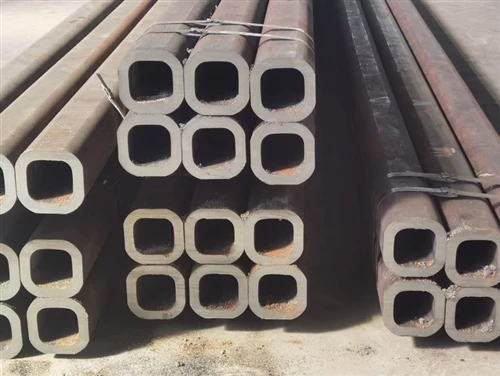
In industrial steel specifications, thick-walled square tubes are defined as square hollow structural sections with a wall thickness of 6mm or above, engineered specifically for heavy-load structural support. The market offers two primary types: welded hot-rolled square tubes and seamless square tubes. Welded thick-walled square tubes dominate structural engineering projects due to their mature production technology, stable quality consistency, and superior cost performance.
Manufactured through hot-rolled plate cutting, precision cold bending, high-frequency welding, integral shaping, and stress-relief annealing, standard thick-walled square tubes feature uniform wall thickness, flat vertical surfaces, and excellent straightness. Unlike thin-walled decorative square tubes, structural-grade thick-walled square tubes undergo professional post-welding stress relief treatment, eliminating residual welding tension and preventing long-term deformation or cracking.
The symmetrical closed square section delivers outstanding planar load-bearing performance. When subjected to vertical compression, bending moments, and horizontal shear forces, stress distributes evenly across the tube body without localized stress concentration, making it ideal for static loads and low-frequency dynamic structural systems.
Different from thin-walled square tubes used for decoration and light support, thick-walled square tubes undergo strict stress relief treatment after welding and forming, which effectively eliminates welding residual stress and avoids structural deformation and cracking problems in the later service process. The standardized closed square section structure enables the tube body to bear uniform planar force, providing stable mechanical support for various static load and low-frequency dynamic load structures.
In terms of structural characteristics, the square closed section has excellent planar stress-bearing performance. The four-sided symmetrical structure makes the force distribution more uniform when bearing vertical pressure, bending moment, and horizontal shear force, with no obvious stress concentration defects in the main stress area. It is specially optimized for static load and conventional dynamic load structural scenarios.

Thick-Walled Square Tube

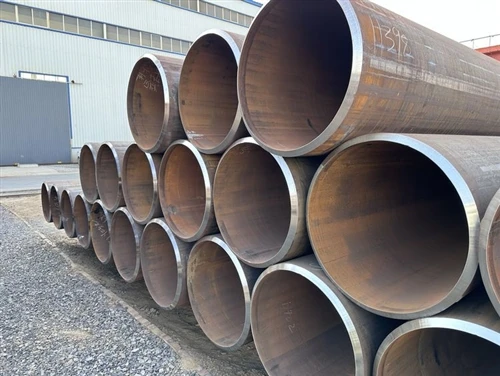
JCOE LSAW Pipe

Redrawn Square/Rectangular Tube from Round Pipe
Seamless steel pipes are premium integral-formed tubular products manufactured without any welding process. The production workflow involves high-temperature heating of solid steel billets, rotary piercing, hot rolling, precision sizing, straightening, and non-destructive flaw detection. The entire pipe body features a unified metallic structure with zero welding seams, zero welding defects, and zero residual welding stress.
Thanks to its dense, uniform internal microstructure, a seamless steel pipe maintains consistent mechanical strength across all sections. Its centrosymmetric circular cross-section provides exceptional resistance to torsion, internal and external pressure, impact loads, and cyclic fatigue stress. This makes seamless steel pipes indispensable for high-pressure, high-temperature, and high-safety industrial systems.
The core advantage of seamless steel pipes lies in omnidirectional uniform stress dispersion. Unlike square profiles that excel in planar force bearing, round seamless pipes withstand three-dimensional complex stress, delivering far higher fatigue resistance and structural stability under extreme working conditions than welded thick-walled square tubes.
The internal metal structure of seamless steel pipes is compact, uniform, and free of structural weak points, with consistent mechanical properties in all parts of the pipe body. The centrosymmetric circular cross-section enables seamless steel pipes to exhibit outstanding performance in resisting torsional load, internal and external pressure, alternating fatigue load, and impact load. It is a key structural material indispensable in high-pressure, high-temperature, high-precision, and high-safety industrial scenarios.
Different from square tubes, the structural advantage of seamless steel pipes lies in three-dimensional uniform stress resistance. The circular section can evenly disperse pressure in all directions, which is irreplaceable in high-pressure, high-temperature, and strong alternating load working conditions. Its structural stability and fatigue resistance are far superior to welded thick-walled square tubes.

Seamless Steel Pipe

Hot Expansion Seamless Pipe

Heavy-Wall Seamless Steel Pipe
2. Professional Comparison of Load-Bearing Capacity: Square Tube vs Seamless Pipe
In structural engineering, load capacity is evaluated based on three main structural stresses: bending (flexure), axial compression (column bucking), and torsion (twisting). The table below details how each shape performs under these distinct conditions:
|
Loading Type |
Superior Choice |
Mechanical Analysis and Technical Insights |
|
Single or Dual-Axis Bending |
Thick-Walled Square HSS |
Square sections place a higher volume of material further away from the center of gravity (the neutral axis). For an identical cross-sectional area (or weight per meter), a square hollow section exhibits a significantly higher section modulus (W ) and moment of inertia (I ) than a circular pipe. Consequently, when resisting vertical or lateral bending moments, square HSS offers superior stiffness and exhibits much lower deflection. |
|
Axial Compression (Columns) |
Tie / Case-Dependent |
A seamless circular pipe features a perfectly axisymmetric cross-section, giving it an identical radius of gyration (γ) in every direction. This provides uniform structural stability against buckling. While a square section performs exceptionally well parallel to its walls, it is marginally weaker along its diagonals. However, by optimizing wall thickness, a square HSS column delivers a structural performance that easily rivals a seamless pipe. |
|
Torsion (Twisting Forces) |
Seamless Steel Pipe |
Circular profiles distribute shear stress uniformly around their perimeter when twisted, maximizing torsional efficiency. Conversely, square sections develop severe stress concentrations at their four corners under high torque. For applications involving high-torque rotational shafts or drivetrains, seamless pipes remain irreplaceable. |
Structural Takeaway:
If your project involves building frameworks, roof trusses, machinery bases, structural columns, or secondary floor beams where forces are primarily driven by bending and compression, you can confidently substitute seamless pipes with thick-Walled square HSS of equal cross-sectional area-often achieving enhanced structural rigidity.
3. Financial Analysis: Raw Material Prices vs. Fabrication Costs
For procurement professionals, cost efficiency determines viability. Let's break down the financial impact into three core areas:
1. Raw Material Price Per Ton
The multi-stage manufacturing process required for seamless pipes (piercing and mandrel rolling) yields lower production rates and demands high-grade steel billets, driving up market costs. In contrast, thick-walled HSS relies on highly efficient, automated continuous welding of mass-produced hot-rolled coils. Consequently, welded thick-walled square HSS generally costs $50 to $120 less per ton than seamless steel pipes of equivalent steel grades.
2. Steel Volume Reduction
Thanks to the structural efficiency of square profiles under bending loads, engineers can often specify a thinner wall or a smaller nominal size without compromising safety factors.
Case in Point: In an industrial roof truss design originally requiring a seamless pipe with an outside diameter of Φ159×8 mm, structural calculations reveal that a 120×120 × 6mmsquare HSS provides identical or superior bending stiffness. This geometric optimization cuts total steel weight by over 10% per meter, delivering a dual financial benefit: lower cost per ton combined with a reduction in total tonnage.
3. Joint Processing and On-Site Assembly Costs
The flat faces of square sections offer an exceptional hidden economic advantage over circular pipes. Joining intersecting circular pipes requires highly complex profile/intersection cutting (saddle cuts), requiring advanced CNC machinery or highly skilled manual welders, which escalates labor expenses.
[Circular Pipe Joining] ──► Requires Complex Saddle Cuts ──► High Welder Labor Costs
[Square HSS Joining] ──► Requires Simple Straight Cuts ──► Rapid assembly & 30%+ Faster Installation
Square profiles require only clean, straight cuts to achieve perfect flush joints against other square sections, H-beams, or flat end plates. They can also be pre-punched for rapid bolting on-site. This simplifies fabrication, accelerating installation ti mes by over 30% and lowering welding consumable costs by 20% to 40%.
4. Clear Substitution Rules: When Can Square Tubes Replace Seamless Pipes?
Based on the above load-bearing performance and cost comparisons, we summarize standardized, code-compliant substitution rules to help designers and buyers implement reasonable material replacement while eliminating safety hazards.
-
Scenarios Where Thick-Walled Square Tubes Can Completely Replace Seamless Steel Pipes
| Core Application Sector | Specific Applicable Engineering Scenarios | Benefit Analysis of Substitution |
| Conventional Building Steel Structures | Main load-bearing columns of industrial workshops, secondary support beams, wall frame supports, floor deck skeletons, and large-span roof trusses. | Give full play to the excellent static bending stiffness of square tubes, reduce deflection deformation, and significantly cut the total steel consumption in tons. |
| Municipal and Landscape Engineering | Highway and bridge guardrail posts, street lamp and signboard bases, landscape three-dimensional steel structure frames, and municipal comprehensive pipe gallery supports. | Stable planar stress bearing, neat and aesthetically pleasing section, greatly simplifying the anchoring construction with civil engineering foundations and embedded parts. |
| Mechanical Equipment Frames | Heavy-duty fixed processing machinery supports, main frames of large-scale stereoscopic warehouse racks, and support frames for logistics conveyor lines. | Pure planar contact facilitates high-precision positioning and bolt fastening installation of mechanical components and guide rails. |
| Normal-Pressure Ordinary Grid Structure Engineering | Various steel grid structures that only undertake structural load-bearing and enclosure functions, and do not bear fluid pressure, high temperature, or strong corrosion. | No complex intersecting line processing is required for node connections, and the on-site assembly speed is significantly improved. |
-
Scenarios Where Substitution Is Prohibited (Seamless Pipes Must Be Used)
Substitution is strictly prohibited in high-risk working conditions where seamless steel pipes remain mandatory.
- high-pressure fluid conveyance systems, including oil and gas pipelines, chemical medium pipelines, boiler high-pressure steam pipes, and hydraulic pressure pipelines, where square tube weld defects may cause leakage or bursting accidents.
- structures bearing strong torsion and alternating fatigue loads, such as mechanical transmission brackets, vibration equipment supports, and vehicle chassis components.
- high-safety-level key projects including nuclear power auxiliary structures, large bridge main stress components, aerospace supports, and petrochemical core frames.
- extreme environment structures operating under high temperature, strong chemical corrosion, or marine salt-fog conditions.
In these professional scenarios, the limited fatigue resistance and weld seam defects of thick-walled square tubes pose severe safety risks, making integral-formed seamless steel pipes the only reliable option.
5. Professional Suggestions for Structural Steel Pipe Selection
- judge material selection by load characteristics. Adopt qualified thick-walled square tubes for static load, bending load, and wind load structural components to cut costs safely. Reserve seamless steel pipes exclusively for torsion, fatigue, high-pressure, and high-temperature working conditions to avoid structural risks.
- balance safety factors and economic benefits. Avoid two common industry errors: cost-driven blind substitution in high-risk scenarios and performance-driven over-specification of seamless pipes for ordinary structures. All material selection must comply with international steel structure design codes and project safety standards.
- enforce strict material quality control for substitution projects. Only use 6mm+ thick-walled square tubes of standard Q235B and Q355B grades; reject thin-walled, unannealed, and recycled inferior square tubes for main load-bearing structures.
- standardize on-site construction quality, conducting full weld flaw detection and stress relief treatment for welded square tube structures to eliminate hidden defects.
6. Conclusion
In conclusion, thick-walled square tubes can safely and legally replace seamless steel pipes for most conventional static structural support applications. With superior static load-bearing efficiency, simpler installation workflows, and significantly lower material and construction costs, thick-walled square tubes represent the most cost-effective solution for general steel structure projects in 2026. Nevertheless, square tube substitution is limited to normal working conditions and is not applicable for high-pressure fluid piping, high-temperature operation, torsional fatigue, and extreme environment projects.
There is no absolute superior or inferior steel profile-only reasonable or unreasonable application. Scientific substitution of thick-walled square tubes for qualified seamless pipe projects has become a mature industry strategy to balance structural safety and economic benefits. For structural engineers and steel procurement teams, mastering the boundary of square tube replacing round pipe enables optimized project budgeting, shorter construction cycles, and zero-compromise structural safety, maximizing overall project returns.