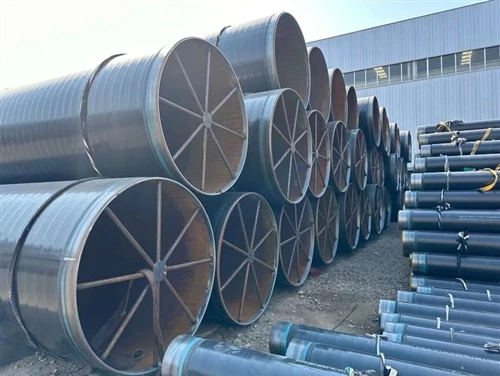
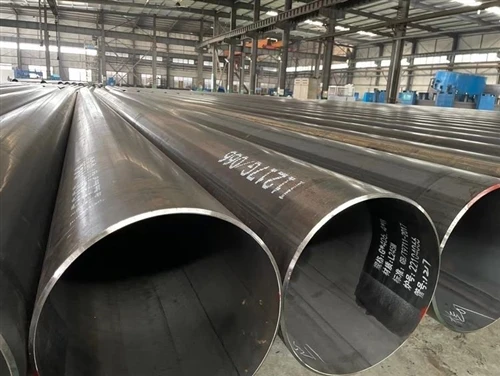
Steel pipe is attacked from two sides at once. Outside, soil moisture, groundwater, seawater and damp air go after the wall. Inside, oxygen-rich water, chemicals and condensation form scale and rust. A pipe protected on only one side is protected halfway, and the unprotected side usually decides the service life.
TPEP anti-corrosion steel pipe is built to protect both sides. This article explains what it is, the main places it is used, and the specification points that decide whether a coated pipe lasts decades or fails early.
What TPEP Anti-Corrosion Steel Pipe Is
TPEP is a trade name widely used for a composite coated steel pipe: a three-layer polyethylene (3PE) coating on the outside and an epoxy powder (EP) lining on the inside, both applied to a carbon steel base pipe. The three outer layers are an epoxy primer, an adhesive layer and a polyethylene topcoat.
Outside China, the same construction is usually written as "3LPE externally coated, epoxy lined steel pipe", so it helps to search standards and approvals under those terms.

The division of work is simple. The steel carries the pressure and the external load. The coatings only protect the steel. A thick coating does not add pressure capacity, which is why the base pipe still has to be specified on its own merits.
Cutaway sample of a TPEP pipe end
Where TPEP Anti-Corrosion Steel Pipe Is Used
Circulating Water Systems
Chilled water, hot water and secondary heating loops all circulate the same water for years. Oxygen picked up at fittings and open points feeds internal corrosion, and the resulting scale rises in pressure drop and fouls heat exchangers and strainers.
An epoxy-lined pipe keeps a smooth bore that does not grow scale, so friction loss stays closer to its design value and pump energy does not creep up. For buried supply lines, the 3PE outside resists soil moisture. Coating systems of this type are designed for a service life of 50 years or more under rated conditions, though real life depends on temperature, pressure cycling and joint quality, not on the coating alone.
One caution. PE-based outer coatings and epoxy powder linings both have rated temperature limits, often in the range of about 60 to 80 degC for continuous service, depending on the material grade. Some buried heating supply lines run hotter than that. Confirm the rated temperature against your supply temperature, or choose an insulated, jacketed pipe for the hot leg.
Fire Protection Water Supply
Fire mains and sprinkler networks sit full of stagnant water for years, then must deliver full flow within minutes. Internal rust and tubercles shrink the effective bore, and flakes can block nozzles or sprinkler heads. The consequence of a restricted pipe is a delayed response, which is the one failure a fire system cannot afford.
An epoxy lining resists internal corrosion in both water-filled and dry conditions. Dry or pre-action systems are especially hard on bare steel because air and condensation corrode the wall. Some fire protection pipe is supplied with a flame-retardant epoxy formulation, so confirm the exact lining material.
Fire systems are governed by local code and by listing requirements for the pipe and its fittings, such as NFPA 13 in many markets. Ask for the approval before ordering, not after.
Water Supply and Drainage in Buildings
Hotels, high-end residential towers and commercial complexes use cold and hot water risers, plant-room headers and large-diameter distribution lines. Coated carbon steel pipe is often more economical than stainless steel or copper at large diameters, while the lining keeps rust from discoloring the water at the tap.
Where the water is drinking water, the lining must be approved for potable contact, for example under NSF/ANSI 61 or the equivalent national scheme. A coating that is excellent for fire water is not automatically acceptable for drinking water.
Corrosive Fluids in Petrochemical, Metallurgy, Coking and Light Industry
Process plants move dilute acids, alkaline solutions, saline water, cooling water and wastewater. The epoxy lining forms a chemical barrier between that fluid and the steel, and the 3PE outside protects against damp plant environments and buried routes.
Chemical resistance depends on the fluid, its concentration and its temperature, not on the general category. Epoxy handles many dilute acids, alkalis and salt solutions well, but strong oxidizing acids and some solvents attack it. Check the actual fluid against the lining supplier's resistance data.
Underground Cable Protection Conduit
Steel conduit protects power and communication cables under roads, rail crossings and other loaded ground. The steel resists crushing, the 3PE resists soil, and the smooth epoxy lining lowers the friction when cables are pulled through. It also keeps cable sheaths away from rough steel and rust flakes.
Because conduit is often assembled from many short lengths, the sleeves or couplings should not leave sharp edges or bare steel at the joint.
Mining: Ventilation, Drainage and Gas Lines
Mines are humid, dusty and often chemically aggressive. Pipes carry positive and negative pressure ventilation air, underground water supply and drainage, fire sprinkler water and gas drainage. Coating on both sides protects the wall from acidic mine water on the inside and damp or dripping conditions on the outside.
Mine safety rules add a requirement that general pipe does not face. Non-metallic coatings used underground are commonly required to be anti-static and flame-retardant, verified by test reports. Confirm what the regulator in your country asks for before ordering.
Municipal Water, Seawater and Sewage
Municipal water mains need a lining that protects water quality and holds flow capacity, plus an external coating for soil. Seawater pipelines are harsher: chloride attacks bare steel quickly, so the coating has to be continuous, and cathodic protection often supplements it. Sewage lines, especially partly filled ones, can produce sulfuric acid at the top of the pipe from hydrogen sulfide, and an epoxy lining helps resist that attack.
Application Summary
| Application | Main Corrosion Driver | Coating Emphasis | First Check |
|---|---|---|---|
| Circulating water | Oxygen, scale, soil moisture | Inner EP lining, outer 3PE if buried | Rated temperature |
| Fire protection | Stagnant water, wet and dry cycles | Inner EP lining | Listing and approval |
| Building water supply | Oxygen, rust coloring | Inner EP lining | Potable approval |
| Industrial corrosive fluids | Acid, alkali, salt | Inner EP lining | Chemical resistance by fluid |
| Cable conduit | Soil moisture, crush load | Outer 3PE, smooth inner lining | Joint edges |
| Mining | Humidity, acidic water | Both sides | Anti-static and flame-retardant reports |
| Municipal, seawater, sewage | Chloride, H2S acid, soil | Both sides | Coating continuity, cathodic protection |
Where Coated Pipe Actually Fails
Coated pipe rarely fails in the middle of a clean length. It fails where the coating is interrupted: at cut or welded ends, at joints, and at local damage.

A cut end leaves bare steel and an exposed lining edge. A joint can break the continuity of both layers. A cut or pinhole in the outer coating lets groundwater reach the steel, and the corrosion then spreads beneath the intact coating. This is why the buying guide below spends so much time on joints and approvals.
Buying Guide: How to Specify Anti-Corrosion Steel Pipe
Name the fluid and its temperature first. Every other choice follows from these two facts. Coating systems have rated temperatures, and chemical resistance is judged against a named fluid, not a category such as "chemicals". Give the fluid, concentration, normal and peak temperature.
Let the base pipe set the pressure rating. The coating adds no strength. The pressure class is set by the steel pipe standard and wall thickness, for example under GB/T 3091, ASTM A53, EN 10217 or API 5L, and the design pressure should be checked against that wall, including any surge.
Read coating thickness against the standard class. External polyolefin coatings are classified in standards such as ISO 21809-1 and DIN 30670, which set minimum thicknesses by pipe size and by mechanical load class. Rocky backfill, horizontal drilling or jacking calls for a heavier class than soft soil. Internal fusion-bonded epoxy is commonly specified at about 0.3 mm or more under water pipeline standards such as AWWA C213. State the class and thickness in the order, not just "3PE".
Decide the joint method before the pipe is made. Welded joints destroy the coating locally and need a field joint coating. Grooved and flanged joints can keep the lining continuous to the joint face. Threaded joints require lined fittings. Cutting or welding on site breaks the lining unless the exposed steel is re-sealed. The joint method should be fixed at design stage, because it determines the pipe end preparation.
Match the lining approval to the service. Drinking water needs a potable approval such as NSF/ANSI 61 or a national equivalent. Fire protection needs system listing. Underground mining needs anti-static and flame-retardant test reports. Chemical service needs resistance data for the actual fluid. One pipe seldom carries all four approvals, so ask for the one your service requires.
Account for soil, marine and exposure conditions. For buried and marine pipe, soil resistivity, groundwater and backfill type influence the coating class. Cathodic protection can work alongside 3PE, and in seawater it is often added. Where the pipe is exposed above ground, confirm UV resistance of the outer layer.
Check external pressure in suction and vacuum duty. Negative-pressure ventilation and some drainage lines can put external pressure on the wall. Wall thickness is then chosen for collapse resistance, not only for internal pressure, and the lining needs good adhesion under suction.
Size using the lined bore and its roughness. The lining reduces the inside diameter slightly but lowers friction. Designers commonly use a higher Hazen-Williams coefficient for epoxy-lined pipe than for aged unlined steel. Use the roughness or coefficient your design code accepts for the declared lining.
Summary
TPEP anti-corrosion steel pipe protects both faces of a steel wall: 3PE outside against soil, water and impact, and epoxy powder inside against scale and rust. That makes it a practical choice for circulating water, fire protection, building water, corrosive process fluids, cable conduit, mines and municipal or seawater lines.
The result depends on matching the coating system to the fluid, temperature and approvals, and on planning the joints so the protection stays continuous. If you share your fluid, temperature, pressure and installation method, we can recommend the coating system and base pipe that fit your project.