

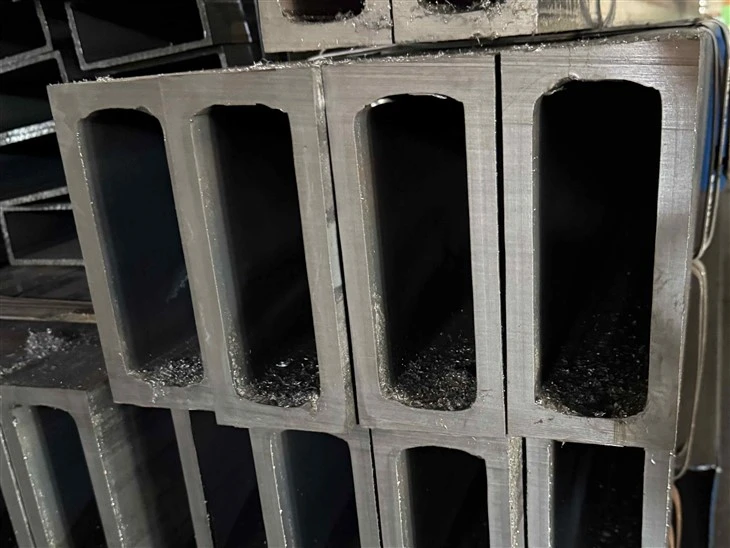
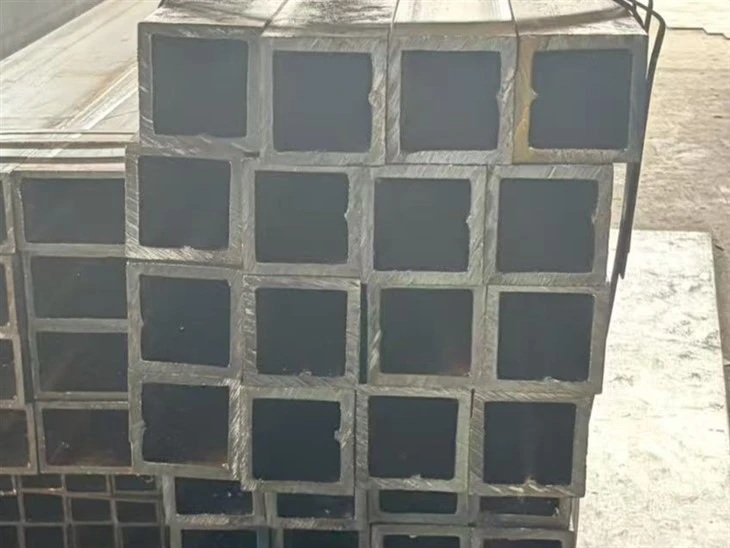
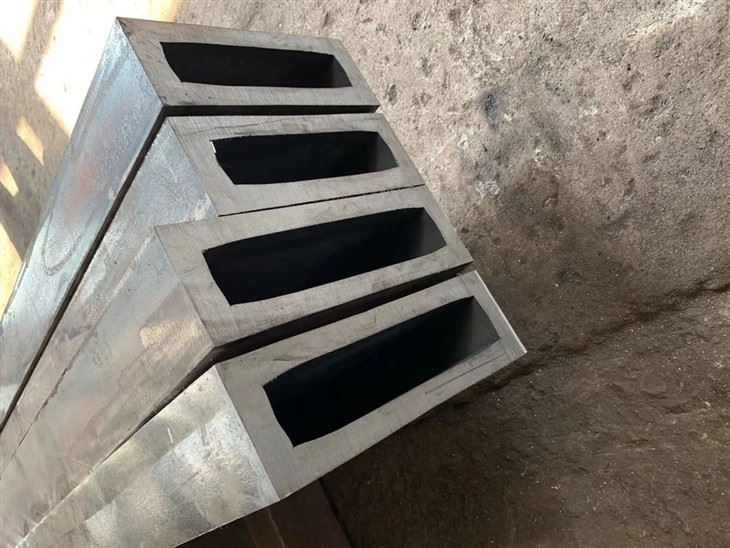
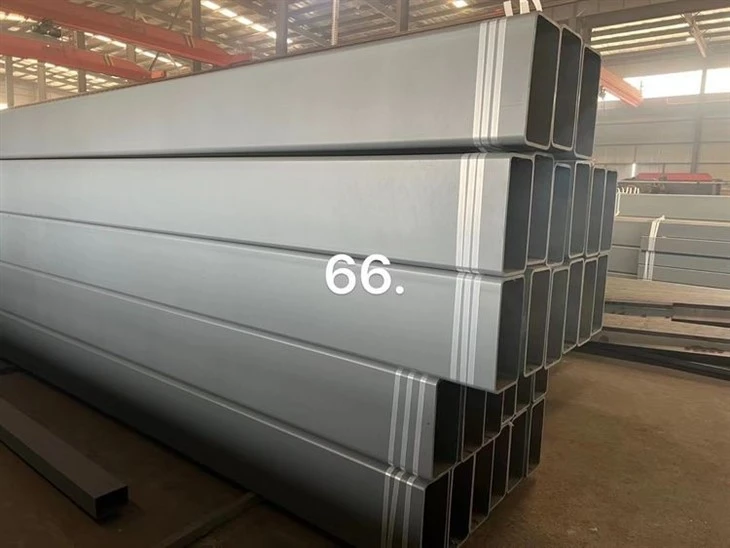
Tianjin Brisk Steel is one of the Sharp Corner Steel Hollow Section in China. Our products are mainly exported to the Middle East, Southeast Asia, Europe, New Zealand, and other regions.If you would like to learn more about our products, feel free to contact us and send your purchase list.


Quick Specification Reference
| Item | Typical Range |
|---|---|
| Shape | Square (SHS) and Rectangular (RHS) |
| Outer size | 20x20 mm to 500x500 mm (custom sizes on request) |
| Wall thickness | 2 mm to 25 mm |
| Corner radius | Near-zero (true sharp corner), independent of wall thickness |
| Standard cold-formed corner radius for comparison | Approximately 2x wall thickness (t), per EN 10219 / ASTM A500 |
| Length | Up to 12 m, mill-cut lengths available |
| Material grades | S235, S275, S355 (EN); ASTM A36 / A500 equivalent chemistry on request |
| Surface finish | Mill/black, hot-dip galvanized, primed, or blasted |
| Standard use | Architectural exposed steel, curtain wall structure, custom fabrication |
Why an Ordinary Cold-Formed Corner Isn't Always "Square Enough"
Conventional square and rectangular hollow sections are made by taking a strip of coil, forming it into a tube shape on a roll-forming line, and welding it closed along one seam. The corners get their shape from a set of forming rolls pressing the strip around a die - not from four flat faces meeting at an angle. That process leaves an outer corner radius that scales with wall thickness, roughly 2t under both EN 10219 and ASTM A500. A 6 mm wall tube might carry a 12 mm outer radius; go to 12 mm wall and the radius can double.
For most structural steelwork that radius is irrelevant - nobody notices a rounded corner on a warehouse column. It becomes a real problem the moment a design assumes a flat, right-angle edge: a glazing gasket that needs a clean seat, a cladding bracket drilled for a square profile, or an exposed architectural post where the rounded edge visibly breaks the line of the facade. Buyers searching for "sharp corner hollow section" are almost always trying to solve one of those fit or appearance problems, not just looking for a stronger tube.
How a True Sharp Corner Is Actually Made
Sharp corner hollow section is not rolled from a single strip - it is built up from flat plate or strip pieces joined at the corners.
- Flat steel strip or plate is plasma or laser cut to the exact width needed for each face of the finished section.
- The individual flat pieces are precisely positioned and tack-welded at each corner joint, typically using submerged arc or high-precision MAG/laser welding.
- The corner welds are run full length, producing a continuous, fully fused seam at each of the four (or more, for custom polygonal shapes) corners.
- The section is straightened to remove any welding-induced camber or twist.
- Corner welds and outer faces are ground or dressed where a smooth exposed finish is required.
- The tube is cut to final length and cambered/tolerance-checked.
- Surface treatment (blasting, priming, or hot-dip galvanizing) is applied per the order.
Because each face starts flat and the corners are welded rather than rolled, the resulting outer radius is close to zero regardless of wall thickness - a 20 mm wall section can have the same sharp edge as a 3 mm wall section, something a rolled profile can never achieve.
Where Sharp Corner Sections Get Specified
Curtain wall mullions and transoms. Facade systems that rely on a flush glazing pocket or a specific gasket profile depend on a true flat corner to seal correctly - a rolled radius eats into the gasket seat.
Cladding and panel support frames. Panel brackets and clip systems drilled to a square reference edge fit correctly only when the corner is actually square.
Architecturally exposed structural steel (AESS). Where the structure itself is the finish - lobby columns, canopies, entrance features - a crisp corner reads as intentional design; a visible radius reads as an off-the-shelf compromise.
Sculptural and bespoke fabrication. Custom box sections for signage, art installations, and furniture-grade steelwork often specify sharp corners purely for the clean visual line.
Precision machine frames. Equipment bases and enclosures that mount flat components flush to the tube face benefit from the corner not intruding into the mounting area.
Trade-Offs to Plan For
Sharp corner construction is not a drop-in replacement for standard hollow section in every case, and it's worth knowing the trade-offs before specifying it by default:
- Lead time and cost. Built-up, welded construction from flat plate takes longer to produce than roll-forming from coil, and pricing reflects the extra cutting and welding steps.
- Corner stress concentration. A true sharp corner has less material continuity at the joint than a smoothly rolled radius; for heavily loaded structural connections, an engineer may still prefer a small radius rather than a mathematically sharp edge. Confirm with the project engineer when the section is doing real structural work, not just an aesthetic finish.
- Minimum quantities. Because sizes and corner details are frequently custom, mills generally quote sharp corner sections against a specific project cut list rather than off a stock size chart.
FAQ
Q: Is sharp corner hollow section the same as "architectural tubing"?
A: Not automatically - "architectural tubing" is sometimes used loosely for standard cold-formed HSS with a nicer surface finish, which still carries a rolled corner radius. If a true flat corner is required, specify "sharp corner" or "laser-welded" hollow section explicitly rather than relying on the word "architectural" alone.
Q: How small can the corner radius actually get?
A: On a properly built plate-welded section, the outer corner is close to a true right angle - visually and functionally flat, not just a smaller version of the standard radius. It will never be a mathematically perfect zero-radius edge, but it is a different category from the 2t radius on cold-formed product.
Q: Can sharp corner sections be hot-dip galvanized?
A: Yes. Vent and drain holes should be specified at the design stage the same as with any closed hollow section, so the galvanizing bath can flow through and vent gas can escape during dipping.
Q: Does going to a sharp corner section change the load rating compared to standard HSS?
A: Section properties (wall thickness, overall dimensions) drive load capacity the same way they do on any hollow section, but the corner detail changes local stress behavior at the joint. For load-bearing use, share the connection design with us so wall thickness and corner weld quality can be matched to the actual stress at that joint, not just the nominal section size.


Hot Tags: sharp corner steel hollow section, China sharp corner steel hollow section manufacturers, suppliers, factory, ASTM A500 GR B HOLLOW SECTION, hollow section commerce, hollow section demand, hollow section identification, hollow section project solution, hollow section recyclability


