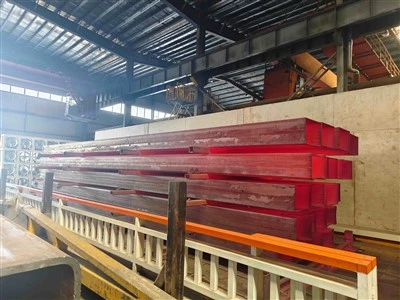
Tianjin Brisk Metalwork Co., Ltd. is one of the leading manufacturers and suppliers of astm a501 hot-formed carbon steel structural tubing in China. We have world-leading production equipment and strong manufacturing capabilities. Please feel free to buy bulk durable astm a501 hot-formed carbon steel structural tubing from our factory.
Tianjin Brisk Steel is one of the ASTM A501 Hot-Formed Carbon Steel Structural Tubing in China. Our products are mainly exported to the Middle East, Southeast Asia, Europe, New Zealand, and other regions.If you would like to learn more about our products, feel free to contact us and send your purchase list.


Quick Reference Table
| Property | Grade A | Grade B | Grade C |
|---|---|---|---|
| Yield Strength (min) | 38,000 psi (260 MPa) | 46,000 psi (315 MPa) | ~50,000 psi (345 MPa) |
| Tensile Strength (min) | 58,000 psi (400 MPa) | 65,000 psi (448 MPa) | 70,000 psi (483 MPa) |
| Elongation (min) | 25% | ~23-24% | 23% |
| Phosphorus / Sulfur (max) | Standard limits | 0.030% / 0.020% | 0.030% / 0.020% |
| Impact Testing | Not required | Optional (S1 supplement) | Optional (S1 supplement) |
| Manufacturing Methods | Seamless, furnace-butt weld, ERW, SAW | Seamless, ERW, SAW | Seamless, ERW, SAW |
| Shapes | Round, square, rectangular, special | Same | Same |
| Finish | Black or hot-dip galvanized | Black or hot-dip galvanized | Black or hot-dip galvanized |
Grade B is the most commonly specified of the three - it offers a meaningful strength step up from Grade A without the tighter chemistry and reduced ductility trade-offs that come with Grade C.
Hot-Formed vs. Cold-Formed: The Distinction That Actually Matters
A501 is frequently confused with ASTM A500 because both cover carbon steel structural tubing in the same shapes and a similar strength range. The difference that matters for design and fabrication isn't the grade letters - it's the forming process itself.
A500 is cold-formed: strip steel is roll-formed into shape and welded at ambient temperature. This cold working measurably increases yield strength, particularly at the corners of square and rectangular shapes, which is part of why A500's published yield values can look competitive with A501 despite starting from similar base chemistry.
A501 is hot-formed: the tubing is shaped and welded at elevated temperature, then allowed to cool without the strain-hardening effect cold working produces. The result is a more metallurgically uniform section - no locked-in residual stress from cold bending, more consistent grain structure around the full perimeter, and mechanical properties that don't vary between the flat faces and the corners the way a cold-formed section's can.
Neither process is categorically "better." Cold-formed A500 tends to win on cost and lead time for standard structural columns and framing. Hot-formed A501 tends to be specified where uniform properties around bends matter more - heavy welded trusses, bridge members subject to fatigue or dynamic loading, and sections that will see significant heat input from field welding, where a cold-worked corner is more prone to localized embrittlement than a hot-formed one.
The Manufacturing Route Nobody Asks About: SAW
A501 permits submerged arc welding as a production method, in addition to seamless, furnace-butt welding, and electric-resistance welding. SAW opens up larger diameters and heavier wall thicknesses than ERW production typically reaches economically, which is why A501 shows up more often than A500 on large-diameter bridge piling and heavy column applications - the standard itself accommodates the production method needed to get there.
Impact Testing Is Supplementary, Not Automatic
Grades B and C carry an optional supplementary requirement (S1) for Charpy V-notch impact testing at low temperature, and wall thicknesses of 0.250 in. (6.3 mm) or less are exempt from impact testing entirely unless specifically called out. This is a detail worth flagging because it's easy to assume a "structural grade" automatically comes with toughness verification - it doesn't, unless the purchase order specifically invokes S1 and states the test temperature and required absorbed energy. A mill certificate with no impact test results isn't a nonconformance on a standard order; it's simply what happens when S1 was never specified.
A Case Where the Forming Process, Not the Grade, Caused the Redesign
A fabricator bidding a welded truss structure had material takeoffs built around A500 Grade B tubing, then substituted A501 Grade B during procurement on the assumption that matching yield and tensile numbers made the two interchangeable. The engineer of record flagged the substitution during shop drawing review: the truss's connection design had assumed the corner strength enhancement typical of cold-formed A500 sections at the gusset plate welds, and hot-formed A501 doesn't carry that same corner condition. The grades matched on paper; the forming process didn't, and the connection detail needed a second look before fabrication proceeded. Nothing was out of spec - the mismatch was between the assumed forming process and the one actually ordered.
FAQ
Q: Is A501 stronger than A500 of the same grade letter?
A: Not necessarily - published minimum yield and tensile values differ somewhat between the two standards even at matching grade letters, and A500's cold-formed corners can carry additional localized strength that A501's hot-formed sections don't replicate. The two standards should be compared on their actual specified values, not assumed equivalent because the grade letter matches.
Q: Can A501 and A500 be substituted for each other on a project?
A: Only if the engineer of record has confirmed the design didn't rely on cold-forming-specific properties, and the specified finish, size, and wall thickness are actually available under the standard being substituted in. Treat it as a design question, not a procurement convenience.
Q: Does A501 tubing always need impact testing?
A: No. Impact testing under A501 is a supplementary requirement (S1) that applies only when specifically ordered, and wall thicknesses of 0.250 in. or less are exempt regardless. A certificate without impact results is normal unless S1 was invoked on the purchase order.
Q: What's the difference between furnace-butt welding and electric-resistance welding under A501?
A: Both are permitted production methods, but furnace-butt (continuous) welding is an older, generally lower-cost process typically limited to smaller sizes, while ERW and SAW cover the larger diameter and heavier-wall range more commonly seen in structural applications today.


Hot Tags: astm a501 hot-formed carbon steel structural tubing, China astm a501 hot-formed carbon steel structural tubing manufacturers, suppliers, factory, ASTM A500 GR C HOLLOW SECTION, flexible hollow section, hollow section dimensions, hollow section joints, hollow section quotation, hollow section shortage