

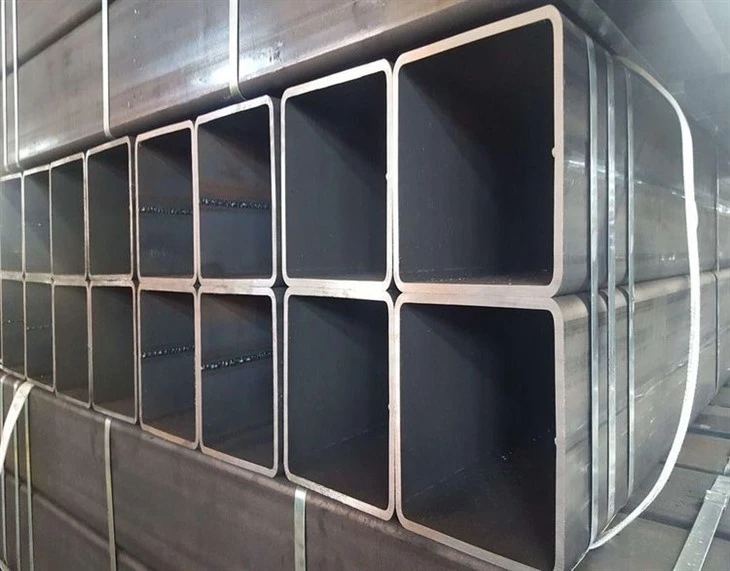


Tianjin Brisk Steel is one of the manufacturers of ASTM A500 Hollow Section in China. Our products are mainly exported to the Middle East, Southeast Asia, Europe, New Zealand, and other regions.If you would like to learn more about our products, feel free to contact us and send your purchase list.


Where This Standard Sits in the Bigger Picture
Across North American structural design, "HSS" almost always means tube built to ASTM A500. It plays the same role that EN 10219 plays in European cold-formed structural work - same underlying manufacturing logic (coil steel, cold roll-formed, electric-resistance-welded), different testing regime, different tolerance tables, different grade-naming convention. If a project spec calls for EN or GB material instead, A500 tube is not an automatic substitute - the chemistry and mechanical thresholds don't line up one-to-one.
The Four Grades, In Plain Terms
- Grade A - the lightest-duty option. Lower yield strength, but easy to cold-work further after purchase. Rarely specified for primary structural members; more common where the tube will undergo additional bending or forming downstream.
- Grade B - the default choice for the majority of structural framing, columns, and general fabrication. Strong enough for most load cases, weldable without special procedures in ordinary wall thicknesses, and the grade most mills keep in continuous stock.
- Grade C - a step up in both yield and tensile strength over Grade B, achieved through a slightly tighter chemistry rather than a different production process. Specified when a smaller section or thinner wall needs to carry more load.
- Grade D - the least commonly ordered grade, offering higher ductility at a lower yield strength. Useful in niche cases involving heavy post-production forming, but generally not the first choice for standard building structures.
For reference, minimum yield strength runs from roughly 33 ksi (Grade A, round) up to 50 ksi (Grade C, shaped sections), with tensile strength minimums between 45 and 62 ksi depending on grade and shape - round and shaped (square/rectangular) sections of the same grade are not held to identical yield minimums, since the additional cold-forming step in shaping round tube into square or rectangular profile increases corner strength.
Note: ASTM periodically revises A500 (strength values and grade coverage have changed across editions), so always confirm which edition your supplier's mill certificate references rather than assuming figures carry over unchanged from older documentation you may have seen elsewhere.
What Actually Changes Between the Grades, Chemically
All four grades share a similar base chemistry - carbon, manganese, phosphorus, and sulfur limits are close across A, B, and D, with copper addition optional in each. Grade C narrows the carbon ceiling slightly compared to the others, which is part of how it achieves its higher strength while still maintaining acceptable weldability. None of the grades require exotic alloying; the strength differences come mainly from a combination of chemistry control and the degree of cold work introduced during forming, not from added alloy content.
Where Each Grade Tends to Show Up
- Building columns, bracing, and floor/roof framing - overwhelmingly Grade B
- Load-critical members where reducing tube weight or footprint matters - Grade C
- Sign structures, guardrail posts, agricultural framing - Grade B, occasionally Grade A
- Assemblies requiring extensive secondary bending or coiling after purchase - Grade D
- Exposed architectural steel (railings, canopies, feature columns) - round Grade B is common for its clean profile
FAQ
Q: What's the difference between ASTM A500 Grade A, B, and C?
A: The grades differ primarily in minimum yield and tensile strength, with Grade B offering a higher yield strength than Grade A, and Grade C offering the highest of the three. Grade B is the most commonly used for general structural steel tube in North America, while Grade C is selected when higher load capacity is needed without increasing the section size.
Q: What is HSS, and is it the same as ASTM A500?
A: HSS (Hollow Structural Section) is the general North American term for structural tube shapes - round, square, and rectangular. ASTM A500 is the material specification that most HSS products are manufactured to, so in practice "HSS" and "ASTM A500 tube" are often used interchangeably, though HSS can technically also reference other specifications in less common cases.
Q: Why is Grade D used less often than Grade B?
A: Grade D has a lower minimum yield strength than Grade B but is valued for its higher ductility, making it more suitable for applications involving significant cold bending or forming after the tube is produced, rather than for standard structural framing where higher yield strength is typically preferred.
Q: Can ASTM A500 tube be welded?
A: Yes, ASTM A500 structural tubing is designed to be readily weldable using standard structural welding procedures, and is commonly welded into fabricated steel frames, connections, and assemblies.


Hot Tags: astm a500 hollow section, China astm a500 hollow section manufacturers, suppliers, factory


