


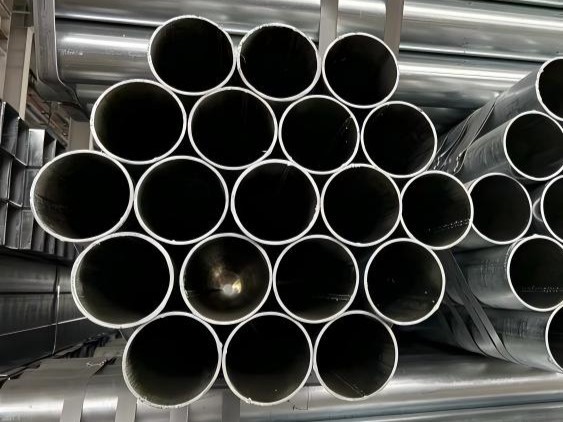
Tianjin Brisk Metalwork Co., Ltd. is one of the leading manufacturers and suppliers of hot-dip galvanized erw round steel pipe for fencing & scaffolding in China. We have world-leading production equipment and strong manufacturing capabilities. Please feel free to buy bulk durable hot-dip galvanized erw round steel pipe for fencing & scaffolding from our factory.
Tianjin Brisk Steel is one of the Hot-Dip Galvanized ERW Round Steel Pipe for Fencing & Scaffolding in China. Our products are mainly exported to the Middle East, Southeast Asia, Europe, New Zealand, and other regions.If you would like to learn more about our products, feel free to contact us and send your purchase list.


What Is Hot-Dip Galvanized ERW Round Pipe?
The base tube starts as ERW round pipe: flat steel strip is roll-formed into a circular shape and welded along a single longitudinal seam using high-frequency electric resistance welding. This process produces a straight, uniform pipe with tight outside-diameter and wall-thickness tolerances, which matters for fencing and scaffolding because fittings, clamps, and couplers are sized to close tolerances.
After the tube is formed, cut to length, and (depending on the mill) tested for weld integrity, it is cleaned in an acid pickling bath to remove mill scale and oxidation, rinsed, dipped in a flux solution, and then fully immersed in a bath of molten zinc, typically held around 450°C (840°F). The zinc reacts metallurgically with the steel surface to form a series of zinc-iron alloy layers topped with a layer of relatively pure zinc. This is different from electro-galvanizing, which electroplates a much thinner zinc layer onto the surface without the alloy bonding - hot-dip coatings are thicker, more abrasion-resistant, and better suited to pipe that will be driven into the ground, stacked, transported, and reused across job sites.
Why Hot-Dip Galvanizing Matters for Fencing and Scaffolding
- Corrosion protection through sacrificial action. Zinc corrodes preferentially to steel. Even where a coating is scratched or nicked during installation, the surrounding zinc continues to protect the exposed steel electrochemically, which is a real advantage over painted or powder-coated pipe that offers no protection once the film is broken.
- Coating durability under mechanical stress. Fence posts get hit by mowers and vehicles; scaffolding tube gets dropped, dragged, and clamped daily. The metallurgically bonded zinc-iron layers resist abrasion and impact far better than a surface-applied coating, which reduces the chance of exposed steel developing rust streaks within the first year of service.
- Long, low-maintenance service life. In typical atmospheric exposure, a standard hot-dip galvanized coating can be expected to last several decades before base metal corrosion becomes a concern, which is why galvanized pipe remains the default choice for perimeter fencing, chain-link line posts, and construction guardrail systems that aren't repainted on a schedule.
- Consistent appearance and paintability. Freshly galvanized pipe has a bright, slightly spangled finish that many buyers use as-is for fencing. Where a colored finish is required later, the surface can also be primed and top-coated once it has weathered or been treated with an etching primer.
Standards, Grades, and Coating Weights
Buyers sourcing galvanized ERW pipe for fencing and scaffolding typically reference one of the following:
ASTM A53 Type E, Grade B - the most common US standard for galvanized ERW pipe, covering both the base tube mechanical properties and, by reference, galvanizing requirements.
Typical hot-dip coating weights fall in the range of 350–600 g/m² of total zinc coverage, corresponding to a coating thickness of roughly 45–85 microns depending on the steel section thickness. Scaffold tube is often produced to a slightly tighter coating tolerance than general fence pipe because it is reused across many projects and needs to keep its protective layer through repeated erection and dismantling cycles.
Common Sizes for Fencing and Scaffolding
| Application | Typical OD Range | Typical Wall Thickness |
|---|---|---|
| Chain-link fence line posts | 48–60 mm (1.9"–2.375") | 1.8–2.75 mm |
| Chain-link fence top rail | 33–42 mm (1.3"–1.66") | 1.5–2.0 mm |
| Guardrail / handrail systems | 42–48 mm (1.66"–1.9") | 2.0–3.0 mm |
| Scaffold tube (BS 1139 standard) | 48.3 mm | 3.2–4.0 mm |
| Scaffold tube (light duty) | 48.3 mm | 2.9–3.2 mm |
Post and rail sizing is frequently swaged (one end reduced in diameter) so that top rail slides into line post fittings without separate couplers - buyers ordering fence-specific pipe should specify whether swaged ends are needed, since swaging is a separate operation from galvanizing.
Frequently Asked Questions (FAQ)
Q: What's the difference between hot-dip galvanized and pre-galvanized (GI) pipe?
A: Hot-dip galvanizing is typically applied after the tube is formed and cut to final length, giving full coating coverage on cut ends and any weld repair areas. Pre-galvanized (GI) pipe is made from steel strip that was galvanized before it was roll-formed into tube, which means the cut ends and the weld seam area may have thinner or no zinc coverage unless touched up. For buried fence posts or scaffold tube exposed to moisture at cut ends, hot-dip galvanizing after fabrication generally gives better corrosion protection.
Q: How long does hot-dip galvanized fence pipe actually last outdoors?
A: Service life depends heavily on the local atmosphere - coastal, industrial, and de-icing-salt environments corrode zinc faster than dry inland climates. As a rough guide, a properly coated hot-dip galvanized post in a moderate climate can remain serviceable for several decades before red rust appears on the base steel, though heavily polluted or marine sites will see shorter life from the same coating weight.
Q: Can galvanized scaffold tube be reused indefinitely?
A: No coating lasts forever under repeated handling. Reputable scaffold hire and construction companies inspect tube periodically for coating loss, dents, and out-of-roundness, retiring tube once bare steel is visibly exposed over a meaningful area or once wall thickness has thinned from corrosion. Well-maintained hot-dip galvanized tube commonly sees many years of rotational use before retirement.
Q: Does hot-dip galvanizing affect the pipe's strength?
A: The galvanizing process itself doesn't meaningfully change the steel's yield or tensile strength - the main consideration is that the bath temperature can occasionally affect very thin-wall or high-strength tube if not properly controlled, which is why mill process control matters more for thin sections. Standard fence and scaffold wall thicknesses are unaffected in normal production.


Hot Tags: hot-dip galvanized erw round steel pipe for fencing & scaffolding, China hot-dip galvanized erw round steel pipe for fencing & scaffolding manufacturers, suppliers, factory, erw pipe emergency response, erw pipe exporter, erw pipe international trade, erw pipe procurement, erw pipe recycling, erw pipe safety


