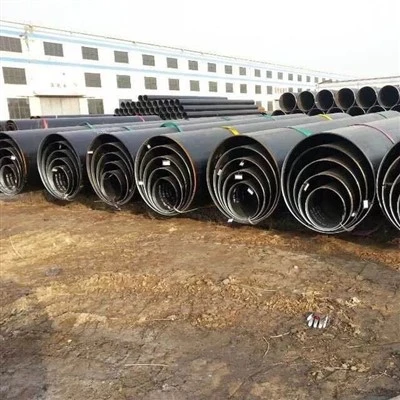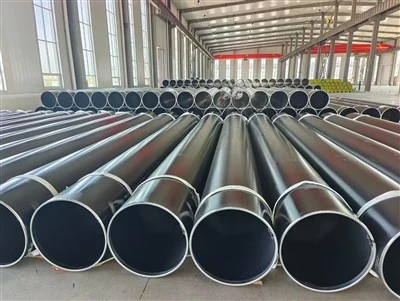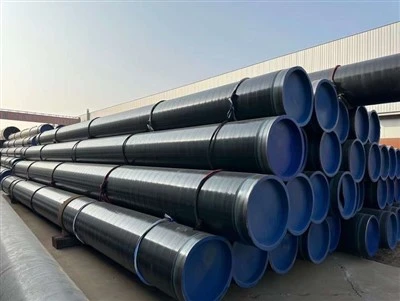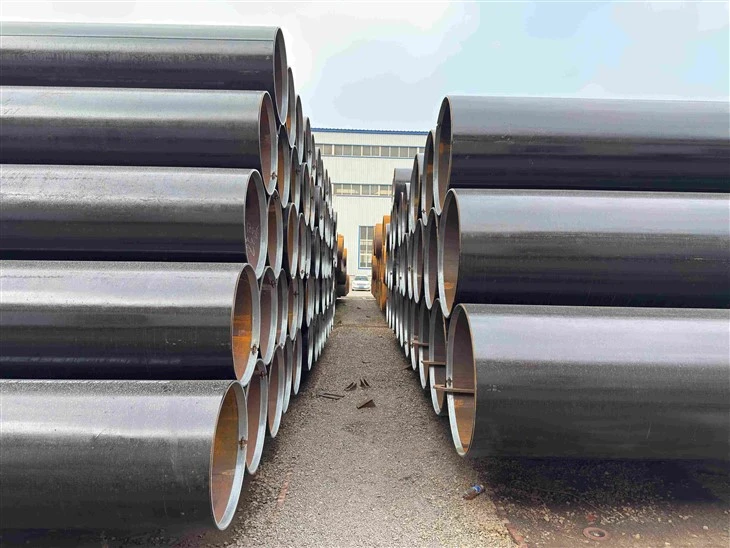
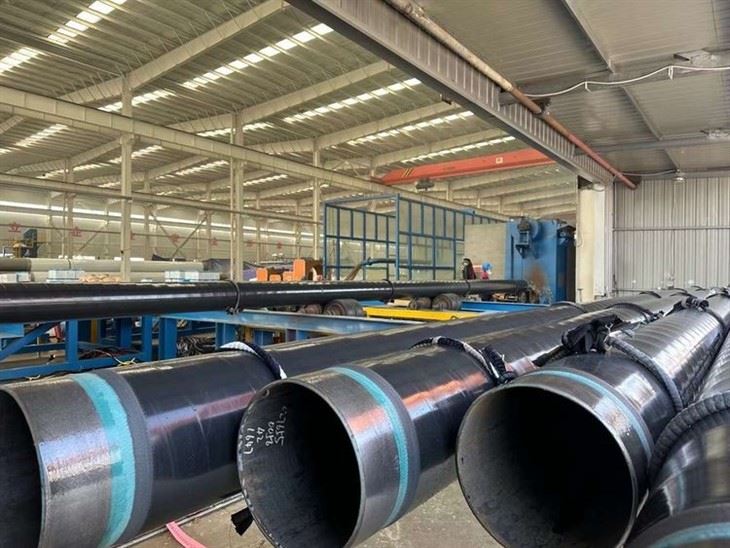
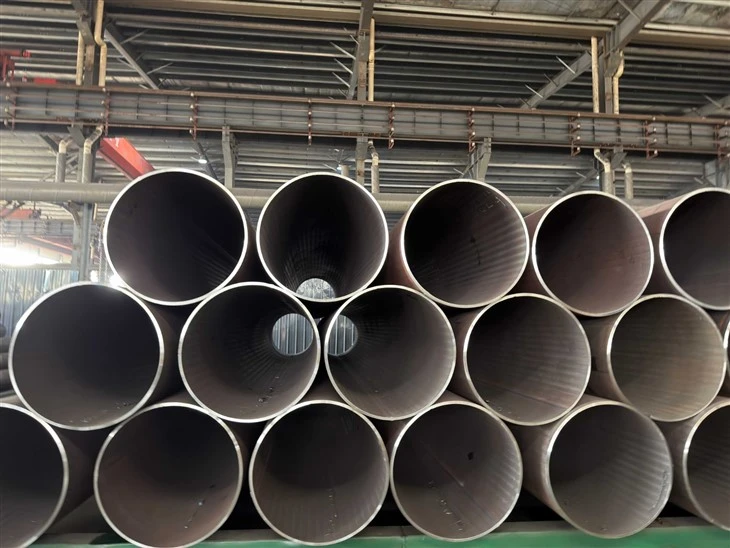
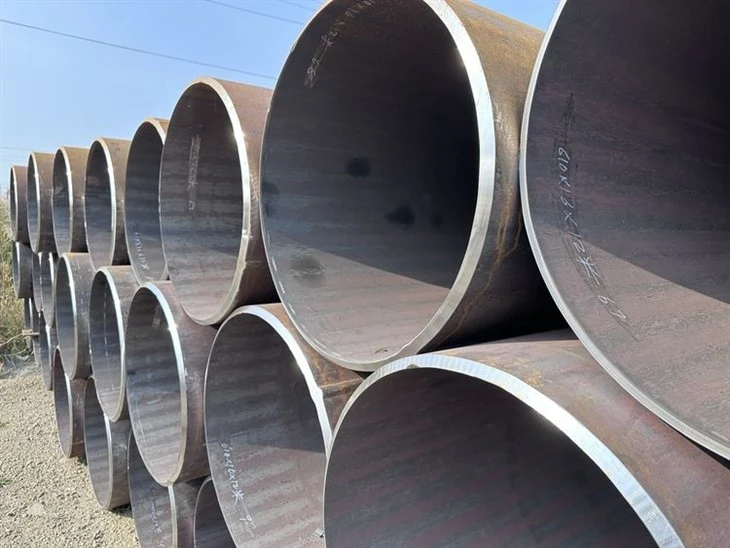
Tianjin Brisk Steel is one of the manufacturers of API 5L Oil Transmission LSAW Steel Pipe in China. Our products are mainly exported to the Middle East, Southeast Asia, Europe, New Zealand, and other regions.If you would like to learn more about our products, feel free to contact us and send your purchase list.


Why LSAW for Oil Transmission Lines
LSAW (Longitudinal Submerged Arc Welded) pipe is formed from a single steel plate, edge-milled, formed into a cylinder (typically by JCOE or UOE press forming), and welded along one straight longitudinal seam using submerged arc welding on both the inside and outside of the pipe. For large-diameter oil transmission trunklines, this process is generally preferred over spiral (SSAW) seam pipe because:
- The straight seam geometry simplifies field girth welding alignment at tie-in points
- Plate-sourced material allows tighter control over base metal cleanliness and inclusion content, relevant for sour or higher-H2S crude streams
- Wall thickness can be more precisely controlled across large diameters, which matters for pipelines designed close to maximum allowable operating pressure (MAOP)
Seamless pipe remains an alternative for smaller diameters, but above roughly NPS 24, LSAW becomes the practical choice since seamless production at that diameter and wall thickness is either unavailable or cost-prohibitive from most mills.
Grade Selection for Oil Transmission
API 5L covers a grade ladder from Grade B up through X80, but oil transmission projects cluster around a narrower practical range:
| Grade | SMYS (min) | Common Oil Transmission Use |
|---|---|---|
| X42–X52 | 42,000–52,000 psi | Lower-pressure gathering and trunk lines, older pipeline replacement segments |
| X60–X65 | 60,000–65,000 psi | Standard modern crude trunkline specification |
| X70 | 70,000 psi | High-pressure, large-diameter long-haul crude lines where reducing wall thickness for a given MAOP lowers material and welding cost |
Compared to gas transmission, oil transmission specifications are somewhat less likely to push into X70/X80 territory, since crude oil pipelines are typically less pressure-constrained by compressibility concerns than gas lines are - but this varies by project economics and terrain profile, and should be confirmed against your specific pipeline design basis rather than assumed from grade alone.
PSL1 vs PSL2 for Oil Service
API 5L defines two product specification levels, and the choice matters more for oil transmission projects than buyers sometimes assume:
- PSL1 - baseline requirements, no mandatory Charpy impact testing, less restrictive chemistry
- PSL2 - mandatory impact testing, tighter carbon equivalent limits, mandatory hydrostatic test pressure and duration documentation, additional NDT requirements
Most modern oil transmission trunkline specifications call for PSL2, particularly where the route crosses low-temperature regions (impact toughness matters for brittle fracture resistance) or where the operator's own pipeline integrity standards exceed the API 5L baseline. Confirm which level your project specification requires before requesting mill quotes - PSL1 material will not satisfy a PSL2 specification even at the same grade and diameter.
Seam Weld Quality: What to Verify
Because the longitudinal seam is the highest-consequence defect location on LSAW pipe, oil transmission buyers should confirm specific quality controls beyond the base API 5L testing minimums:
- 100% seam ultrasonic testing (UT) across the full pipe length, not sample-based testing
- 100% radiographic testing (RT) of the seam weld, particularly at girth weld tie-in zones
- Double submerged arc welding (DSAW) - both inside and outside weld passes, verified in the mill's process documentation
- Hydrostatic test pressure and hold time - confirm the tested pressure and duration meet or exceed your project's pipeline design factor requirements, not just API 5L's stated minimum
- Post-weld heat treatment or seam normalizing, where specified - relevant for higher-grade, thicker-wall pipe where residual stress at the seam is a greater concern
FAQ
Q: Can LSAW pipe be used for both crude oil and refined products in the same pipeline?
A: Yes, the pipe itself is not product-specific - the relevant design factors are pressure, corrosivity, and any batching/interface considerations for multi-product lines, which are addressed through coating, cathodic protection, and operating procedure rather than pipe manufacturing method.
Q: Why does oil transmission LSAW pipe sometimes specify a lower carbon equivalent than gas transmission pipe of the same grade?
A: Lower carbon equivalent generally improves weldability and reduces hydrogen cracking risk at girth welds - some oil pipeline specifications tighten this beyond the API 5L PSL2 baseline specifically to reduce field welding defect rates on long-haul construction projects with high daily weld counts, though requirements vary by project rather than being universal to "oil" vs "gas" service.
Q: Is LSAW pipe more prone to seam failure than seamless pipe over a pipeline's service life?
A: When manufactured and tested to PSL2 requirements with full seam NDT coverage, LSAW pipe has an extensive track record in oil transmission service; seam-related failures in properly manufactured and inspected LSAW pipe are rare and are more commonly linked to inadequate NDT coverage or manufacturing quality control than to the seam design itself.
Q: What diameter range is typically available in API 5L LSAW pipe for oil transmission?
A: Most mills produce API 5L LSAW pipe from roughly NPS 16 up to NPS 60 or larger, though maximum diameter and wall thickness combinations vary significantly by mill press capacity - confirm specific size availability directly with your supplier for your project's diameter and thickness requirements.


Hot Tags: api 5l oil transmission lsaw steel pipe, China api 5l oil transmission lsaw steel pipe manufacturers, suppliers, factory