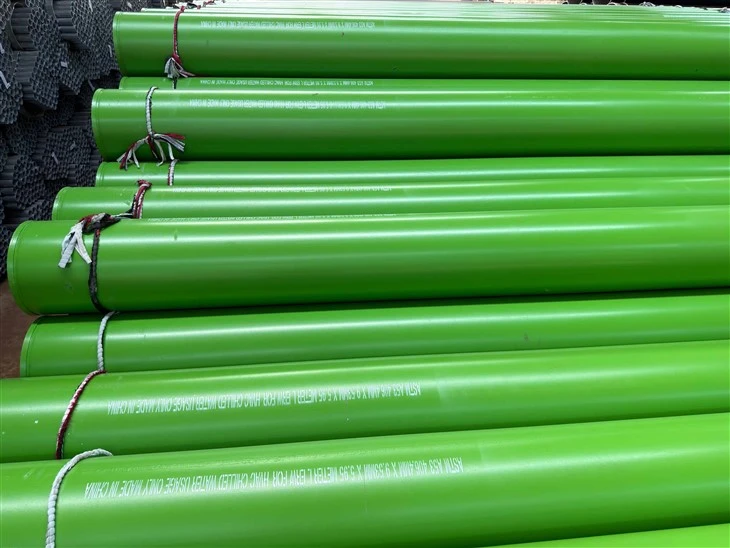
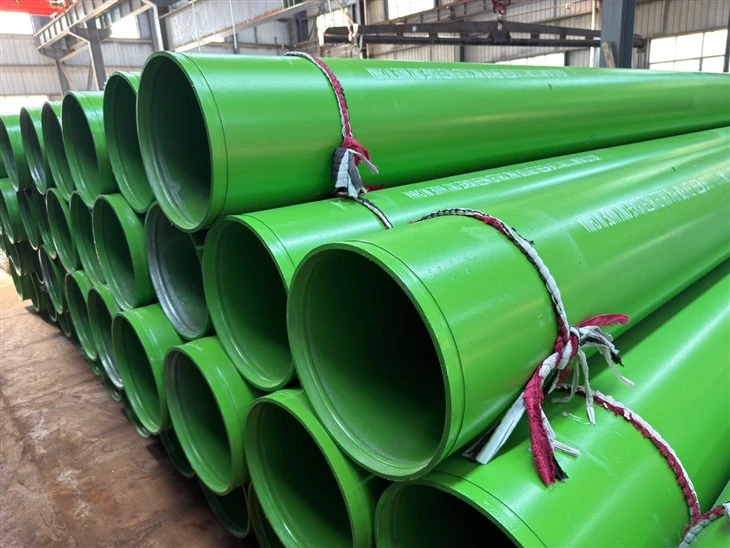
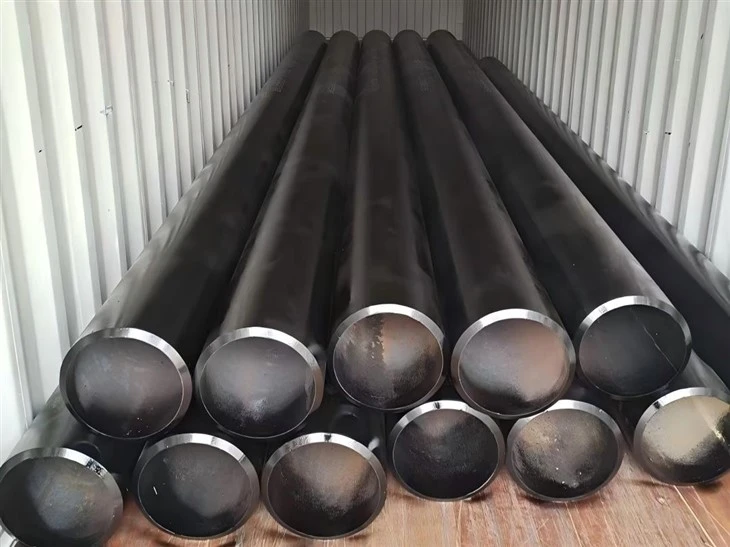
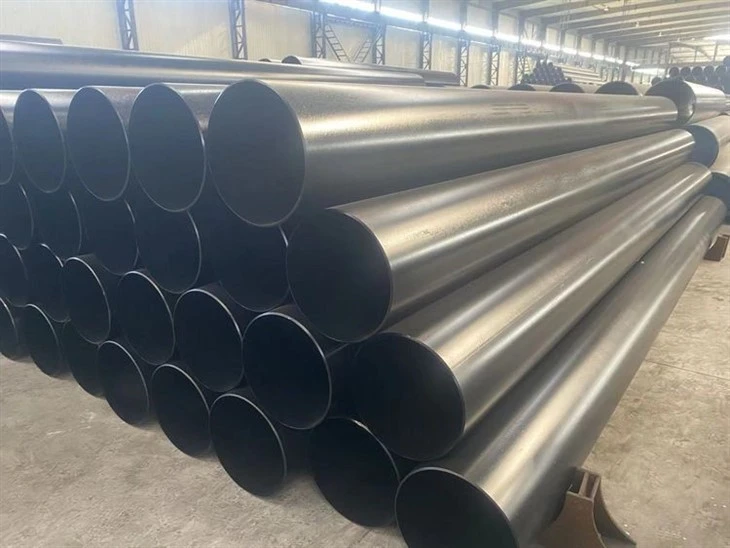
Tianjin Brisk Steel is one of the Gas Line Steel Pipe in China. Our products are mainly exported to the Middle East, Southeast Asia, Europe, New Zealand, and other regions.If you would like to learn more about our products, feel free to contact us and send your purchase list.


Gas Line Steel Pipe
| Item | Specification |
|---|---|
| Standards | ASTM A53 Grade B, API 5L (Grade B and X42-X70) |
| Manufacturing | ERW, LSAW, SSAW, seamless (by size/pressure class) |
| PSL Level (API 5L) | PSL1, PSL2 |
| Size Range | 1/2" to 48" OD |
| Coating | Black/bare, FBE, 3PE, or per project spec |
| End Finish | Beveled (butt-weld), threaded (small diameter service) |
| Testing | Hydrostatic test, NDE per applicable standard/PSL |
"Gas line steel pipe" is one of the broadest search terms in this industry - and one of the least specific. It covers everything from a 2-inch service line feeding a residential meter to a 36-inch transmission main running under 1,000 psi. Those two products don't share a standard, a wall thickness logic, or a price point, which is exactly why a generic "gas line pipe" inquiry is one of the harder ones for a mill to quote accurately on the first pass.
Three Tiers, Three Different Answers
Service and low-pressure distribution lines (typically under ~125 psi, smaller diameters feeding individual buildings or local distribution networks) are commonly supplied to ASTM A53 Grade B, often Type E (ERW). A53 is a general-purpose pressure-piping spec - it doesn't carry gas-specific grade requirements, but it's widely accepted by utility codes for this pressure range and is readily available in stocked sizes and schedules.
Distribution mains (higher pressure, larger diameter feeder lines within a city gas network) increasingly get specified to API 5L, particularly where the owner's engineering standard or local code requires PSL controls, defined toughness, or full material traceability that A53 doesn't provide as standard.
Transmission pipelines (long-distance, high-pressure, moving gas from field or import terminal to distribution networks) sit firmly in API 5L X-grade territory - X42 through X70 depending on pressure and diameter - manufactured as LSAW or SSAW at larger sizes, with PSL2 as the near-universal requirement given the consequence of failure.
The practical problem: none of these three tiers announce themselves clearly in a one-line RFQ that just says "gas line pipe, 8 inch." Pressure class is the input that actually determines standard, wall thickness, and PSL - not diameter alone, and not the word "gas" by itself.
Coating Is a Separate Decision From Standard
Whichever tier applies, if the line is buried - which almost all gas distribution and transmission pipe is - corrosion protection needs its own answer. Bare/black pipe is common for above-ground service risers and short exposed runs; buried mains and transmission lines are typically FBE or 3PE coated with cathodic protection, following the same logic covered on our dedicated coating pages. Coating spec doesn't follow automatically from the pipe standard - it has to be called out separately, and we've seen orders arrive without it simply because the buyer assumed "gas pipe" implied coated pipe by default.
One Detail Buyers Often Miss: A53's Silence on Gas-Specific Requirements
A53 does not include hydrogen embrittlement resistance, fracture toughness (Charpy) requirements, or the traceability documentation that API 5L PSL2 mandates. For low-pressure, low-consequence distribution runs this is rarely an issue. But if a project's own engineering code calls for defined toughness or full heat-to-joint traceability - common on larger-diameter or higher-pressure distribution mains - A53 alone won't satisfy that requirement even though it's technically rated for the pressure. This is a code-compliance gap, not a strength shortfall, and it's easy to miss if the purchase order only references pressure rating.
Illustrative case: A municipal gas utility issued an RFQ for "12-inch gas line pipe" for a distribution main expansion, referencing only diameter and a general pressure rating. Based on the stated pressure alone, A53 Grade B ERW pipe would have met the numeric requirement. During technical review, it emerged the utility's own engineering standard required API 5L PSL2 with Charpy toughness testing and full traceability documentation for any main above 10 inches - a code requirement the original RFQ hadn't specified but that governed the project regardless. Supplying to the correct spec upfront avoided a rejected shipment and a multi-week reorder.
Why Source Your Gas Line Pipe From Us
We manufacture gas line pipe across all three tiers - A53 Grade B for distribution and service lines, API 5L Grade B/X-grades for distribution mains and transmission - with coating applied in-house or through qualified partners, and full mill certification issued against the standard and PSL level actually ordered, not just the pressure class implied by diameter. Tell us your operating pressure, diameter, burial condition, and any owner engineering standard that applies, and we'll confirm the correct standard, grade, and coating before quoting - not after delivery. Send us your project details for a tailored quotation and lead time.
FAQ
Q: Can ASTM A53 pipe be used for a natural gas transmission pipeline?
A: Generally no. A53 doesn't include the toughness, PSL controls, or X-grade strength options that transmission-line design typically requires. API 5L is the standard normally specified for transmission service.
Q: Does "gas line pipe" always need to be coated?
A: Not always - exposed risers and short above-ground runs are often supplied bare - but any buried gas line, distribution or transmission, should have a coating and cathodic protection spec confirmed at order stage, since it isn't automatically included with the base pipe standard.
Q: What's the difference between API 5L Grade B and the X-grades for gas service?
A: Grade B is the lowest strength level in API 5L and suits lower-pressure distribution mains; X-grades (X42-X70) provide higher yield strength for higher-pressure transmission service, generally paired with PSL2 controls.
Q: Is threaded-end pipe common for gas lines?
A: Yes, for small-diameter service lines feeding individual meters or buildings - larger distribution and transmission pipe is almost universally beveled for butt-welding.


Hot Tags: gas line steel pipe, China gas line steel pipe manufacturers, suppliers, factory, cost effective hollow section, hollow section grilles, hollow section opportunity, hollow section security, hollow section supports, welded hollow section