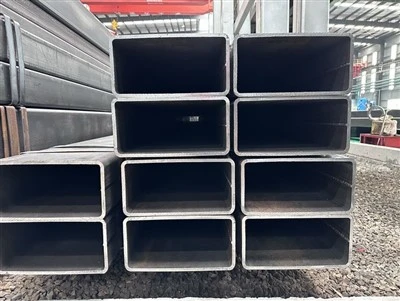
Tianjin Brisk Metalwork Co., Ltd. is one of the leading manufacturers and suppliers of en10219 s460nh square hollow section in China. We have world-leading production equipment and strong manufacturing capabilities. Please feel free to buy bulk durable en10219 s460nh square hollow section from our factory.
Tianjin Brisk Steel is one of the EN10219 S460NH square hollow section in China. Our products are mainly exported to the Middle East, Southeast Asia, Europe, New Zealand, and other regions.If you would like to learn more about our products, feel free to contact us and send your purchase list.


Quick Spec Reference
| Parameter | Typical Range |
|---|---|
| Size Range | 40x40mm – 400x400mm |
| Wall Thickness | 3mm – 20mm (thicker sections may need special order confirmation) |
| Standard | EN 10219-1 / EN 10219-2 |
| Grade | S460NH (normalized/normalized-rolled delivery condition) |
| Minimum Yield Strength | 460 MPa (for wall thickness ≤ 16mm; decreases slightly above) |
| Minimum Tensile Strength | 550–720 MPa |
| Minimum Elongation | ≥17% |
| Impact Toughness | 40J minimum at -20°C (Charpy V-notch) |
| Production | Cold-formed from hot-rolled coil, longitudinally welded, sized square |
| Typical Use | Heavy structural columns, bridge components, high-load trusses, offshore structures where section weight matters |
What the Grade Designation Actually Tells a Buyer
S460NH breaks down into three pieces of information that each affect sourcing differently. The S simply denotes structural steel. The 460 is the minimum yield strength in MPa - this is the number that lets a structural engineer specify a smaller, lighter section than an equivalent S355 member while still carrying the same design load, which is the entire reason a buyer ends up looking for S460 in the first place rather than defaulting to the far more commonly stocked S355. The NH is where sourcing actually gets harder to plan around: N means the steel is delivered in the normalized or normalized-rolling condition, and H means it's a hollow section grade under EN 10219 specifically (as opposed to S460NL, which carries a lower minimum impact-test temperature for cold-climate service, or the EN 10210 hot-finished equivalent).
The normalizing requirement is the part buyers most often underestimate. It's a heat treatment step that refines the grain structure of the cold-formed section to restore toughness that cold working would otherwise reduce - and it means not every mill that produces standard S355 hollow sections is set up to also produce S460NH, because the additional processing step and the tighter chemistry control it demands aren't something every production line carries as standard capability. Sourcing S460NH successfully starts with confirming the specific mill actually runs normalized-grade production, not just requesting the grade on a PO and assuming any hollow-section supplier can fill it.
Why a Project Specifies S460 Instead of S355 at All
Higher yield strength doesn't automatically make S460 the better choice - it makes sense specifically when the structural design is stress-governed rather than deflection- or buckling-governed. In a stress-governed member (short-span heavily loaded columns, tension members, some truss chords), a higher-yield material lets the engineer specify a smaller cross-section for the same load, directly reducing steel tonnage and, on large structures, foundation and connection loads that scale with member self-weight. In a deflection-governed or slenderness-governed member (long unbraced compression members, members where serviceability deflection controls the design rather than strength), a higher yield grade often doesn't help much, because stiffness depends on the section's geometry and elastic modulus - both essentially unchanged between S355 and S460 - rather than on yield strength. This is why S460NH shows up heavily on offshore platforms, heavy industrial structures, and long-span bridge trusses where weight reduction has compounding value, and rarely on ordinary low-rise building framing where S355 is already more than adequate and considerably easier to source.
Weldability and Fabrication Considerations at S460
Higher-strength steel isn't simply "the same steel, stronger" from a fabrication standpoint - carbon equivalent (CE) becomes a real consideration at S460 in a way it typically isn't at S355. A higher carbon equivalent increases the risk of hydrogen-induced cracking in the heat-affected zone during welding, which means site or shop welding procedures for S460NH connections often need preheat, controlled interpass temperature, and low-hydrogen consumables specified explicitly - requirements that a fabricator used to routine S355 work may not have built into their standard welding procedure specification. Buyers should confirm the mill certificate's actual carbon equivalent value (not just confirm the grade passed) and pass that figure to the fabricator's welding engineer before shop drawings are finalized, since the welding procedure qualification needs to match the specific heat's chemistry, not a generic S460 assumption.
FAQ
Q: Is S460NH stronger than S355 by exactly the ratio of 460 to 355?
A: Not directly usable that way for design - the yield strength ratio doesn't translate one-to-one into a proportional section size reduction, because Eurocode design checks also account for buckling, local slenderness, and connection design, which don't scale purely with yield strength. The actual size reduction achievable depends on which failure mode governs the specific member, which is a structural engineering calculation, not a simple ratio.
Q: Can S460NH and S355 sections be welded to each other in the same structure?
A: Yes, this is common practice - for example, a high-load column in S460NH connecting to lower-stressed bracing in S355 - but the welding procedure needs to be qualified for the higher-carbon-equivalent material, and the weld filler metal is typically selected to match or slightly undermatch the higher-strength member rather than the lower one.
Q: Why does EN 10219 specify a minimum test temperature for impact toughness on S460NH?
A: Cold-formed hollow sections work-harden at the corners during forming, which can reduce toughness locally compared to the flat faces, and higher-strength steels are generally more notch-sensitive than lower grades. The impact test at -20°C confirms the material retains adequate toughness against brittle fracture at typical service temperatures, which matters more as yield strength increases.
Q: Does S460NH cost proportionally more than S355 per tonne?
A: The per-tonne price premium is real but generally smaller than the potential steel-weight savings on a genuinely stress-governed design, which is the economic case for specifying it in the first place - but the premium is larger than the strength ratio alone would suggest, because of the added normalizing step and lower production volume, not because the base chemistry is dramatically more expensive.


Hot Tags: en10219 s460nh square hollow section, China en10219 s460nh square hollow section manufacturers, suppliers, factory, API5L X52M PSL2 LSAW PIPE, efficient hollow section, hollow section construction, hollow section industrial design, hollow section quotation, import of hollow section