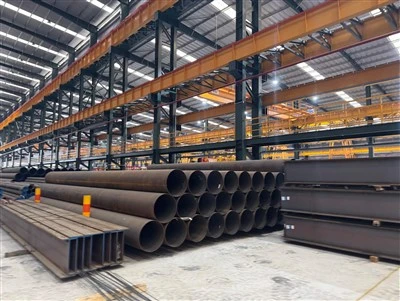
Tianjin Brisk Steel is one of the manufacturers of ERW Line Pipe for Oil & Gas Pipeline in China. Our products are mainly exported to the Middle East, Southeast Asia, Europe, New Zealand, and other regions.If you would like to learn more about our products, feel free to contact us and send your purchase list.


ERW Line Pipe for Oil & Gas Pipeline
Our ERW (Electric Resistance Welded) line pipe is a high-frequency welded carbon steel pipe engineered for the gathering, transmission, and distribution of oil, natural gas, and other petroleum products. Produced from hot-rolled steel coil through a high-frequency induction welding process followed by full-body normalizing and non-destructive testing, our ERW line pipe delivers a uniform weld seam, consistent wall thickness, and reliable pressure performance across the full size range.
Unlike general-purpose ERW pipe made to structural or fluid-conveyance standards, line pipe intended for oil and gas service is manufactured, tested, and certified specifically to API 5L - covering weld seam integrity, hydrostatic testing, and mechanical property requirements that pipeline operators require for upstream, midstream, and gathering-line applications.
ERW PROCESS

Key Features
- Manufactured to API 5L (PSL1/PSL2) and ISO 3183 for line pipe service, alongside ASTM A53 and EN 10217 for general ERW pipe requirements
- High-frequency induction welding produces a narrow, fully fused heat-affected zone with minimal weld defect rate
- 100% weld seam ultrasonic testing (UT) and hydrostatic testing on every length before shipment
- Available in PSL1 and PSL2 quality levels, with PSL2 offering tighter chemistry, toughness (Charpy impact), and NDT requirements for higher-pressure or sour-service pipelines
- Bevel end, plain end, or threaded/coupled end finishing available per project specification
- Anti-corrosion coating options: 3LPE, FBE, coal tar epoxy, or bare pipe per customer requirement
Grades
API 5L Grade B, X42, X46, X52, X56, X60, X65, X70 (PSL1 and PSL2). Higher X-grades (X60 and above) are typically specified for long-distance, high-pressure transmission pipelines where wall thickness reduction and weight savings are a design priority; Grade B and X42 remain common for gathering lines and lower-pressure distribution networks.
Size Chart & Wall Thickness
| Outer Diameter | NPS (in) | Wall Thickness | Approx. Weight (kg/m) |
|---|---|---|---|
| 60.3mm | 2" | 3.9–5.5mm | 5.4–7.5 |
| 114.3mm | 4" | 4.5–8.6mm | 12.2–22.3 |
| 168.3mm | 6" | 5.0–11.0mm | 20.1–42.4 |
| 219.1mm | 8" | 5.9–12.7mm | 31.5–65.2 |
| 323.9mm | 12" | 6.4–17.5mm | 50.0–128.6 |
| Up to 630mm OD | Custom | up to 18mm | On request |
Standard length: 6m, 12m, or random/double random length (RL/DRL) per API 5L. Custom lengths available on request.
Weight Calculation Formula
Weight (kg/m) = π × (OD − t) × t × 0.00785
Where OD = outer diameter (mm), t = wall thickness (mm). This is the same formula used across API 5L wall thickness tables and standard line pipe weight charts, and it applies equally to any custom OD/wall-thickness combination not listed above - useful for verifying mill test certificates or estimating pipeline tonnage during project bidding.
Frequently Asked Questions (FAQ)
Q: What is the difference between ERW line pipe and ERW structural pipe?
A: ERW line pipe is manufactured and tested to API 5L, which includes mandatory hydrostatic testing, weld seam UT, and mechanical property requirements specific to pressurized pipeline service. ERW structural pipe, by contrast, is typically produced to ASTM A500 or similar standards for load-bearing structural use and does not carry API 5L certification.
Q: What is the difference between PSL1 and PSL2 line pipe?
A: PSL2 (Product Specification Level 2) has stricter requirements than PSL1 for chemical composition, mandatory Charpy V-notch impact toughness testing, tighter tensile property ranges, and additional NDT - making it the more common choice for higher-pressure transmission pipelines and sour-service environments, while PSL1 is generally sufficient for lower-pressure gathering and distribution lines.
Q: Can ERW line pipe replace seamless line pipe?
A: For most onshore transmission and distribution applications up to X70 grade, API 5L-certified ERW line pipe is a widely accepted and more cost-effective alternative to seamless pipe. Seamless pipe is still typically specified for high-pressure, high-temperature, or critical sour-service segments where weld-seam-free construction is required by the operator's specification.



Hot Tags: erw line pipe for oil & gas pipeline, China erw line pipe for oil & gas pipeline manufacturers, suppliers, factory