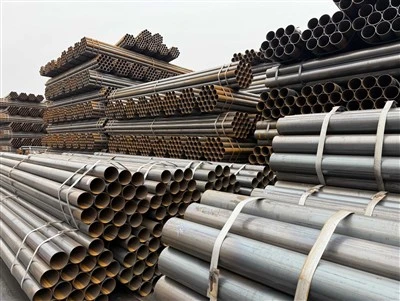
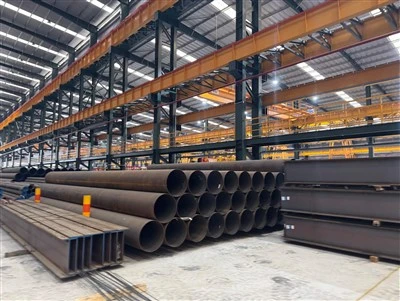
Tianjin Brisk Steel is one of the API 5L PSL2 ERW Steel Gas Pipe in China. Our products are mainly exported to the Middle East, Southeast Asia, Europe, New Zealand, and other regions.If you would like to learn more about our products, feel free to contact us and send your purchase list.


Quick Spec Reference
| Parameter | Detail |
|---|---|
| Standard | API 5L, Product Specification Level 2 (PSL2) |
| Manufacturing process | Electric Resistance Welded (ERW), high-frequency |
| Grades | B, X42, X46, X52, X56, X60, X65 |
| OD range | 21.3 mm - 610 mm (up to ~24") |
| Wall thickness | 3.2 mm - 20 mm, grade and diameter dependent |
| Ends | Plain or beveled |
| Typical use | Natural gas gathering, distribution, and transmission piping |
We supply ERW line pipe produced and tested to full API 5L PSL2 requirements specifically for gas service - PSL2 isn't optional paperwork for gas pipelines, it's the product level that carries the fracture-control testing gas transmission actually depends on.
Why Gas Service Asks More of the Pipe Than Liquid Service Does
Oil and gas pipelines built to the same grade and wall thickness aren't carrying the same risk. Liquid is close to incompressible - if a pipeline wall develops a crack, the pressure at the crack tip drops off almost immediately as liquid escapes, and a running fracture tends to arrest itself within a short distance. Gas is compressible. A crack in a gas line keeps seeing near-full line pressure behind it as the gas ahead of the crack tip continues expanding, which lets a fracture propagate much further before it runs out of energy - historically for miles in some documented transmission line failures, rather than meters.
This is the underlying reason gas transmission codes lean so heavily on PSL2's toughness requirements rather than treating PSL1 as generally sufficient. PSL2 mandates Charpy V-notch impact testing at a specified minimum energy level, and for higher-pressure/larger-diameter gas transmission work, drop-weight tear testing (DWTT) is often layered on top through the project's own specification, specifically to confirm the pipe body can arrest a running ductile fracture rather than just resist crack initiation. It's a different failure mode than what liquid pipeline design is primarily managing, and the testing reflects that difference even though both use the same base standard.
What Changed in ERW Seam Quality - and Why It Still Gets Asked About
Older low-frequency ERW pipe from decades past had a documented history of seam-related failures in gas transmission service, which is part of why gas pipeline regulations (in the US, 49 CFR Part 192; internationally, equivalent codes) apply extra scrutiny to ERW seam integrity specifically, separate from general PSL2 requirements. Modern high-frequency ERW, with 100% seam ultrasonic testing during production and the mechanical property testing PSL2 requires on the weld seam itself, is a materially different product from that older low-frequency material - but the history is exactly why some project engineers still ask pointed questions about ERW seam quality on gas jobs specifically, in a way they might not on a liquid pipeline of the same grade. It's a fair question to ask, and one we'd rather answer directly with test records than have assumed away.
Case Example
A gas distribution contractor's initial inquiry specified "API 5L Grade B ERW pipe" without naming a PSL level, based on a prior liquid-service project where PSL1 had been acceptable. Their project's regulatory compliance review - required under the governing gas pipeline code - flagged that PSL2 was mandatory for the application, along with the associated 100% seam NDT and Charpy impact test records that PSL1 wouldn't have provided. The order was revised to PSL2 before production started, and the mill test certificate package was expanded to include the seam-specific mechanical test results the compliance reviewer needed for the regulatory file. Confirming PSL level and any project-specific fracture-toughness requirement (like DWTT) at inquiry stage - rather than assuming it carries over from a different application - is worth doing on every gas order.
Frequently Asked Questions (FAQ)
Q: Is PSL2 always required for gas service, or does it depend on the project?
A: It depends on the governing code, operating pressure, and diameter - many gas transmission and higher-pressure distribution projects require PSL2 by code or company specification, but not universally. Tell us your operating pressure, diameter, and governing code (49 CFR 192, or the equivalent in your region) and we'll confirm what product level and testing package applies.
Q: What is DWTT and does every PSL2 gas pipe order need it?
A: Drop-weight tear testing evaluates a pipe's resistance to running ductile fracture, which matters most on larger-diameter, higher-pressure gas transmission lines. It's not automatically part of every PSL2 order - it's typically added as a project-specific requirement above the PSL2 baseline for pipelines where fracture arrest is a governing design concern. Confirm with your project specification whether DWTT applies.
Q: Does ERW seam quality actually differ meaningfully from LSAW or seamless for gas service?
A: Properly produced and tested modern high-frequency ERW meets the same PSL2 mechanical and NDT requirements regardless of process. ERW's practical diameter ceiling (around 24") is the more common reason larger-diameter gas transmission projects move to LSAW rather than a seam-quality concern with ERW itself, assuming the pipe is tested to spec.
Q: Is the coating decided separately from the PSL2 spec?
A: Yes - PSL2 covers pipe body chemistry, mechanical properties, and NDT, while coating (FBE, 3PE, or bare/black for above-ground or later field coating) is a separate line item on the order. Tell us if the project needs a coated finish so we can quote both together.


Hot Tags: api 5l psl2 erw steel gas pipe, China api 5l psl2 erw steel gas pipe manufacturers, suppliers, factory, Astm A53 Erw Pipe, cheap erw pipe, erw pipe industry trends, erw pipe investment, erw pipe price negotiation, oval erw pipe