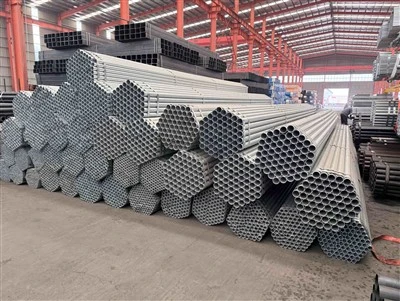
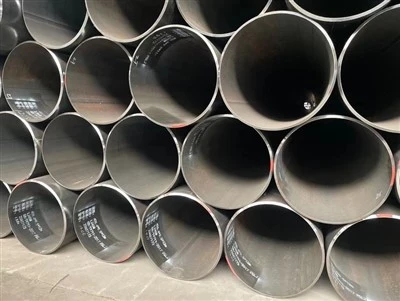
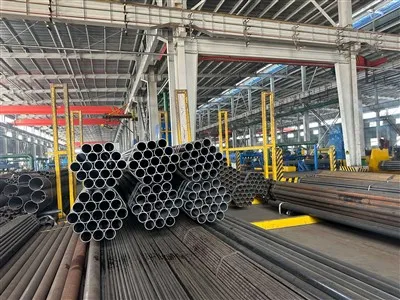
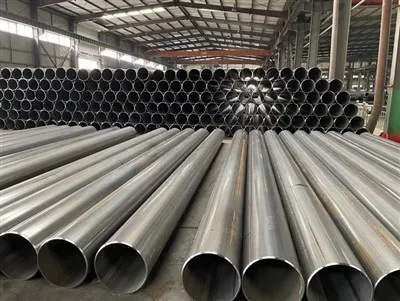
Tianjin Brisk Metalwork Co., Ltd. is one of the leading manufacturers and suppliers of api 5l erw line pipe in China. We have world-leading production equipment and strong manufacturing capabilities. Please feel free to buy bulk durable api 5l erw line pipe from our factory.
Tianjin Brisk Steel is one of the manufacturers of Hot-Dip Galvanized ERW Steel Pipe in China. Our products are mainly exported to the Middle East, Southeast Asia, Europe, New Zealand, and other regions.If you would like to learn more about our products, feel free to contact us and send your purchase list.


Where PSL Level Actually Gets Decided
API 5L splits line pipe into PSL1 and PSL2, and on paper the difference is a list of tighter requirements - chemistry, Charpy impact testing, NDT acceptance criteria. In practice, the PSL level is usually decided by three project-specific factors rather than a general preference for "better" pipe:
- Design pressure and MAOP. Higher maximum allowable operating pressure pushes toward PSL2, since its tighter toughness requirements reduce the risk of brittle fracture propagation along the pipeline if a defect does initiate.
- Population density along the route. Pipelines running through higher-consequence areas (near populated zones, water crossings, or environmentally sensitive terrain) are more likely to require PSL2 regardless of pressure, because regulatory class location requirements often reference toughness and testing rigor, not just wall thickness.
- Operating temperature. Colder climates or below-grade installations in freezing regions increase the risk of brittle failure, which is another reason toughness testing (mandatory under PSL2) becomes a project requirement rather than an option.
A pipeline engineer weighing these factors will usually already know which PSL level they need before contacting a supplier - the more common breakdown in an order is confirming the mill can actually document Charpy results per heat, not just claim PSL2 compliance on the packing list.
Grade Selection Is a Wall Thickness Trade-Off, Not Just a Pressure Rating
Buyers sometimes treat X-grade selection (X42 vs X52 vs X65, for example) as simply "pick the grade rated for my pressure." The more complete picture is that a higher grade allows a thinner wall for the same pressure, which changes:
- Steel tonnage and freight cost - thinner wall means less steel weight per meter, which matters on long-distance transmission runs where freight is a significant share of delivered cost.
- Field weldability - thinner wall combined with higher grade generally means higher carbon equivalent is harder to avoid, which pushes field welding crews toward more careful preheat and interpass temperature control during tie-ins.
- Handling and installation - thinner-wall large-diameter pipe is more prone to ovality during transport and lay, which can show up as fit-up problems at the field joint that weren't visible on the mill's dimensional report.
The practical implication: choosing the highest grade that technically satisfies the pressure calculation isn't automatically the lowest-cost option once freight, field welding procedure changes, and handling are factored in. This is a decision that benefits from involving the pipeline design engineer and the construction contractor together, not procurement alone.
Typical Applications
- Onshore oil and gas gathering pipelines.
- Onshore transmission pipelines.
- Gas distribution networks.
- Water transmission and municipal distribution.
- Pump station and compressor station piping.
- Structural piling and foundation work.
- General industrial and plant piping.
Sourcing Consistency Across a Multi-Heat Order
Large pipeline orders rarely come from a single steel heat. A buyer purchasing several hundred tons of X60 PSL2, for example, is typically receiving pipe rolled from multiple heats over several production runs. Two issues come up more often than buyers expect:
- Heat-to-heat chemistry variation within the same nominal grade. Even within allowable limits, carbon equivalent can vary enough between heats to require the welding crew to check the MTC for each new heat before continuing field welds with the same procedure, rather than assuming one qualified WPS covers the whole order.
- Traceability breaking down when pipe is sourced through a trader rather than the mill. A mill can tie every length back to its heat number and NDT record; a reseller consolidating stock from multiple mills sometimes can't, which becomes a real problem if a pipeline integrity review later needs to trace a specific joint back to its original test data.
FAQ
Q: Is ERW pipe as strong as seamless pipe?
A: When manufactured to the same API 5L grade and properly seam-tested, high-frequency welded ERW pipe can meet the same mechanical property requirements as seamless pipe of the same grade. The key difference is the longitudinal weld seam, which requires additional non-destructive testing (typically ultrasonic testing) to verify seam integrity that isn't necessary on seamless pipe.
Q:What does the "X" number in a grade like X52 or X65 mean?
A: The number following the "X" represents the minimum specified yield strength in thousands of pounds per square inch (ksi). X52 has a minimum yield strength of 52,000 psi, while X65 has a minimum yield strength of 65,000 psi. Higher X-grades allow a thinner wall for the same pressure rating.
Q: Can API 5L ERW pipe be used for water pipelines?
A: Yes. API 5L line pipe, including Grade B and lower X-grades, is commonly used for water transmission and distribution pipelines, though some water utility specifications also reference AWWA standards in parallel, so it's worth confirming which standard governs a specific water project.
Q: How is the weld seam on ERW pipe tested?
A: The weld seam is typically inspected using ultrasonic testing (UT) along the full length of the pipe to detect any lack of fusion, inclusions, or other seam defects. PSL2 pipe generally has more stringent UT acceptance criteria than PSL1.


Hot Tags: api 5l erw line pipe, China api 5l erw line pipe manufacturers, suppliers, factory, erw pipe economic impact, erw pipe finishing process, erw pipe flanges, erw pipe protection, erw pipe smoothness, retail erw pipe