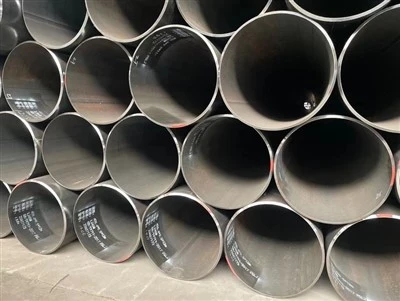
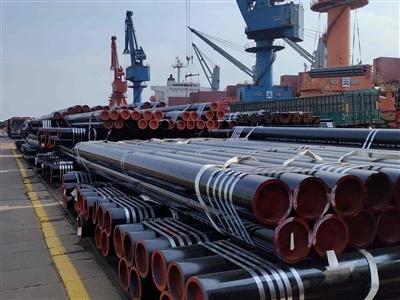
Tianjin Brisk Metalwork Co., Ltd. is one of the leading manufacturers and suppliers of api 5l erw line pipe for oil and gas in China. We have world-leading production equipment and strong manufacturing capabilities. Please feel free to buy bulk durable api 5l erw line pipe for oil and gas from our factory.
Tianjin Brisk Steel is one of the manufacturers of API 5L ERW Line Pipe for Oil and Gas in China. Our products are mainly exported to the Middle East, Southeast Asia, Europe, New Zealand, and other regions.If you would like to learn more about our products, feel free to contact us and send your purchase list.


Why the Weld Seam Is the Focus, Not the Whole Pipe
In ERW pipe, steel coil is cold-formed into a cylindrical shape and the two edges are heated to forging temperature by high-frequency induction current, then fused together under mechanical pressure - with no filler metal added. The base metal of an ERW pipe is chemically and mechanically identical to seamless pipe rolled from the same coil. The manufacturing risk is concentrated entirely at the seam and the narrow heat-affected zone (HAZ) surrounding it, which is why weld seam quality control is the single most important factor separating a reliable ERW line pipe supplier from a risky one.
Common Weld Seam Defects and Why They Occur
Incomplete fusion / cold weld - occurs when welding parameters (frequency, forging force, line speed) are not properly matched to wall thickness and steel chemistry, leaving the seam edges not fully bonded. This is one of the most serious ERW defects because it can be difficult to detect visually.
Hook cracks - small crescent-shaped discontinuities that curve away from the weld line near the inside or outside surface. These are strongly associated with older, low-frequency ERW (LF-ERW) pipe manufactured before the 1970s and with poor bond-line inclusion control; modern high-frequency ERW (HF-ERW) with tightly controlled process parameters largely eliminates this failure mode, but it remains a defect type that testing must specifically screen for.
Inclusions along the bond line - non-metallic particles (oxides, silicates) trapped at the fusion line when they are not fully expelled during the forging/upset process. Proper trim tooling and upset pressure control minimize this.
Undercut and misalignment - surface-level geometric defects at the outer weld bead from trimming or roll alignment issues; generally easier to detect visually or with surface NDT.
What Separates a Well-Controlled ERW Weld from a Risky One
Post-weld heat treatment (normalizing). Reputable line pipe mills apply in-line induction normalizing to the seam and HAZ immediately after welding. This refines the coarse, hardened grain structure that forms during welding back into a structure comparable to the base metal - reducing hardness peaks in the HAZ that would otherwise be a preferential site for cracking, particularly under cyclic or sour-service loading. Pipe without documented seam normalization should be treated as a red flag for pressure pipeline service.
100% ultrasonic testing (UT) of the weld seam. Every length of finished pipe should have its full seam length scanned by automated UT equipment tuned to detect longitudinal discontinuities, not just spot-checked. Ask whether UT is performed in-line during production (higher throughput, consistent coverage) or only as a final offline check.
Streamline angle / weld line examination. Metallurgical inspection of sample cross-sections checks that the "streamline angle" where displaced metal flows around the weld - a visual indicator of proper fusion - falls within an accepted range (commonly cited as roughly 40°–70°). Mills that can show this kind of process-control data, not just a pass/fail UT report, are demonstrating a more mature quality system.
Hydrostatic testing. Independent of UT, every pipe is pressure-tested to a specified percentage of its minimum yield strength. This is a whole-pipe test, not a seam-specific one, but a poorly bonded seam is often the point of failure if a hydrostatic test is going to catch a defect at all.
Buying Guide: Verifying Weld Seam Quality and Sour-Service Readiness
1. Ask for seam-specific test records, not just a general MTC A standard mill test certificate confirms base metal chemistry and mechanical properties. For weld-critical purchases, request the UT report format (in-line vs. offline, coverage percentage) and, where available, HAZ hardness survey data.
2. Confirm normalizing is applied to the seam, not just claimed Ask whether normalizing is in-line (immediately after welding, within the same production process) or a separate downstream step, and request the process parameters if your project specification requires them.
3. For sour service, request HIC test reports specific to the production lot A generic sour-service capability claim is not sufficient for critical projects - request NACE TM0284 HIC test results tied to the actual heat/lot being supplied, particularly the crack sensitivity ratios (CSR, CLR, CTR) against your project's acceptance criteria.
4. Clarify whether sour-service qualification was done on ERW pipe specifically Some mills qualify sour-service performance on seamless pipe from the same steel chemistry and apply it loosely to their ERW product. Because the HAZ is the highest-risk zone, sour-service test data should come from testing that specifically includes a cross-section through the actual weld seam.
5. Understand that sour-service ERW pipe is a special order, not a standard stock item Expect longer lead times and minimum order quantities for NACE MR0175-qualified ERW pipe compared to standard PSL1/PSL2 pipe, since it typically requires a dedicated production run with tighter chemistry control rather than being pulled from general stock.
FAQ
Q: Are hook cracks still a real concern in modern ERW line pipe?
A: Hook cracks were a significant issue in low-frequency ERW pipe manufactured before roughly the 1970s, largely due to inconsistent weld control and inadequate seam heat treatment. Modern high-frequency ERW production with in-line normalizing and 100% UT inspection has greatly reduced this risk, but it remains a defect type that quality testing is specifically designed to catch, and buyers should still confirm current-production testing rather than assume it's a solved problem industry-wide.
Q: Does the weld seam ever get removed or ground down for extra safety?
A: The external weld bead is typically trimmed flush during manufacturing for dimensional consistency, but this is a cosmetic/dimensional step, not a substitute for proper welding process control and NDT. Grinding cannot fix an internally unfused or defective seam.
Q: Is sour-service ERW pipe as reliable as sour-service seamless pipe?
A: When properly qualified - with documented normalizing, HIC testing on samples including the actual weld seam, and controlled chemistry - ERW pipe can meet the same NACE MR0175/ISO 15156 acceptance criteria as seamless pipe. The key difference is that ERW pipe has one additional zone (the weld and HAZ) that must independently pass the same cracking-resistance criteria as the base metal.
Q: What hardness limit is typically used to assess sour-service suitability?
A: NACE MR0175 guidance for carbon steel commonly references a maximum hardness around 22 HRC as an indicator of acceptable sulfide stress cracking resistance, though the exact requirement depends on the specific material, product form, and edition of the standard referenced in your project specification - always confirm the applicable limit against your project's governing document rather than a general figure.


Hot Tags: api 5l erw line pipe for oil and gas, China api 5l erw line pipe for oil and gas manufacturers, suppliers, factory, erw pipe bends, erw pipe modernization, erw pipe testing, erw pipe trade regulations, erw pipe weight accuracy, long erw pipe